|
View this email in your browser

THE DAILY
Thursday, May 28, 2026
The five minutes that makes you the most informed person in freight today
|
|
Newsletter Brought to You By — Amazon Supply Chain Services
|
|
Breaking News
|
JK
|
John Kingston
@JohnHKingston
|
|
Decision is out from #SCOTUS in Flowers Foods. Bottom line: a company that operates totally intrastate but is the last delivery leg of an interstate journey is an interstate company, and its workers can sue over a dispute rather than being forced into arbitration. Story to come.
9:49 AM · May 28, 2026 · View on X →
|
|
|
The Daily
FreightWaves Today gives supply chain its first live daily command center
For decades, Wall Street professionals started their mornings the same way: live television, market data in real time, and unfiltered conversation with the executives making the biggest calls. Supply chain never had that, but starting June 1, it does.
FreightWaves is launching FreightWaves Today, a live weekday broadcast airing at noon ET. The show is hosted by FreightWaves Founder and CEO Craig Fuller and SONAR CMO & COO Julie Van De Kamp, with daily market analysis from Zach Strickland and Malcolm Harris. It will stream across YouTube, LinkedIn, Facebook, X, and tv.freightwaves.com/today, with full episodes available on demand and distributed through Spotify and Apple Podcasts.
The launch week lineup signals immediately what kind of show this will be. Shelley Simpson, President and CEO of J.B. Hunt, and Eugene Seroka, Executive Director of the Port of Los Angeles, appear in the first five episodes alongside Webb Estes (President & COO, Estes Express Lines), Tom Madine (CEO, WWEX Group), Aaron Graft (Founder, Vice Chairman, and CEO, Triumph Financial), and several others from brokerage, 3PL, freight finance, and technology. That’s the largest publicly traded trucking company, the nation’s busiest container port, and major operators across every freight vertical, all in a single week of programming.
The timing is not accidental. Tariff volatility is reshaping import flows in real time. Capacity is shifting. AI is entering fleet operations faster than most technology cycles. The industry needs a daily anchor point: one place where decision-makers gather to hear directly from the people running the supply chains that power the economy. That access previously required a conference ticket or a C-suite network. Starting June 1, it arrives at noon.
So What? If you’re in freight and you’re not watching at noon starting June 1, you’re getting your market intelligence secondhand. The guests in launch week are the people making the decisions that move rates, set capacity, and reshape trade lanes. Hearing Simpson on JB Hunt’s capacity posture or Seroka on port throughput in real time is a different quality of signal than a press release two days later. Block the noon slot.
Read the full story →
|
 |
|
|
Top Stories
More than 20 trucking companies filed for bankruptcy in May
Regional carriers, oilfield haulers, and 3PLs across Illinois, Texas, Arkansas, and Oklahoma filed Chapter 7 liquidations and Chapter 11 restructurings over the past 30 days as erratic demand, soft spot rates, and elevated operating costs continued pressuring the industry. The most notable case was the final liquidation of Standard Forwarding Freight — a 92-year-old Georgia-based carrier with 302 trucks and 230 drivers that abruptly shut down late last year. The largest Chapter 11 came from Bullet Energy Services, an Oklahoma oilfield hauler listing $10 million to $50 million in liabilities. SONAR’s Carrier Net Revocations show exits running 31% above the same period in 2025, with new authority issuances down 22% in recent weeks.
So What? Carrier exits running 31% above last year’s pace with new authority issuances falling 22% means the capacity floor is rising faster than demand. Small fleets with fewer than 10 trucks account for most of these filings, partly because they have no margin buffer against elevated insurance and equipment costs. Shippers still pricing off 2024 contract benchmarks should model what spot rates look like when the carrier base continues shrinking.
Read the full story →
Motive rolls out stereo-vision dashcam and AI automation platform at Vision 26
At its Vision 26 conference in Nashville, Motive announced the AI Dashcam Plus, a combined telematics and camera unit running on a Qualcomm AI processor with three times the processing power of prior generations. The device runs more than 30 AI models simultaneously and introduces collision avoidance using stereo vision that models the trajectory of vehicles, pedestrians, cyclists, and animals in real time. Atlas, an AI assistant embedded across the Motive platform, can generate morning briefings, draft personalized messages to drivers, and resolve compliance issues through conversational prompts. A new Model Context Protocol integration connects Motive data directly to third-party AI tools including ChatGPT and Claude. The Automations engine enables real-time fleet actions without manager intervention — when a critical fault code triggers, Atlas contacts the driver automatically with plain-language context and recommended next steps. "Across the U.S. economy, 860 million hours were spent last year on tasks that Motive can now automate," said Sean Santschi, director of product management at Motive.
So What? The Atlas assistant and the Automations engine are the most commercially significant announcements. For fleets with high administrative overhead, automated fault code responses and AI-drafted driver messages represent real labor savings. The Model Context Protocol integration is particularly notable: it routes Motive safety data into AI tools your team already uses, reducing the need for new workflows or interfaces.
Read the full story →
BMO’s trucking credit metrics barely move despite a stronger freight market
Canada’s BMO, one of the largest lenders to the U.S. trucking sector, reported second-quarter credit data that showed all four key financial health indicators deteriorated despite higher freight rates. Gross impaired loans rose to Ca$576 million from $563 million in Q1. Allowances for credit losses on impaired loans climbed to $86 million, up from $77 million and well above $57 million a year earlier. Provisions for credit losses rose to $41 million from $39 million. Net writeoffs ticked up to $25 million from $24 million. The loan portfolio actually grew to $12.65 billion, up from $12.42 billion, with loan originations exceeding both prior-quarter and year-ago figures. This is likely the penultimate transparent report of its kind: BMO is selling its transportation group to private equity firm Stonepeak, with the deal expected to close in Q4.
So What? All four credit metrics deteriorated despite a freight market generating higher rates. Two readings are possible: carriers are applying improved revenue to service debt rather than build cash, or the rate recovery hasn’t reached the smaller operators that form most of BMO’s book. When the Stonepeak sale closes, this quarterly window into trucking’s financial health closes with it, so the last two reports matter more than usual.
Read the full story →
Sponsored By Clean Energy
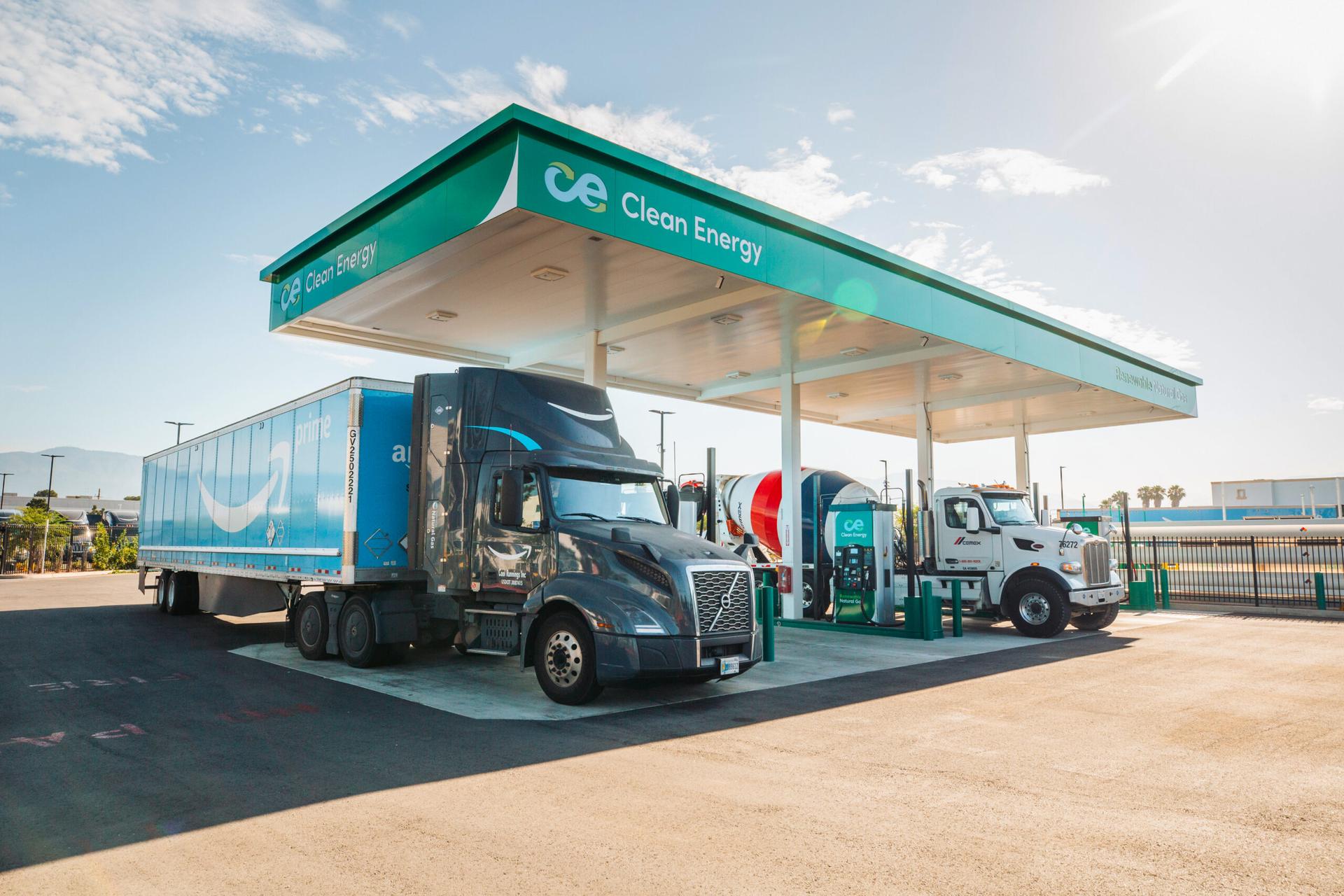
RNG now saves Class 8 fleets $2 to $5 per gallon versus diesel in many U.S. lanes
The Cummins X15N — up to 500 horsepower, 1,850 foot-pounds of torque — now delivers diesel-like performance while Clean Energy’s 200-plus open-access truck stations fuel at 8 to 10 gallons per minute. For fleets that hold assets five years or more and run predictable routes, payback on the $80,000 to $100,000 premium over diesel arrives in roughly two years. The carbon math is compelling too: Clean Energy’s average portfolio carbon intensity score sits at negative 120, with certain dairy RNG pathways as low as negative 300. The business case is built without assuming government subsidies.
Read the full story → |
Walmart opens supplier consolidation network to prepaid freight vendors
Walmart is expanding its automated consolidation program, which was previously limited to collect freight suppliers, to vendors that manage their own transportation on prepaid terms. Under the new program, suppliers can merge LTL shipments into full truckloads at one of three automated consolidation centers (Colton, California; Minooka, Illinois; and Lebanon, Pennsylvania), which then routes combined inventory to Walmart’s 42 regional distribution centers. Instead of creating 42 separate purchase orders and 42 pallets for each DC, suppliers now ship on a single PO to a single consolidation point. Walmart is deploying new technology to optimize inventory allocation across its DC network. Approved 3PL partners include C.H. Robinson, Hub Group, and RJW Logistics. "I think this is part of a larger trend where large shippers are reducing transportation randomness," said Daniel Garza, who heads enterprise transportation and logistics strategy at AT&T. "This could quietly reduce shipper optionality over time."
So What? Suppliers who’ve been shipping LTL direct to 42 DCs face a real tradeoff: lower costs and simpler operations in exchange for greater dependence on Walmart’s network timing and allocation decisions. Garza’s "Amazon-esque" framing is apt. The efficiency gains are real. So is the lock-in. Understand what you’re trading before your procurement team opts in.
Read the full story →

|
|
|
Sponsored Insight
|
Presented by Amazon Supply Chain Services
Solutions that save: How Amazon’s Supply Chain Services give back time, money, and peace of mind
Managing a supply chain shouldn’t mean choosing between cost, speed, and peace of mind — but for many businesses, it does. Amazon Supply Chain Services (ASCS) offers flexible, resilient logistics support that eliminates those tradeoffs, helping businesses of every size reduce complexity, cut costs, and reclaim time. With access to Amazon’s global infrastructure and no lock-in required, ASCS gives you the freedom to build the supply chain that works for your business.
Read more → |
|
FreightWaves Announcement
FreightWaves Today, launching June 1
The supply chain moves fast. Now your news does too. Craig Fuller and Julie Van De Kamp bring you a daily live show — real-time market analysis and interviews with the leading executives who are shaping freight & logistics. Live every weekday at noon ET on FreightWaves socials and tv.freightwaves.com/today.
Watch live → |
|
 |
|
|
From the Research Desk
|
In partnership with Trimble
2026 Outlook: Spot Market Strategies for Shippers, Carriers, and Brokers
FreightWaves and Trimble surveyed shippers, carriers, and brokers to understand how spot freight strategy is shifting heading into 2026. The results show an industry treating the spot market not as a fallback but as a deliberate tool for managing flexibility and cost. Given the carrier exit pace in SONAR’s revocation data, procurement teams still benchmarking off 2024 contract rates need a new model fast.
Download the full report → |
|
In partnership with Avalara
Supply Chain Strategies for an Uncertain Trade Environment
FreightWaves partnered with Avalara to survey how supply chain professionals are adapting to rapidly evolving tariffs, geopolitical tension, and regulatory volatility. The white paper covers how companies are integrating adaptive strategies and technology to maintain resilience when the rules keep changing. Timely reading given today’s cross-border environment.
Download the full report → |
|
Courtesy of Werner
Werner doubles its Mexico container fleet to 800 units as nearshoring freight demand builds
Werner is scaling asset-based intermodal service into Mexico, deploying Werner-owned containers across 12 border crossing ports and leveraging 27 years of cross-border expertise. The fleet currently sits at roughly 400 containers, with plans to double to 800 by year-end. The company’s Mexico Direct solution clears customs at origin, bypassing border congestion that adds transit variability on traditional over-the-road crossings. With record foreign direct investment flowing into Mexican manufacturing for five consecutive years, the freight demand is structural — and truckload capacity alone won’t absorb it.
Read more → |
|
|
Upcoming Event
Supply Chain AI Symposium
July 15, 2026 | The Old Post • Chicago, IL
Past the hype. Operators, founders, and enterprise leaders are converging in Chicago for an intimate, high-stakes conversation about deploying AI in supply chain — tackling real implementation challenges and building the systems that actually work at scale.
Register Now → |
|
|
|
What We’re Watching
▸ FreightWaves Today’s launch week lineup. The show debuts June 1 with Shelley Simpson and Eugene Seroka — the CEO of the largest publicly traded trucking company and the executive director of the nation’s busiest container port, in the first five episodes. Watch whether the live format delivers the kind of real-time market clarity the industry has been missing. If it does, noon ET becomes a fixture.
▸ Carrier exit pace through Q2. SONAR’s net revocation data is running 31% above 2025 levels with new authority issuances down 22%. If that pace holds through June, the capacity floor rises faster than demand can recover. Shippers extending 2024 contract pricing should model what spot rates look like when available carrier capacity keeps shrinking.
▸ Walmart’s consolidation rollout and supplier prioritization. The retailer says expansion will proceed in phases based on volume alignment and capacity. Watch which supplier categories get prioritized first — that’s where LTL volume shifts will land hardest on C.H. Robinson, Hub Group, and RJW Logistics, the three approved 3PL partners for the program.
|
|
|
That’s your Daily for today. See you tomorrow.
Was this forwarded to you? Subscribe here | Have a tip? Just reply to this email.
FreightWaves 405 Cherry St., Chattanooga TN 37402
Unsubscribe | Forward to a Friend | FreightWaves.com
|
|