| • |
CBP’s De Minimis Rule Wins Trade-Group Praise, But Express Shippers Want Postal Parity: Trade groups welcomed U.S. Customs and Border Protection’s (CBP) rule ending the de minimis exemption, though at least one group representing express carriers is now pushing for postal services to be held to the same standard. |
| • |
CBP has said postal channels handled roughly 8% of de minimis parcel volume before the exemption ended. |
| • |
The group argues postal services should face the same enforcement duties as express carriers, both to catch illicit shipments and to make sure duties actually get collected. |
| • |
Worth watching whether CBP extends express-carrier-level requirements to the postal channel, since that would close a gap shippers are already flagging. |
| • |
Legal Landscape: Section 301 Seen as Tougher to Challenge, While a New Suit Seeks Broader Relief: Two separate legal developments this week point in different directions for importers weighing whether to fight their tariffs in court. |
| • |
Attorneys say the Section 301 tariffs imposed on 60 economies over alleged forced-labor enforcement failures will hold up better in court than tariffs imposed under the International Emergency Economic Powers Act (IEEPA) or Section 122. |
| • |
Separately, the Liberty Justice Center filed its own tariff challenge as a class action, specifically so a win wouldn’t just benefit plaintiffs with the resources to sue on their own. |
| • |
Russia Sanctions Bill: Sponsors Announce Bipartisan Deal: The lawmakers behind the Senate bill pairing Russia sanctions with secondary tariffs say they’ve struck a bipartisan agreement on its terms, a shift after weeks of reported friction over its scope. |
| • |
No floor vote timeline has been announced yet, so businesses tracking the secondary tariff exposure to China and India should keep watching for next steps. |
| • |
Administration Sends Mixed Signals on Trade Priorities: Two comments this week, from different corners of the administration, suggest not every trade front is moving at the same pace. |
| • |
USTR Jamieson Greer said he expects the Section 301 investigation into global structural overcapacity to wrap up soon. |
| • |
President Trump, meanwhile, indicated he isn’t particularly interested in reopening USMCA for renegotiation right now, a notable contrast to Greer’s recent comments on tightening enforcement under the deal. |
| • |
CBP and Agency Compliance Updates: CBP and the FDA rolled out several administrative changes this week. |
| • |
CBP plans to roll out a new error code for corrections filed after cargo admission, effective in August. |
| • |
CBP refreshed its website pages covering the Consumer Product Safety Commission (CPSC) implementation guide and the Partner Government Agency (PGA) flag enforcement table. |
| • |
CBP posted new antidumping and countervailing duty (AD/CVD) case messages as of July 27, along with several miscellaneous releases. |
| • |
The Food and Drug Administration (FDA) issued new and revised import alerts on July 27. |
| • |
Other Regulatory Actions to Watch: Marine Mammals, Meat Imports, and Lithium Batteries: A handful of smaller agency actions could still create real compliance work for specific importers. |
| • |
The National Marine Fisheries Service (NMFS) opened a comment period on how it enforces import provisions under the Marine Mammal Protection Act. |
| • |
USDA’s Animal and Plant Health Inspection Service (APHIS) is seeking comments on an information-collection request tied to meat imports. |
| • |
The Foreign-Trade Zone (FTZ) Board issued actions and notices on July 28. |
| • |
One law firm flagged that CPSC’s pending lithium-ion battery rule could add new import compliance obligations. Importers in that category should get ahead of it; Flexport’s Audit Your Customs Broker tool can help confirm current entries are already meeting existing requirements before new ones land. |
OCEAN MARKET NEWS
| • |
Two separate disruptions escalated again this week. The Strait of Hormuz has been effectively closed to normal commercial transit since February 28. Renewed fighting between the U.S. and Iran resumed around July 9, after Iran exited an earlier memorandum that had allowed some traffic to resume in June. |
| • |
Vessel transits have fallen further as a result: on July 19, commercial transit ran at about 17% of pre-crisis volume, with roughly 15 vessels crossing against a typical rate near 88 a day. Total traffic through the strait is down about 90% year over year. |
| • |
The Red Sea disruption is a separate event, active since late 2023, that has forced most carriers to route Asia-Europe and Asia-U.S. East Coast cargo around the Cape of Good Hope instead of through the Suez Canal. |
| • |
This week brought a new development within that disruption: Houthi forces opened a new front by attacking vessels linked to Saudi Arabia specifically, and several ships bound for Saudi ports have turned back. Some carriers had begun testing a return to Suez Canal transit earlier this year; this new attack pattern adds fresh uncertainty to that trend, on top of the Suez Canal Authority’s transit surcharge increase that took effect July 15. |
| • |
Blank sailing activity remains at a structurally elevated baseline versus pre-pandemic norms. Industry-wide tracking shows roughly 46 blank sailings scheduled across major East-West trades over the 5 weeks spanning mid-July through mid-August, a cancellation rate near 6%. |
| • |
Freight rates appear to be topping out after an early peak season run-up. A broad container rate index reached its highest level since September 2024 in early July, then eased for 2 consecutive weekly readings through July 23, with the most recent decline driven by softening on both Asia-Europe and Trans-Pacific lanes. |
| • |
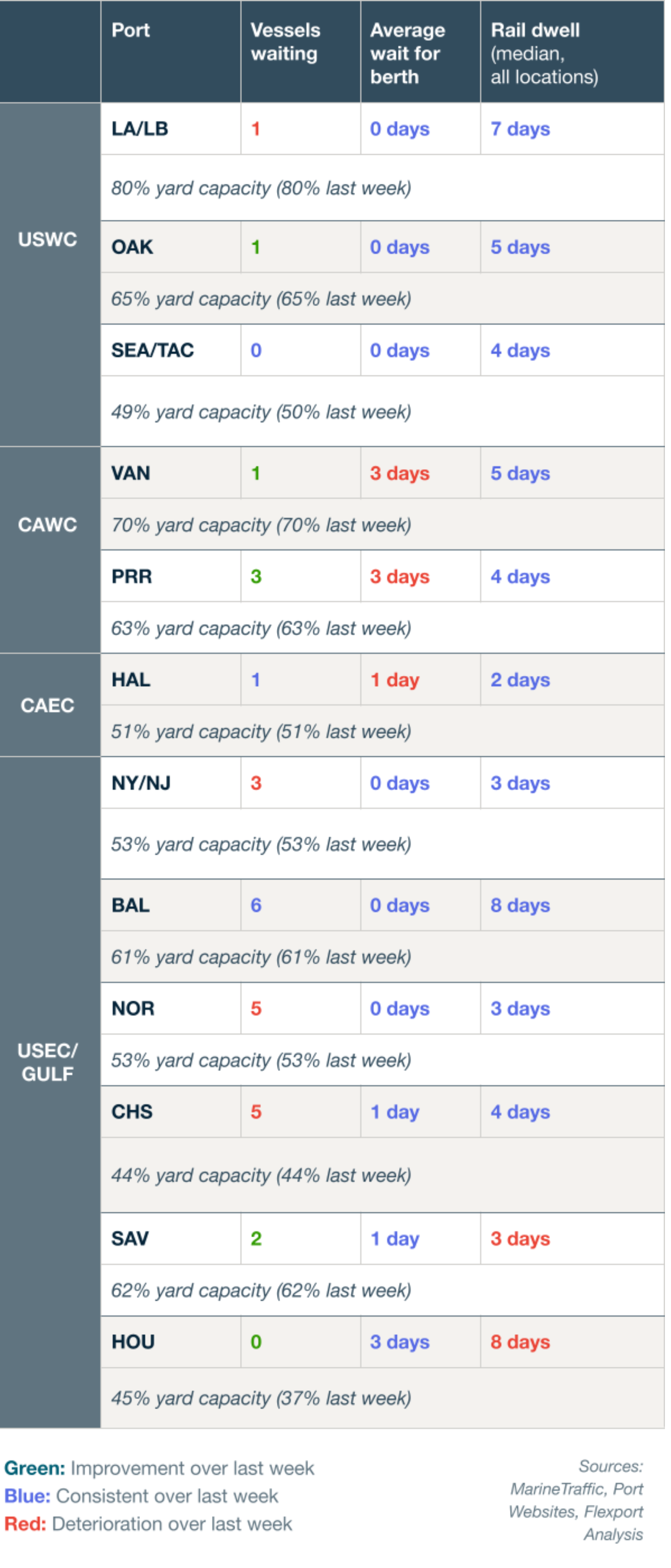
Port congestion remains elevated in several regions: Colombo, Sri Lanka is seeing high congestion tied to Middle East cargo diversions, and China ports are still working through a backlog following a recent typhoon. |
| • |
Extreme heat forced gate suspensions at Rotterdam in mid-July, and a berth-side crane repair project is reducing handling capacity at a major Tokyo terminal through the end of this month. |
| • |
The Panama Canal is tightening further. As the authority manages watershed levels against a developing El Nino pattern, the Panama Canal Authority lowered the maximum draft at the Neopanamax locks to 49.0 feet effective July 24, with a further step down to 48.5 feet planned for August 15. |
TRANS-PACIFIC EASTBOUND (TPEB)
| • |
Blank sailing activity rose to 1.2% of scheduled capacity this week, up from 0.5% last week. Next week, data is pointing to a further increase of roughly 2.9%. |
| • |
Freight Rates: All Carriers have announced August 1 rate increases. Following multiple extra loaders in July, demand stays high, and vessel utilization remains strong. More carriers are now adding Panama Canal surcharges and weight restrictions as the canal continues tightening constraints amid lower water levels. |
| • |
Book 4-6 weeks in advance. Space remains tight and in high demand, especially to the East Coast and Gulf. |
FAR EAST WESTBOUND (FEWB)
| • |
Blank sailing activity eased to 0% this week. Incoming data shows an increase to roughly 4% the week after next; treat the coming weeks as directional only. |
| • |
Underlying demand remains steady, but this week’s Houthi blockade targeting Saudi-linked shipping adds new uncertainty to any near-term return to Suez Canal transit. Cape of Good Hope remains the main route for FEWB. |
| • |
Freight Rates: Rates on Asia-Europe corridors remain near multi-year highs, even as the broader market indicators show early signs of easing from their early-July peak. |
| • |
Continue planning for Cape of Good Hope transit times until further notice and build an extra schedule buffer into bookings given the industry-wide drop in schedule reliability in June. |
| • |
Watch developments around the Bab el-Mandeb closely: this week’s targeted attacks on Saudi-linked vessels are a new and distinct escalation, not simply a continuation of the existing Cape diversion, and a broader closure would be a material new disruption layered on top of it. |
TRANS-ATLANTIC WESTBOUND (TAWB)
| • |
Blank sailing activity rose to 6.9% this week, up from 0% the prior week, and forward data indicate it will hold near 7% next week. This is one of the more elevated readings this year for a trade that has typically carried the lowest disruption levels of the four covered here. |
| • |
This is normally a slower period for the lane, with European summer factory closures reducing volumes. Despite that seasonal lull, carriers have announced rate increases effective in the first half of August, suggesting capacity discipline rather than demand strength is driving the market. |
| • |
Freight Rates: Multiple carriers have announced rate increases on Northern Europe-origin corridors effective in early-to-mid August. |
| • |
Confirm space early for August, given the reversal in blank sailing activity and the announced rate increases. |
| • |
Monitor whether the current pullback in capacity holds into next week before committing to longer allocations. |
INDIAN SUBCONTINENT TO NORTH AMERICA (ISC)
| • |
Space remains constrained due to continued high demand against the backdrop of reduced supply on the major corridor, Northwest India to USEC. |
| • |
Backlog of cargo ready to move is the current norm at all ISC loading ports. |
| • |
Two direct sailing services on this corridor have resumed standard Suez Canal routing, cutting 1 week of transit time versus the alternative route around the southern tip of Africa. |
| • |
Colombo, a key transshipment hub for this corridor, continues to see elevated congestion tied to Middle East cargo diversions, growing demand for feeder ships from smaller ISC ports connecting to mother vessels at Colombo, port congestion, and weather-related challenges. |
| • |
Freight Rates: Rates on this corridor continue to climb to their highest level in multiple years driven by imbalance of Demand and Supply, port congestion, and the lingering effects of regional disruption. |
| • |
Secure space early given tight capacity and an extended peak season, and build extra time into routings for origin port delays. |
| • |
U.S. West Coast and U.S. East Coast rates moved up this week, the first broad-based rate increase on the transpacific China lane in several weeks. East Coast is outperforming West Coast on demand. |
| • |
A new capacity constraint has emerged across the network: high ambient temperatures are cutting payload capacity on both commercial and charter flights, tightening effective capacity independent of demand. Carriers expect the condition to persist for several days. |
| • |
The Europe lane is unchanged from last week, with rates holding at the same low, range-bound level in place since the EU parcel handling charge and summer holidays took hold in July. |
| • |
South China (HKG/SZX/CAN): |
| • |
Demand rose over the weekend on general cargo, and U.S. West Coast space is fully booked this week after a single multi-carrier booking of more than 100 tons pushed rates higher. Rates and fuel surcharges are increasing on the transpacific lane. |
| • |
Demand to Europe continues to soften and rates there are falling. Hong Kong-to-Europe volumes fell for a fifth consecutive week, down almost a quarter versus a year ago, as new EU import rules removing the duty exemption on ecommerce parcels under €150 took effect July 1. |
| • |
Hong Kong’s high ecommerce mix has made it the most exposed origin to the rule change (Source: WorldACD). |
| • |
U.S. West Coast space is full into the first week of August, particularly to San Francisco; U.S. East Coast remains manageable and the Europe market stays slack. Book 5 to 7 days in advance to secure space. |
| • |
Volumes rebounded 32% week over week after flight cancellations tied to Typhoon Bavi held back the prior week (Source: WorldACD). |
| • |
Rates are softening as demand eases, and some carriers now have open capacity. Book 5 to 7 days in advance to take advantage of the open space while it lasts. |
| • |
Volumes to Europe remain below year-ago levels, part of the broader pullback in Asia-to-Europe ecommerce traffic following the EU rule change. |
| • |
Demand remains high, space stays congested, and rates hold at elevated levels on both the U.S. and Europe lanes. |
| • |
Book at least 7 working days in advance to secure space. |
| • |
Demand has softened, but rates have not come down with it. |
| • |
Europe and intra-Asia lanes (excluding Singapore) remain manageable; for the U.S., book at least 3 days ahead of departure. |
| • |
Demand is stable and spot rates are unchanged from last week on both the U.S. and Europe lanes. |
| • |
Finalize bookings 5 to 7 days ahead to secure space and avoid volatility. |
| • |
The market is stable, with a slight volume dip expected around the July 28 to 29 public holidays. Carriers report available capacity with rates holding at current levels; book 5 to 7 days in advance. |
| • |
Volumes to Europe remain below year-ago levels, tied to the EU rule change. |
| • |
Demand ticked up as shippers convert bookings from ocean to air because of ocean equipment shortages and capacity constraints. |
| • |
Rates are unchanged from last week; booking confirmations are taking longer as carriers work through the added volume. |
| • |
India (BOM/DEL/MAA/BLR): |
| • |
Demand holds at last week’s elevated level as ocean container congestion and vessel processing backlogs at major U.S. ports push shippers toward air. |
| • |
Book at least 1 week in advance, given tightening capacity on U.S. lanes. |
| • |
Broader Indian subcontinent (Bangladesh, Sri Lanka, Pakistan): |
| • |
Sri Lanka: Largely unchanged, with most carriers back on schedule and fuel surcharges continuing to ease, though Middle East-based carriers are seeing space constraints from rising perishable volumes. |
| • |
Bangladesh: The Europe lane remains reliable with open space; the U.S. lane stays tight and less reliable. |
| • |
Pakistan: The tightest market in the subcontinent. Capacity is fully committed across all lanes, and carriers are quoting only 1 to 2 days of rate validity. Schedules remain reliable. |
(Source: Flexport)
Please reach out to your account representative for details on any impacts on your shipments.
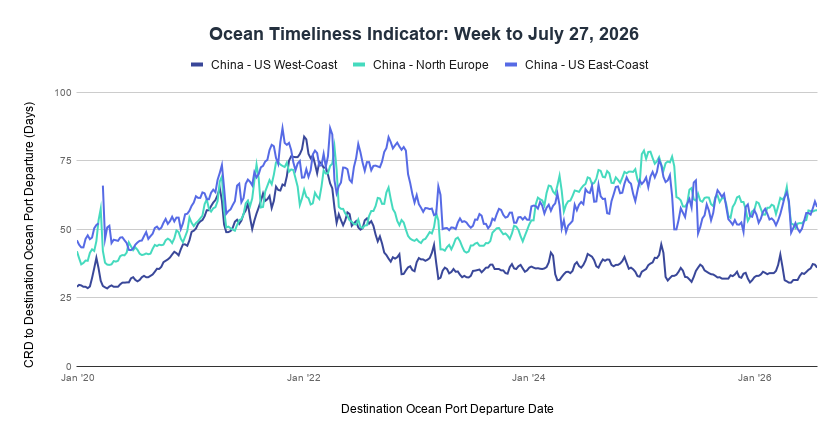
Transit time decreased from China to the U.S. West Coast, remained stable from China to the U.S. East Coast, and decreased from China to North Europe.
Week to July 27, 2026
Transit time decreased from 37 days to 36 days from China to the U.S. West Coast; flat at 57 days from China to the U.S. East Coast; and decreased from 60.2 days to 58.2 days from China to North Europe.
Thanks for tuning in. Catch you next week! Sign up here to get this newsletter in your inbox. Stay in the loop—read past newsletters here. For more information, connect with one of our logistics experts here.
| Follow us for more updates: |
 |
 |
©2026 Flexport, Inc. – All Rights Reserved. 100 California Street, FL 5, San Francisco, CA 94111.
This email was sent to your address because you’re opted into Flexport’s Global Logistics Updates. Want to change what communication you receive? You may update your email preferences or unsubscribe below.
|