

| The Daily // Fri 09.18.26 | View in browser → |
.png)
The Daily
 |
NEWSLETTER BROUGHT TO YOU BY — QUANTIX
One call covers dry bulk, liquid bulk, packaging, warehousing and managed transportation. Quantix removes the obstacles between your material and your customer. One partner, nationwide. Learn more.
|
|
Announcement
|

Schneider CEO says capacity exodus is growing, not slowing
|
60K→14K
Schneider’s approved carrier list, down from its peak
|
10-13%
Projected Q3 2026 one-way rate increase, year over year
|
2027
Bid season expected to bring strong contract-rate gains
|
Trucking capacity isn’t coming back. It’s leaving faster.
Schneider National CEO Jim Filter said finding capacity, not demand, is now the industry’s biggest constraint, as a year-old regulatory crackdown on noncompliant drivers keeps pushing smaller carriers out of business. Schneider has cut its own approved carrier list from 60,000 haulers at its peak to just 14,000 today, a screening effort that started as a fight against cargo theft and has since hardened into a broader quality bar.
The exodus is compounding. Rising diesel prices are hitting small operators without fuel-surcharge protection harder than large fleets, the Supreme Court’s broker-liability ruling is forcing shippers and brokers to vet carriers more carefully, and thousands of drivers who entered the industry during the last boom lacked proper training or legal operating authority. "There was no standard for entry-level driver training," Filter said, describing how unqualified drivers flooded the market before the crackdown began.
Tender rejection rates remain elevated and new motor carrier authorities keep declining, pointing to genuinely tight supply rather than a temporary blip. FreightWaves projects one-way truckload rates to climb 10% to 13% year over year in the third quarter, with strong contract-rate increases expected heading into the 2027 bid season. "We don’t necessarily need more demand," Filter said, arguing the supply exodus alone has created enough work for carriers that meet today’s compliance bar.
Executives are calling this "early innings," so shippers should expect insurance and compliance costs to keep pricing out marginal carriers — locking in capacity now, especially through dedicated fleets, will look cheap next to what the 2027 bid season may bring.
Tesla targets end-2027 Europe deliveries for the Semi
Tesla plans to begin European demonstrations of its Semi truck in the first half of 2027, with a target of starting customer deliveries by the end of that year, according to Semi head Dan Priestley. The initial trucks will still be built in Nevada; Priestley said Tesla isn’t worried about relying on North American manufacturing capacity for the European launch. The European-spec Semi is rated for 550 kilometers of range at 40 metric tons, consumes about 1 kWh per kilometer, and can accept 800-kilowatt charging to recover more than 60% of its range in 30 minutes; a heavier-duty version is rated up to 44 metric tons for drayage and container work. Tesla plans more than 100 Megacharger stalls across Europe in 2027 alongside dedicated service centers, and is already selling 17,000-euro Basecharger units. The company says its existing fleet has logged more than 28 million kilometers, including 19 million by customers, with 98% uptime this year.
A 2027 delivery target gives European fleets a year of runway to plan charging infrastructure and duty-cycle testing, but the Nevada-only production base means early allocation will likely go to fleets willing to commit before Tesla proves it can scale European-spec builds.

Rail freight slides in rare off-week, though 2026 stays ahead of last year
U.S. rail traffic fell in the week ending Sept. 12, an uncommon dip, with total carloads and intermodal units down 3.7% year over year to 494,865. Commodity carloads fell 3.3% to 223,560 and intermodal volume dropped 4.1% to 271,305 containers and trailers. Motor vehicles and parts led the declines, down 18.8%, followed by chemicals, down 9.2%, and nonmetallic minerals, down 6%, while grain rose 17.3% and petroleum products climbed 6.5%. Despite the weekly dip, year-to-date volume through 36 weeks remains ahead of 2025: carloads are up 2.7% to more than 8.2 million and intermodal units are up 4% to more than 10.1 million. North American combined traffic, including Canadian and Mexican railroads, fell 3.6% for the week but is still up 3% year to date.
A single off-week doesn’t break the year-to-date trend, but the sharp drop in auto-related carloads is worth watching alongside broader vehicle-production swings — if that commodity keeps sliding, it will weigh on intermodal’s year-to-date cushion faster than grain and petroleum gains can offset it.
Estes bets $56M on cross-border, offshore freight expansion
Estes Express Lines, North America’s largest privately held LTL carrier, is investing nearly $56 million to expand cross-border and offshore capacity, on pace to push its terminal network past 14,000 doors by the end of October across roughly 300 locations, up from 13,857 today. In Mexico, where Estes already runs 52 service centers, the carrier is buying a larger Laredo facility that will roughly double its door count from about 40 to 85, with added investment planned at Otay Mesa and El Paso-Juarez by year-end. On the Canadian border, Estes relocated a Buffalo terminal to 171 doors in June — quadrupling its prior capacity — nearly doubled Detroit to 139 doors from about 70, and doubled capacity in Fargo, North Dakota; Canada volumes, down 1-2% early in the year, have posted year-over-year LTL growth since reversing in late February. The carrier’s offshore network, which uses 45-foot ocean containers to serve Alaska, Hawaii and Puerto Rico, added a 29-door Oahu service center in 2025. "We’re really looking at all of these investments from a long-term horizon and viewpoint perspective," said Alex Peebles, Estes’ senior director of offshore and international, noting that tariff-driven uncertainty is pushing some manufacturers to shift from full truckloads to smaller, more frequent cross-border shipments.
A 95-year-old carrier plowing $56 million into border and offshore terminals through "fluid" trade conditions signals it sees durable upside past the current tariff noise — and the shift some manufacturers are making from full truckloads to smaller, more frequent shipments could keep funneling volume toward LTL providers with border capacity already in place.
Mexico reverses empty-truck ban after 700 tractors stall at border
Mexico’s customs agency, ANAM, lifted a five-day ban on empty trucks entering the country through the Eagle Pass-Piedras Negras crossing after nearly 700 tractors piled up on the U.S. side. The Sept. 9-14 restriction blocked empty trailers and tractors while still allowing loaded trucks through, cutting daily commercial crossings from about 1,000 vehicles to 300-400; ANAM never publicly explained why it targeted Piedras Negras. Mexican carriers’ permit types kept them from rerouting through alternate crossings like Del Rio, stranding equipment that needed to return empty to pick up its next load. Industry representatives, including Consejo Binacional de Transportistas president Elías Tarín, met Monday with ANAM, U.S. Customs and Border Protection and the Mexican consulate, and officials reinstated empty-truck movement the same day, heading off a planned trucker demonstration. INDEX president Alejandro Ruiz Rueda estimated the disruption was costing the crossing, the nation’s 10th-largest by trade volume, roughly $1 million a day.
A five-day, unexplained restriction that nearly triggered a border blockade shows how thin the margin is at high-volume crossings like Eagle Pass — carriers running that corridor should keep contingency routing plans current, since permit restrictions can cut daily capacity by 60% overnight with no warning.

Brought to you by Samsara — built with operators, for operators. Blind spots cause some of fleets’ costliest, most complex collisions. Learn how AI-powered 360-degree visibility helps you spot risks in real time and protect drivers, pedestrians and cyclists.

| Time | Guest | Topic |
|---|---|---|
| 12pm | Ryan B. Schreiber | Chief Growth Officer, Metafora |
| 12pm | Don Everhart | Head of Partnerships & Strategy, Transflo |

White Paper: Q3 2026 Freight Brokerage Rate Report
FreightWaves’ Freight Brokerage Rate Report — sponsored by Triumph — provides a review of the previous quarter and a forecast for the coming months.
Is Your Tech Stack Built for Growth? How Strategic LSPs Use AI to Win
Join Blue Yonder live on Sept. 22 for a look at how strategic logistics service providers are using AI to build tech stacks that scale with growth instead of limiting it.

What It Takes to Win in the Next Era of Drayage
How automation and digital transformation enable growth and scale without adding costs.

One Network for Every Form of Chemical Freight
One partner for dry bulk, liquid bulk and warehousing.

What It Takes to Win in the Next Era of Drayage
Demand volatility, terminal congestion and driver shortages are squeezing drayage margins. FreightWaves and CargoWise Landside surveyed operators on where automation and digital investment are actually paying off.
High-Stakes Freight Brokerage: Risk and Accountability
Shippers moving high-value freight say lower-cost brokerage is starting to carry higher risk. FreightWaves and Werner surveyed where compliance gaps and carrier performance issues are driving accountability higher.
How Tariffs Raised the Execution Standard, Not Just Costs
New research from Infios shows 2025’s tariff overhaul turned transport mode, tariff exposure and trade-route selection into managed variables rather than fixed costs shippers can set and forget.
 ▶ ▶ |
Freight Procurement Is Always On Now — AI Speeds It UpWatch the full breakdown on FreightWaves TV. |
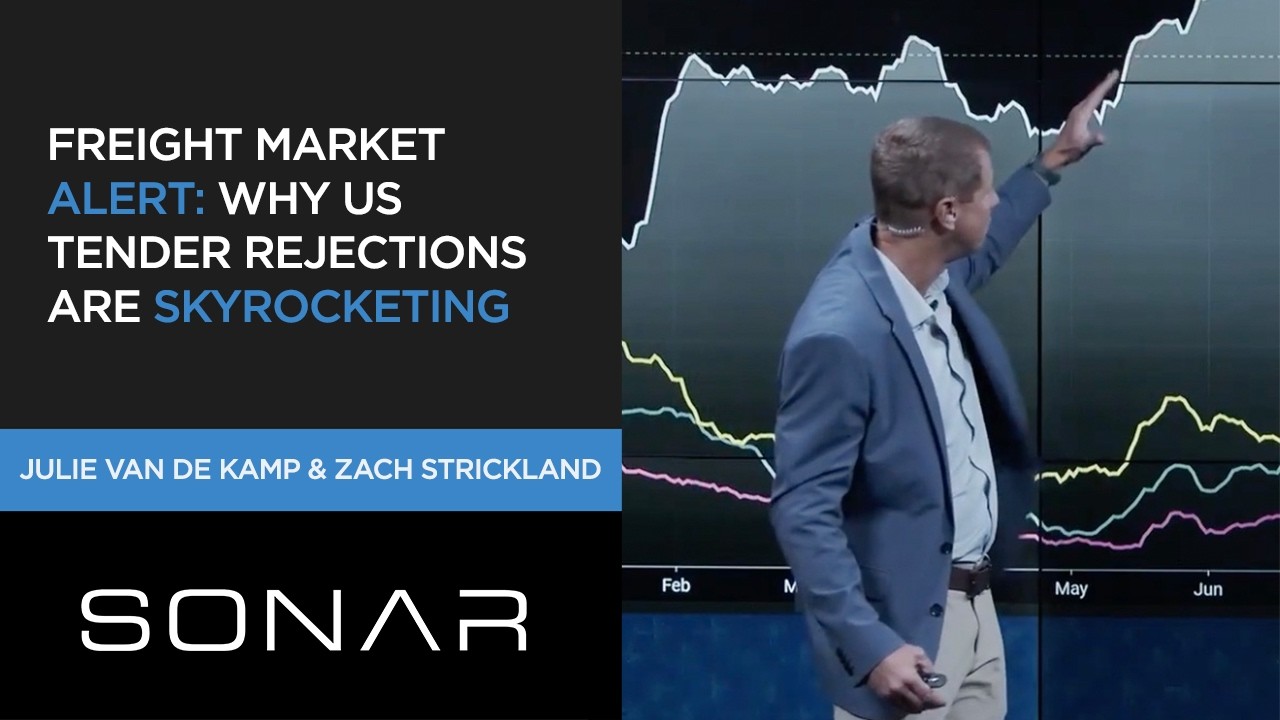 ▶ ▶ |
Freight Market Alert: Why US Tender Rejections Are SkyrocketingWatch the full breakdown on FreightWaves TV. |
 ▶ ▶ |
USMCA Deadlock, Canada Bans: What It Means for TruckingWatch the full breakdown on FreightWaves TV. |
|
▸
|
Whether Schneider’s carrier cuts keep pace with demandFilter says the exodus is "early innings." Watch whether one-way rates land at the top of the 10-13% projected range as fewer approved carriers chase the same freight into 2027 bid season. |
|
▸
|
Whether Eagle Pass holds after the empty-truck reversalANAM never explained why it targeted Piedras Negras. Watch whether the restriction resurfaces without warning, and whether carriers push Mexico for advance notice on future permit changes. |
|
▸
|
Whether auto-related rail volume keeps dragging on intermodalMotor vehicles and parts carloads fell 18.8% in the off-week. Watch whether that decline persists into next week’s report or proves to be the one-off behind this week’s rare dip. |
