
| The Daily // Mon 11.02.26 | View in browser → |

The Daily
 |
NEWSLETTER BROUGHT TO YOU BY — QUANTIX
One call covers dry bulk, liquid bulk, packaging, warehousing and managed transportation. Quantix removes the obstacles between your material and your customer. One partner, nationwide. Learn more.
|
Flexport volumes up 40% as headcount grows only 5%
Flexport’s freight volumes are up 40% from a year ago while its headcount has grown 5%, founder and CEO Ryan Petersen told FreightWaves, according to Thomas Wasson’s reporting. He credits the gap to artificial intelligence tools the company runs across customs, routing and its own engineering teams. “Our volumes are up 40% annually. And headcount’s only up 5%, so you can see the AI’s working,” Petersen said. The interview followed Flexport’s fall technology release, which added an AI classification tool to its customs software and rail, barge and air routing to its free Flexport Atlas map.
In customs, AI still has a limit. Flexport’s new tool suggests a 10-digit tariff code and links the CBP rulings behind it, but any code a customer wants to use goes to a licensed customs broker on Flexport’s team, who reviews it by hand before filing. Under 19 U.S.C. 1641, only a licensed broker can conduct customs business on behalf of another party. Petersen said AI models often hallucinate in customs work, partly because CBP leaves older binding rulings posted after newer ones supersede them. Flexport also has AI write code for customer delivery rules, and once an expert signs off, the code runs the same way every time.
Petersen said audits of entries filed by competing brokers, run through a free tool Flexport launched in February, found an average error rate of 20%, which he blamed on 2025’s tariff churn. He put Flexport’s own error rate on U.S. customs filings last year at 0.2%. On demand, he offered a theory he said he has not seen written elsewhere: tariff refunds, which he called a “massive stimulus for the industry.” He also estimated that data center cargo accounts for around 8% of global air freight capacity and is projected to triple next year.
Flexport credits AI for 40% volume growth on 5% more staff. In customs, its AI still routes through licensed brokers, as CBP rules require, and the 20% error rate it cites for competitors comes from its own audits.
TFI CEO Bedard says U.S. LTL operations must change
TFI International CEO Alain Bedard was blunt about the company’s U.S. LTL operations on Friday’s third-quarter earnings call, according to John Kingston’s reporting. “Truckload is great. Logistics is great. U.S. LTL is not,” Bedard said. He said a new manager for the unit, on the job since Oct. 1 and to be identified soon, is being brought in, and that TFI has no intention of selling its U.S. LTL operations. The company-wide LTL operating ratio was 91.3%, compared with 88.8% a year earlier, and Bedard said the U.S. operation is closer to a 97. TFI shares were down 14.71% to $95.99 at about 2:15 p.m. EDT.
Bedard said TFI plans to slowly build a non-union network in parallel, through Hercules Forwarding, which handles about 1,000 LTL shipments per day. He also cited density: the average distance between stops in U.S. package and delivery is about twice that of the Canadian operation.

Canadian National third-quarter profit rises 6% as freight revenue climbs 15%
Canadian National Railway reported a 6% increase in third-quarter profit Friday as stronger grain, energy and automotive freight activity lifted revenue, according to Stuart Chirls’ reporting. Revenue increased 15%, and adjusted diluted earnings rose 18%, ahead of analyst expectations. CN’s reported operating ratio deteriorated to 63.7% from 61.4% on a technology write-down, advisory costs and higher fuel costs, while the adjusted ratio improved to 61.0%.
CN maintained its full-year outlook and said earnings growth is tracking toward the upper end of its range. Grain and fertilizer revenue rose 19%, petroleum and chemicals 17% and automotive 31%, while coal, forest products and intermodal traffic declined.
Georgia Ports opens $134 million Gainesville Inland Port
Gov. Brian Kemp and Georgia Ports Authority officials celebrated the grand opening of the $134 million Gainesville Inland Port on Thursday, according to Stuart Chirls’ reporting. The terminal, operational since May 4, provides direct Norfolk Southern rail service between Gainesville and Savannah five days a week, an alternative to a roughly 600-mile round trip by truck. Georgia Ports expects it to shift 26,000 containers to rail in its first year but has not disclosed volume since it opened. The 104-acre facility is designed to handle 200,000 containers annually at full build-out.
The terminal extends Savannah’s port services into a region with more than 330 manufacturers and gives shippers access to about 40 weekly vessel calls. State officials say the connection will lower freight costs, support industrial growth and reduce highway traffic.
FedEx Freight sees volumes stabilize, expects Q4 margin improvement
FedEx Freight said Thursday that shipment volumes have continued to stabilize and that it expects stronger operating leverage next year as a standalone company, according to Todd Maiden’s reporting. Results for June through September showed revenue up 9% year over year to $3.28 billion and an 84.5% adjusted operating ratio, 90 basis points better y/y. Adjusted earnings per share of $2.15 were 70 cents lower.
Fourth-quarter guidance calls for revenue of $2.3 billion to $2.37 billion, and the company expects both volumes and yield excluding fuel to increase. Its 2027 general rate increase is expected to average 6.9%, effective Jan. 8.
Brought to you by Samsara — built with operators, for operators. Blind spots cause some of fleets’ costliest, most complex collisions. Learn how AI-powered 360-degree visibility helps you spot risks in real time and protect drivers, pedestrians and cyclists.

| Time | Guest | Topic |
|---|---|---|
| 12pm | Cristiano Façanha | Head of Road Freight Electrification, North America, at Smart Freight Centre |
| 12:30pm | Todd Maiden | Finance Editor at FreightWaves |


How Supply Chain Leaders Should Approach Their Next AI Investment
What New Research From Gartner, McKinsey, and FreightWaves Reveals About Closing the AI Readiness Gap

Death by a Thousand Loads: When Margin Drifts and How You Catch It

Why More Fleets Are Looking at Captives
Reliance Partners’ Frank Kneeland on the shifting math behind alternative risk and what it takes for a fleet to make the leap

One Network for Every Form of Chemical Freight
One partner for dry bulk, liquid bulk and warehousing.
What It Takes to Win in the Next Era of Drayage
Demand volatility, terminal congestion and driver shortages are squeezing drayage margins. FreightWaves and CargoWise Landside surveyed operators on where automation and digital investment are actually paying off.
High-Stakes Freight Brokerage: Risk and Accountability
Shippers moving high-value freight say lower-cost brokerage is starting to carry higher risk. FreightWaves and Werner surveyed where compliance gaps and carrier performance issues are driving accountability higher.
New Research: Tariffs Didn’t Raise Costs. They Raised the Execution Standard.
Infios research shows the 2025 tariff overhaul turned transport mode, tariff exposure and trade-route selection into variables shippers now have to manage actively, not fixed costs they can set and forget.
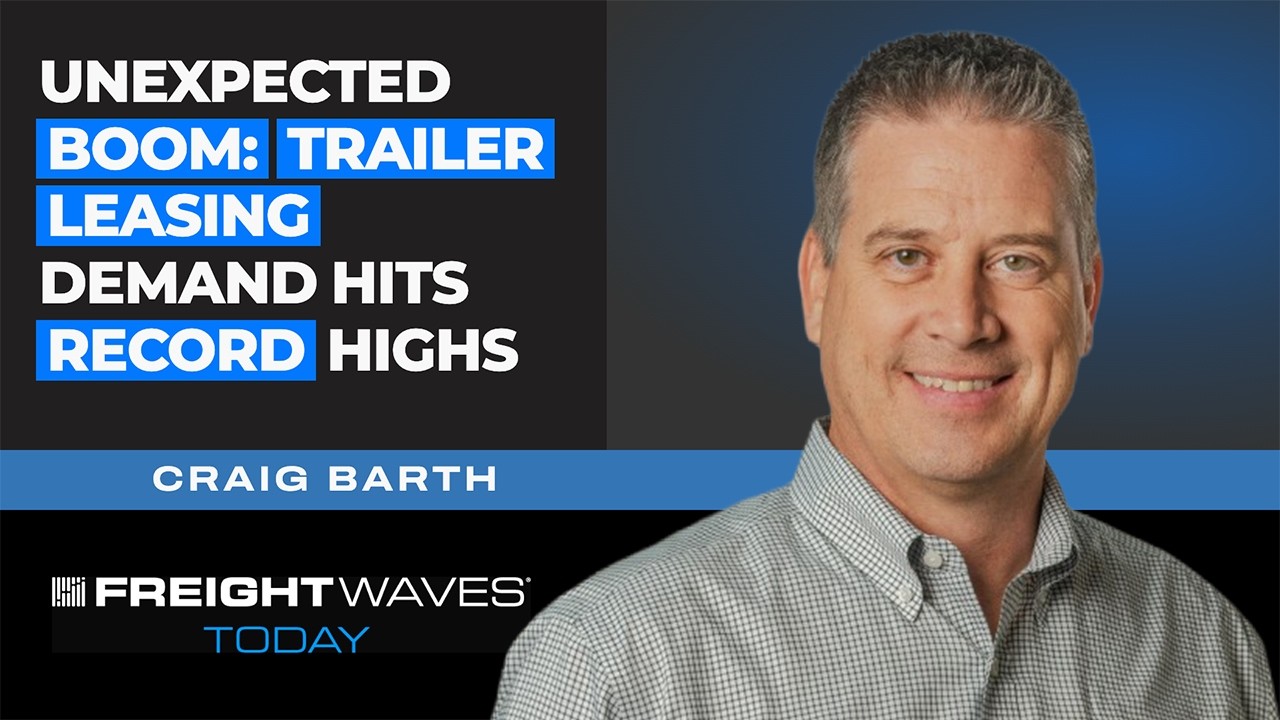 ▶ |
Unexpected Boom: Trailer Leasing Demand Hits Record HighsTrailer utilization rates are surpassing even pandemic levels, driving an unexpected surge in the trailer market. |
 ▶ |
Schneider’s Bold Move to Norfolk Southern from CSXFreightWaves TV looks at Schneider’s decision to shift its eastern rail business from CSX to Norfolk Southern. |
|
▸
|
Flexport’s pace of changeFlexport is weighing engineering teams of two or three, down from eight, and may move to three or four technology releases in 2027. Watch whether volume growth keeps outpacing headcount. |
|
▸
|
TFI’s U.S. LTL resetA new U.S. LTL manager started Oct. 1 and will be named soon, and TFI plans to slowly build a non-union network. Watch the new hire and the U.S. operating ratio, which Bedard put closer to 97. |
|
▸
|
Data center air cargoPetersen estimated data center cargo is around 8% of global air freight capacity and projected to triple next year, with Taiwan and Southeast Asia lanes “really constrained.” Watch air rates on those lanes. |
