
| The Daily // Wed 11.04.26 | View in browser → |

The Daily
 |
NEWSLETTER BROUGHT TO YOU BY — QUANTIX
One call covers dry bulk, liquid bulk, packaging, warehousing and managed transportation. Quantix removes the obstacles between your material and your customer. One partner, nationwide. Learn more.
|
|
ANNOUNCEMENTS
|

Peak season inventory surge bolsters TL carriers’ double-digit rate ask
An October survey of supply chain executives confirmed what truckload carriers said on recent quarterly calls: rates are likely to remain on the rise, according to Todd Maiden’s reporting. The Logistics Managers’ Index, released Tuesday, showed further capacity declines alongside surging pricing. The transportation capacity reading was 38 for October, an 11th straight month of contraction, though at a pace 3.6 percentage points slower than September’s. Transportation prices, at 88, continued “expanding at a highly significant rate,” but 4.7 points slower than in September.
While cost pressures tamped down truckload carriers’ third-quarter earnings, the group expects to capture double-digit rate increases in the upcoming bid season. Knight-Swift, which has roughly 70% of its TL fleet operating under non-dedicated agreements, is targeting “at least double-digit” increases in annual contract negotiations that just began. The article’s SONAR chart caption puts recent contract renewals at an average of 13%. Logistics managers expect the market to stay very tight over the next 12 months, with future readings of 49.3 for capacity and 90 for pricing.
The overall LMI was 70.7, up 50 basis points in October. Inventory levels jumped 8 points from September as firms pulled inventories in ahead of what the report called a hoped-for “blockbuster holiday season.” Inventory costs, at 88.8, reached the highest reading since March 2022, and Knight-Swift said it is seeing the most peak-season project freight in its network since the pandemic.
The LMI provides a look at all major supply chain costs. The latest report signals a difficult operating environment for shippers characterized by limited capacity and rapidly rising costs, with aggregate logistics costs at 257.5, up 11.4 points from September and the fastest growth since March 2022.
Benchmark diesel price falls as futures drop sharply
The Department of Energy/Energy Information Administration average weekly retail diesel price, the benchmark used for most fuel surcharges, fell 6 cents to $6.292 per gallon, effective Monday, according to John Kingston’s reporting. The bigger move came in futures on Monday: December ultra low sulfur diesel settled at $4.4216 per gallon, its lowest settlement since Oct. 6, and Brent fell 10.94% while West Texas Intermediate declined 7.36%. Comparing the December contract over two days, the drop was 25.45 cents per gallon.
Oil fell on hopeful news about negotiations between the U.S., Israel and Iran, and the article notes that prices can reverse quickly. On Tuesday, a report that Iran and the U.S. were “far from a deal” helped send ultra low sulfur diesel up 8.94 cents, just over 1%, to $4.5110 per gallon at about 11:30 a.m.

ILWU Local 26 and PMA extend contract to Wednesday, delaying a port strike
The Pacific Maritime Association and International Longshore and Warehouse Union Local 26 signed a contract extension through 5 p.m. Pacific time Wednesday, Nov. 4, temporarily postponing a potential work stoppage at the ports of Los Angeles and Long Beach, according to Stuart Chirls’ reporting. Local 26 represents about 250 watchmen who perform security-related duties at port terminals, and the sides will keep bargaining with help from the Federal Mediation and Conciliation Service. The extension does not resolve the underlying dispute.
Watchmen make up about 2% of the ILWU workforce at the two ports, but PMA has warned that other ILWU members could honor picket lines in a strike, potentially interrupting vessel, yard and gate operations. The dispute is separate from the West Coast longshore agreement, which runs through 2028.
BCG survey: AI is moving beyond trials in ports, but earnings gains are scarce
A survey of 103 industry experts found that artificial intelligence is moving beyond trials in container ports and terminals, but measurable financial returns remain scarce, according to Stuart Chirls’ reporting. Boston Consulting Group reported that 44% of respondents said their organizations had reached the scaling stage or beyond, yet only 4% reported measurable earnings gains and just 11% systematically tracked AI’s contribution to efficiency or margins. The survey was conducted in August with the Terminal Industry Committee 4.0.
Uncertainty over return on investment was the most cited barrier to wider adoption, named by 41% of respondents. BCG and TIC4.0 recommended that operators establish evidence of value before expanding deployments.
Rush Enterprises CEO says final EPA ’27 rule may not come soon
William Rush, CEO of Rush Enterprises, said on the company’s earnings call Wednesday that he is hearing the final EPA rule on nitrogen oxide standards, known as EPA ’27, will not arrive in November, according to John Kingston’s reporting. Rush predicted a final decree in January or February, even though the rule must take effect Jan. 1. The core proposal, an 80% reduction in NOx emissions to 0.035 g/bhp-hr, has not changed.
The July amendment with the most industry support is noncompliance penalties that engine makers can pay if they miss the new standard. Rush said he would lean toward paying them and testing the new engines before committing. An EPA spokesman said the agency is working to finalize the rule as expeditiously as possible.
Brought to you by Samsara — built with operators, for operators. Blind spots cause some of fleets’ costliest, most complex collisions. Learn how AI-powered 360-degree visibility helps you spot risks in real time and protect drivers, pedestrians and cyclists.

| Time | Guest | Topic |
|---|---|---|
| 12pm | Luc Vincent | Special Advisor at Empiric Earth |
| 12:30pm | Bill Stephens | Trains Magazine Editor |


Why Logistics AI Still Needs “Experts in the Loop”

What the Mastio Rankings Actually Tell Shippers
Old Dominion Freight Line’s Mastio Wins and How to Choose a Carrier Based on the Attributes That Matter Most

One Network for Every Form of Chemical Freight
One partner for dry bulk, liquid bulk and warehousing.
What It Takes to Win in the Next Era of Drayage
Demand volatility, terminal congestion and driver shortages are squeezing drayage margins. FreightWaves and CargoWise Landside surveyed operators on where automation and digital investment are actually paying off.
High-Stakes Freight Brokerage: Risk and Accountability
Shippers moving high-value freight say lower-cost brokerage is starting to carry higher risk. FreightWaves and Werner surveyed where compliance gaps and carrier performance issues are driving accountability higher.
New Research: Tariffs Didn’t Raise Costs. They Raised the Execution Standard.
Infios research shows the 2025 tariff overhaul turned transport mode, tariff exposure and trade-route selection into variables shippers now have to manage actively, not fixed costs they can set and forget.
 ▶ |
Diesel Prices Collapse, Then Rebound: What’s Driving Volatility?Diesel prices dropped sharply, then rebounded on geopolitical news, in a volatile market with inventories critically low. |
 ▶ |
Why Your Trucking Insurance Costs Are Rising & How to Fight BackPeter Niro of Progressive Insurance explains why trucking insurance costs are rising and says fleets can control them by focusing on risk reduction before losses occur. |
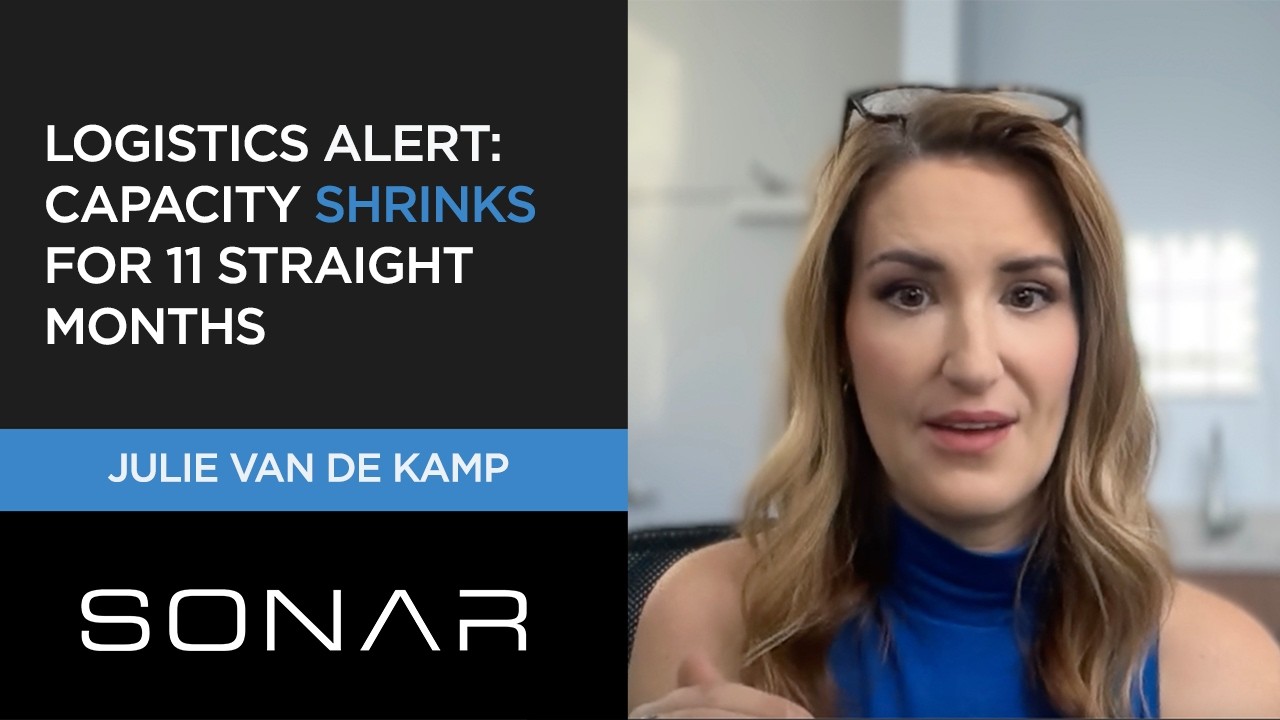 ▶ |
Logistics Alert: Capacity SHRINKS for 11 Straight MonthsThe latest ISM Manufacturing PMI and LMI reports confirm that demand is strong but capacity is heavily constrained. |
|
▸
|
Port labor deadlineThe ILWU Local 26 extension runs through 5 p.m. Pacific time Wednesday, Nov. 4. Watch whether the sides reach a deal, and whether other ILWU members honor picket lines if a strike starts. |
|
▸
|
Truckload bid seasonKnight-Swift is targeting at least double-digit increases in contract negotiations that just began. Watch whether the LMI’s forecast pricing reading of 90 and recent renewals averaging 13% hold up. |
|
▸
|
EPA ’27 timingRush expects a final rule in January or February, while the rule is meant to take effect Jan. 1. Watch for a decision on noncompliance penalties. |
