Will They Really Enforce It? Why English Proficiency Standards Might Finally Get Real
|
|
|
|
|
NEWSLETTER BROUGHT TO YOU BY — SIRIUSXM
|
SiriusXM keeps truck drivers informed and entertained with 24/7 music, sports, and more. Hear all your SiriusXM favorites on every haul for $6.06/month. Sign up.
|
|
|
ELP Rules Tighten, Rates Shift Early – The Market’s Moving Without Warning
|
|
|
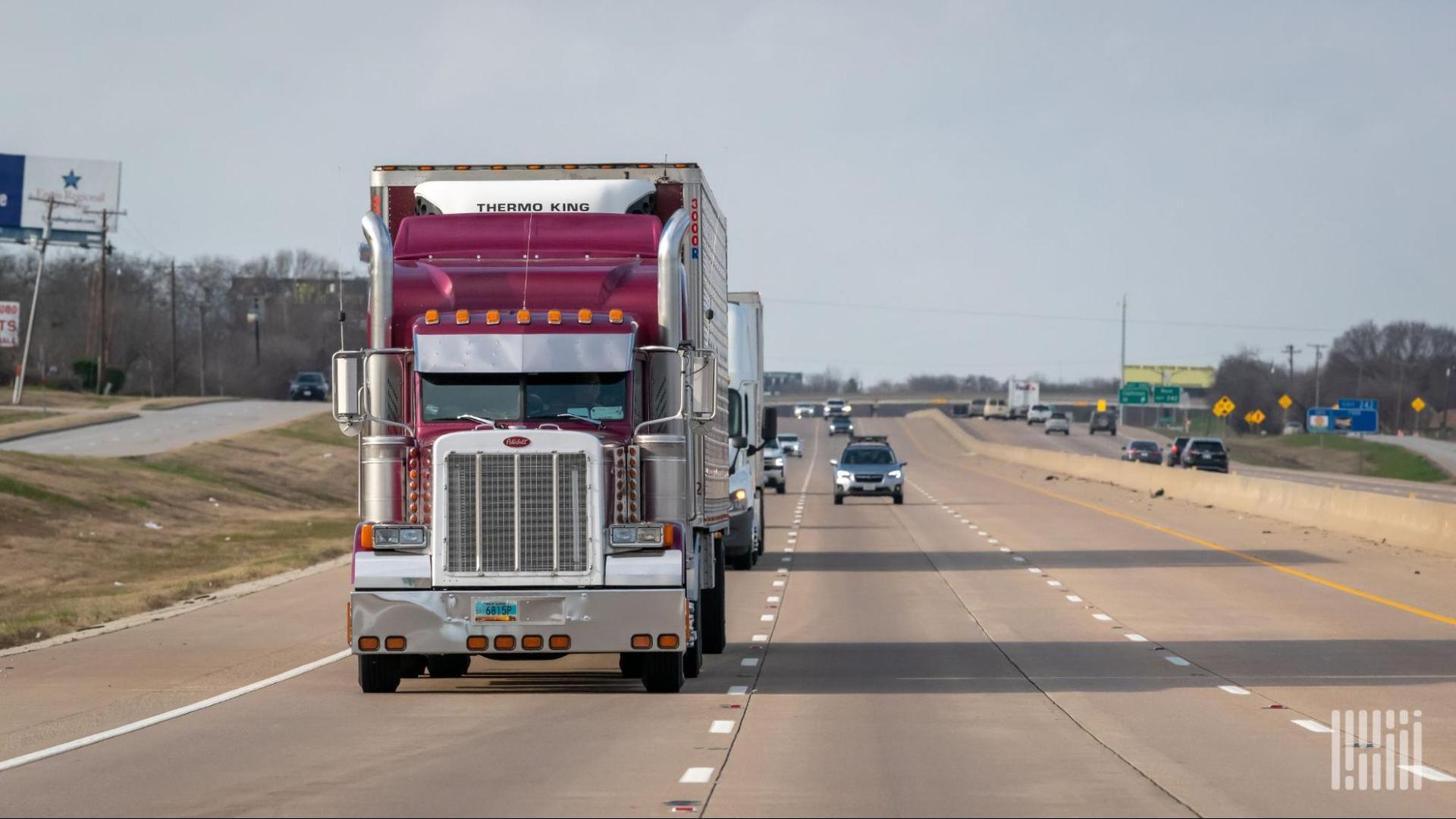
(Photo: Jim Allen/FreightWaves. FMCSA is finally putting real pressure behind English proficiency standards—and this time, it might stick. If enforcement follows through, thousands of underqualified drivers could be sidelined, tightening capacity and shifting rate leverage back toward compliant carriers. Don’t ignore it—this quiet regulation could reshape the freight lane.)
|
|
|
Will They Really Enforce It? Why English Proficiency Standards Might Finally Get Real
|
There’s no shortage of rules in trucking—but not all of them get enforced. That’s why this latest move from FMCSA is worth watching closely. Because this time, enforcement may actually follow through—and if it does, it could shake up the labor pool, reshape competition, and tilt some rate power back toward carriers who play by the book.
As of June 25th, the FMCSA is advancing its plan to enforce English language proficiency (ELP) standards for commercial drivers. On paper, this requirement has been around for years. But let’s be honest—it’s rarely been enforced with consistency. That might be changing.
The agency is proposing that carriers take on more direct responsibility for verifying that their drivers can speak and understand English well enough to safely operate on U.S. highways. And they’re not talking about a checkbox. They’re talking evaluations, documentation, and consequences. That means audits, citations, and possible disqualification if a company is found to have skirted the rules.
And this isn’t just about language. It’s about safety.
We’re talking about drivers being able to:
- Read detour signs in a construction zone
- Understand emergency instructions from roadside officers
- Follow hazmat placards or bridge clearance warnings
- Communicate clearly in the event of an accident or breakdown
- Accurately fill out logs, inspection reports, and load paperwork
When drivers lack these skills, it’s not just a compliance issue—it’s a hazard. And if enforcement finally grows teeth, the entire industry could feel the impact.
So what happens if FMCSA follows through?
We could see an immediate contraction in the labor pool. Thousands of drivers who’ve slipped through the cracks—barely scraping by without the necessary language skills—could be sidelined. For a market already walking a tightrope, that kind of pullback in available capacity can add pressure to rates quickly, especially in lanes where unqualified drivers have been propping up excess supply.
For small carriers who are already compliant, this is a window of opportunity. If enforcement sticks:
- Capacity shrinks
- Rates climb
- The playing field starts to level
This isn’t about punishing non-English speakers. It’s about making sure everyone on the road can operate safely and legally in an environment that depends on clear communication.
And let’s not forget—the ones who’ve been hurt most by loose enforcement are often the compliant carriers who’ve watched mega-fleets bend rules to move more trucks. If this regulation is finally taken seriously, the pressure shifts—and the edge goes to those already doing it right.
Will FMCSA follow through with real teeth? Time will tell. But if they do, this quiet rule could become a loud turning point.
Stay sharp. Because enforcement isn’t just coming—it might finally mean something.
|
|
|
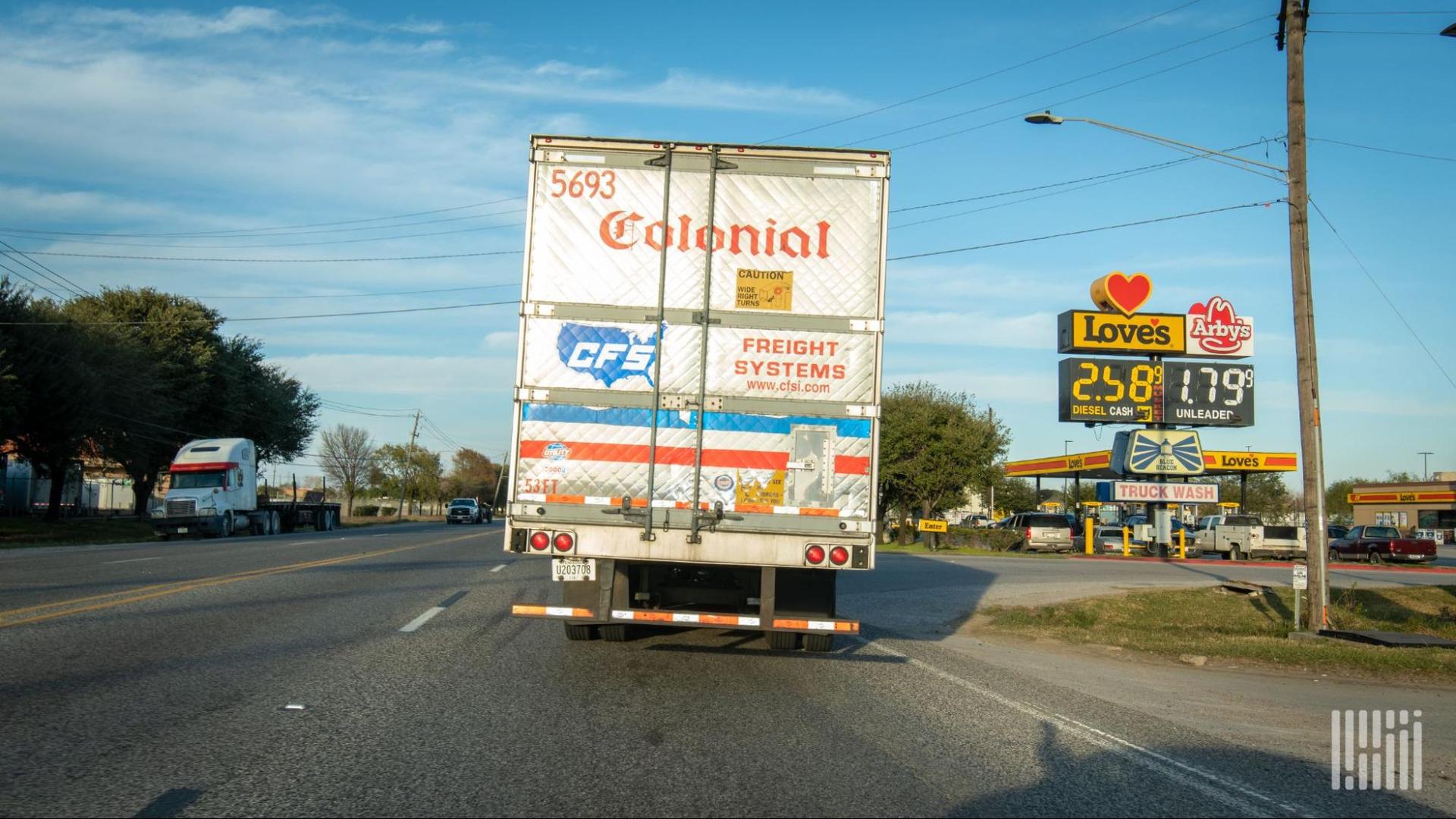
(Photo: Jim Allen/FreightWaves. July 4th freight is already heating up — and if you’re not planning two weeks out, you’re behind. Spot rates are rising early in the Southeast and Mid-Atlantic, capacity is tightening fast, and smart carriers are locking in lanes now to avoid the holiday scramble. Don’t wait. Position your truck where the money’s moving — not where it used to be.)
|
July Fourth Freight Is Already Heating Up – Here’s What That Means for You
|
If you’re waiting until the week of the 4th to start planning your loads, you’re already behind.
The latest market movements show that July freight pressure is coming earlier than expected this year. Tender rejections are climbing, capacity is tightening, and retailers are moving goods now to avoid the usual holiday bottlenecks. What’s happening isn’t just seasonal—it’s strategic. Shippers are adjusting early to dodge disruptions, and if you’re not ready to ride that wave, you’ll miss out.
The Southeast and Mid-Atlantic are already lighting up. Spot rates are pushing higher in key lanes, and the regions that normally peak right before the 4th are showing signs of early surge. That means if you’re running lanes in or out of places like Atlanta, Charlotte, or Richmond—you need to raise your rate floor now. Don’t wait for the holiday scramble to start holding your ground.
Fuel prices are also part of this mix. As diesel continues to rise, smart shippers are consolidating loads and booking early. That can play in your favor—if your truck is positioned in the right place at the right time. But if you’re chasing cheap freight in soft markets, you’ll find yourself stuck with empty miles and no leverage.
Here’s what you should be doing right now:
- Plan two weeks ahead, not two days. The carriers that win this season are already mapping their calendar. If your truck isn’t spoken for during that July 1–7 window, start locking it in now.
- Lean into your relationships. This is when it pays to be a known, reliable carrier. If a broker or shipper can count on you to cover holiday freight, you can count on better-than-average rates.
- Avoid dead zones. After the 4th, there will be a slowdown. Don’t let yourself get stuck in a low-volume region with no reload. Cluster your runs around cities that maintain outbound demand after the holiday—Dallas, Harrisburg, and Chicago are smart bets.
Bottom line: This July 4th isn’t going to be business as usual. The market is shifting earlier, and the carriers that adapt fast will catch the best-paying freight before it dries up. You’ve got the playbook—now run it.
|
|
|
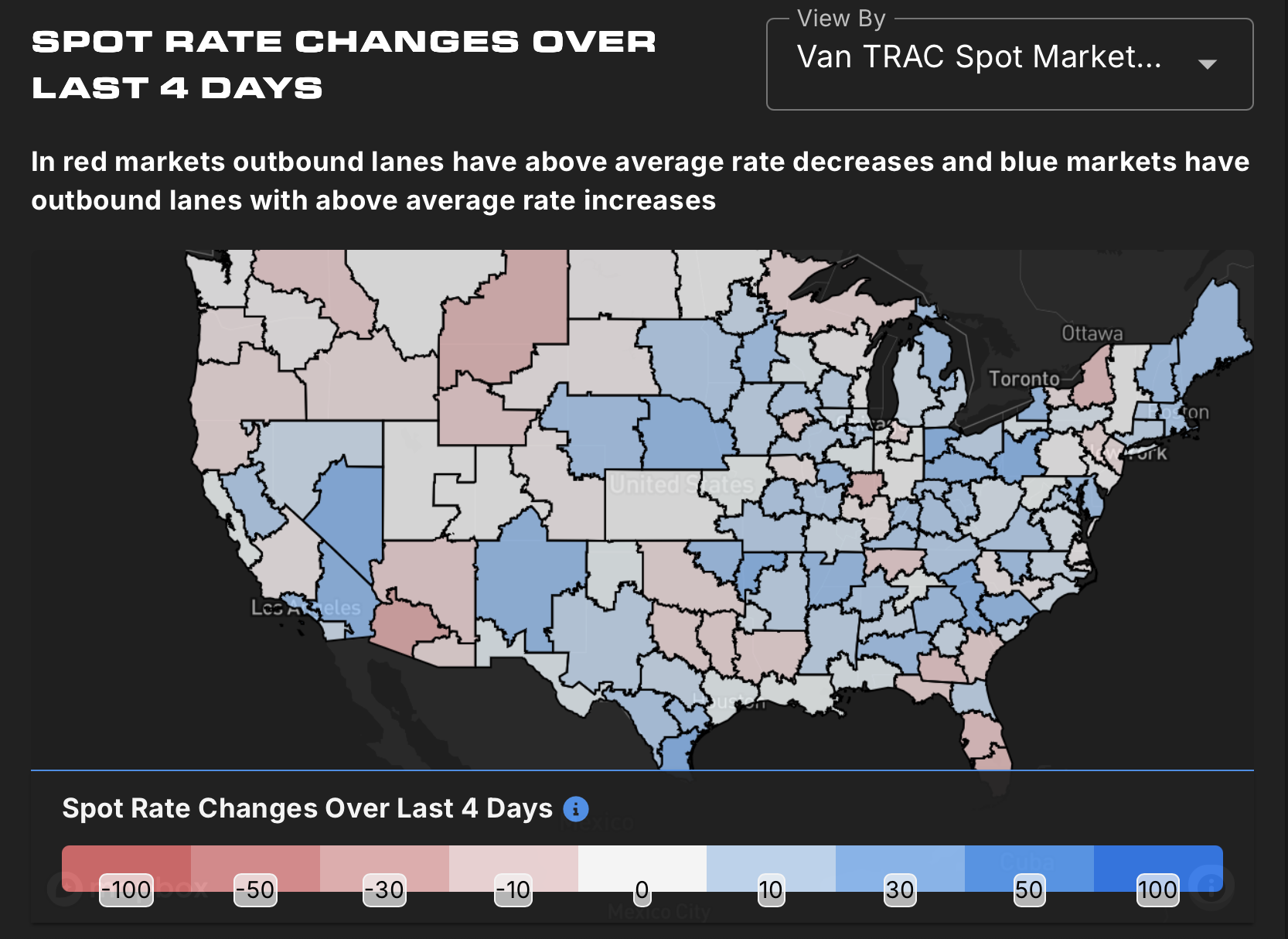
(Source: SONAR Spot Rate Changes Over Last 4 Days (Van TRAC Map). Watch the map, not your emotions. Rate strength is rising in key areas like the Northeast and Midwest — target those lanes for better rate leverage.)
|
Freight Market Conditions – Week of June 27, 2025
If you’ve been hoping July would bring some big shift in the freight market, we don’t want to say it will be a big shift but there are some better times ahead. The signs we’re seeing don’t point to a clean rebound—they show a market still stuck in a tug-of-war between weak volume, slow demand, and volatile fuel. Rates are moving, but not in a straight line. Rejections are climbing, but volumes are shaky. And diesel? It’s doing its own thing entirely. For owner-operators who live off the boards, this isn’t the time to guess. It’s time to read the field. So let’s break it down—chart by chart—so you can play smarter this week.
|
|
|
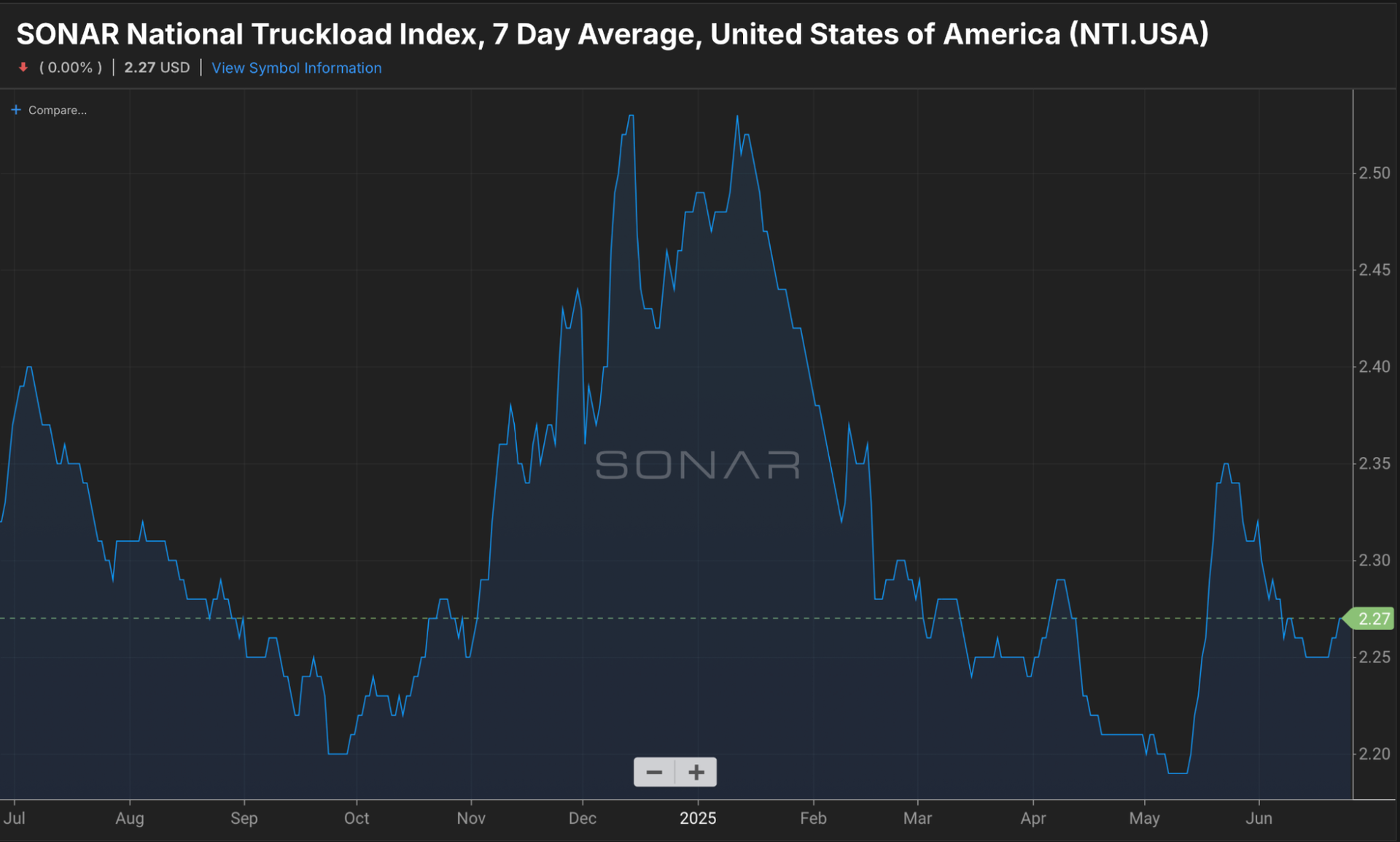
(Chart: SONAR National Truckload Index (NTI.USA). Spot rates are stuck in neutral — holding above the May low but not pushing up just yet. Don’t book blindly under this number if your breakeven is higher.)
|
Rates Are Sitting Flat – NTI Holds at $2.27
The National Truckload Index (NTI) is currently hovering at $2.27 per mile. That’s up slightly from the lows in May but still below what many owner-ops need to stay truly profitable after costs. This index reflects real-world spot rate averages, including fuel, so it’s one of the clearest snapshots we’ve got of the market’s willingness to pay.
Here’s what’s tricky: despite OTRI rising, NTI is struggling to follow through with a strong upward push. That tells us the pressure is building — but not enough yet to create widespread rate inflation. We’re in a tug-of-war between carriers wanting better rates and brokers holding the line because volumes are soft.
Use this as your floor, not your ceiling. If your breakeven is anywhere above this number (and let’s be real, most small carriers are in the $2.40–$2.60 range with fuel right now), you’ve got to negotiate up or sit it out. Know your worth. Know your cost. Use rate history tools, market trends, and capacity data to support your asks. If you’re blindly booking under NTI, you’re bleeding profit.
|
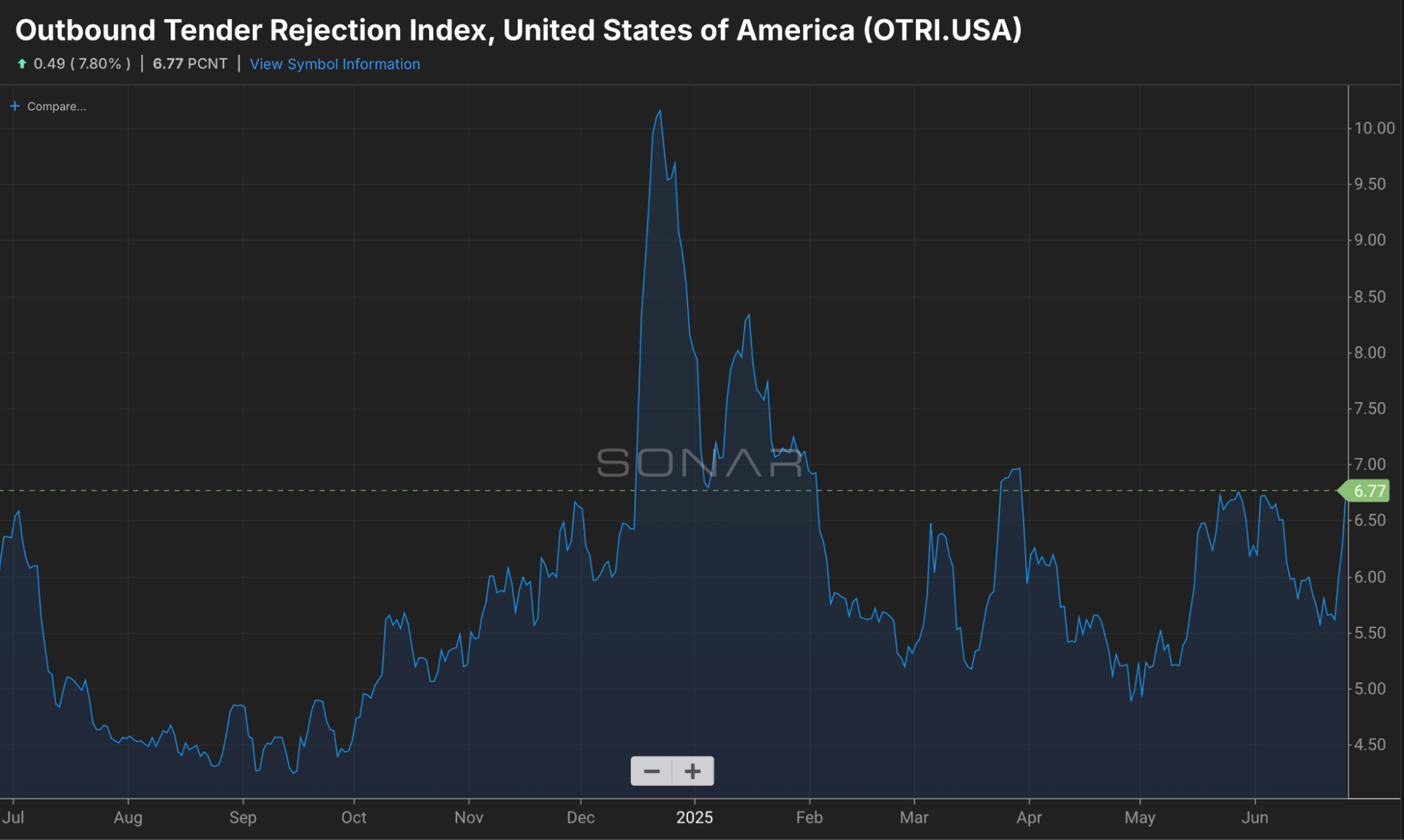
(Chart: SONAR Outbound Tender Rejection Index (OTRI.USA). More carriers are starting to say no to contract freight — that’s a sign brokers are struggling to cover loads and spot market leverage is slowly shifting back in your favor.)
|
Rejections Are Climbing Again– Capacity Still Outpaces Demand
The Outbound Tender Rejection Index (OTRI) is sitting at 6.77%, up from the mid-5% range just a week ago. This tells us one key thing — more carriers are starting to turn down contracted freight, which means brokers are having to dig deeper into the spot market to get their loads covered. When OTRI rises, it’s usually a sign that capacity is tightening, or at the very least, that carriers are starting to get a little more selective about what they haul.
But let’s keep this in perspective: we’re still well below the 8–10% rejection rates that typically trigger real upward pressure on spot rates. This is more of a simmer than a boil. Still, for load board-dependent carriers, this kind of shift matters. When rejections rise, brokers lose leverage — and that’s your chance to push back on lowball offers.
Use this uptick as a targeting tool. Look at which regions or lanes are showing the sharpest rejection rate climbs and focus your search there. Those markets will have brokers under more pressure, which means better negotiation potential for you — especially if you’re already tracking your cost-per-mile and can speak to your numbers confidently.
|
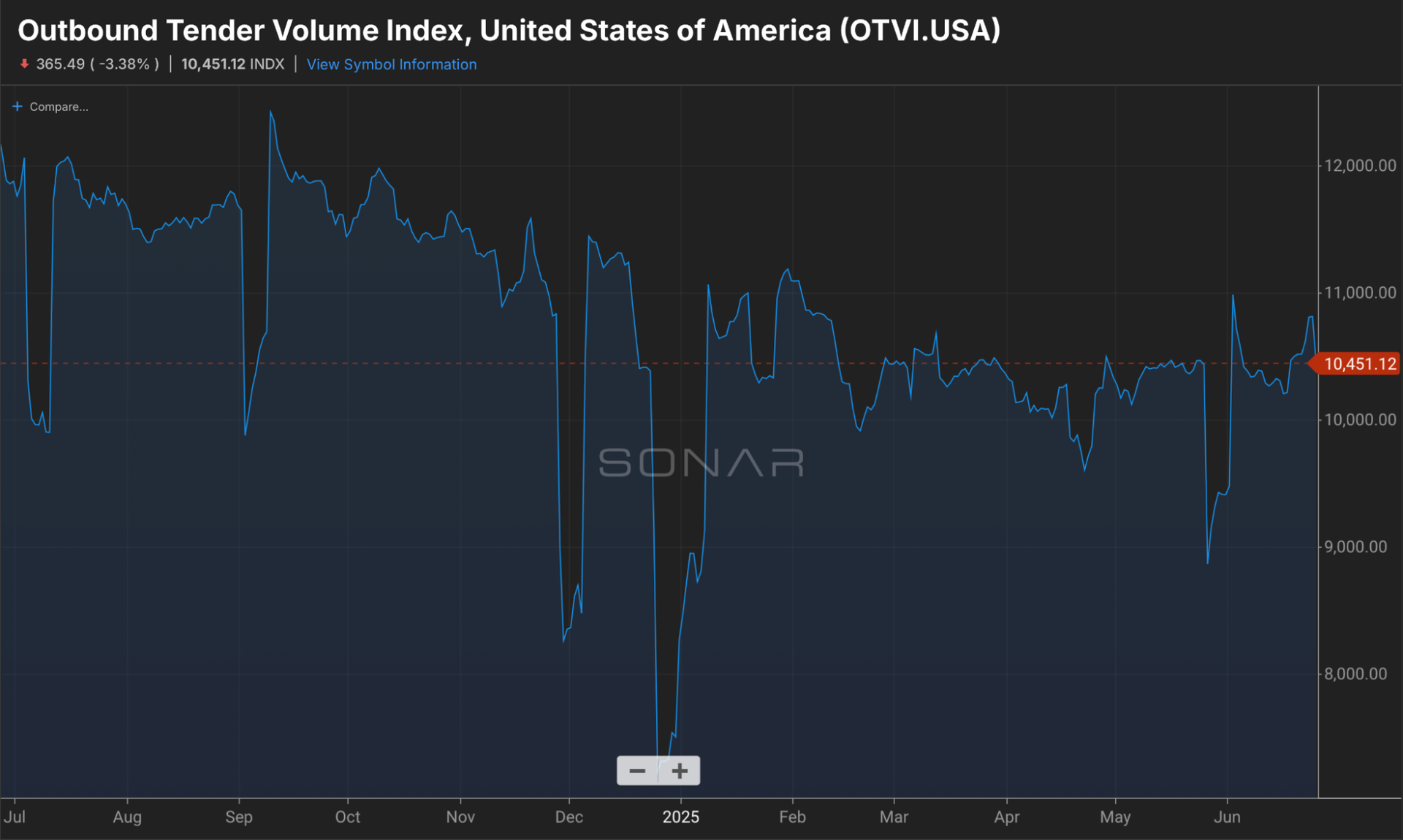
(Chart: SONAR Outbound Tender Volume Index (OTVI.USA). Freight volumes dipped again this week — fewer loads hitting the market means more competition on every load board post. Plan your week accordingly.)
|
Outbound Tender Volume Index (OTVI) – Demand Slips but Not Collapsing
The Outbound Tender Volume Index (OTVI) just took a notable dip, down over 3% week-over-week. That means fewer loads are being offered into the market compared to recent averages. OTVI is our proxy for shipper demand — when it falls, it means the pie is shrinking and there are fewer loads to go around. And that can get real uncomfortable, real fast, especially if you’re relying solely on spot freight.
To give you a sense of scale: volumes today are sitting right around 10,451 — a far cry from the 11,000+ range we saw earlier in the year. That drop means more carriers are now chasing fewer opportunities, and that’s when brokers get bold. Expect more “that’s all I got in it” phone calls and tighter rate spreads on apps.
Here’s how to play this: don’t just chase volume blindly. Pair this with OTRI data — if volume is dropping but rejections are climbing in certain markets, that’s where brokers are most desperate. Target those zones. And don’t forget, slow volume means longer booking windows, so book smarter, not faster.
|
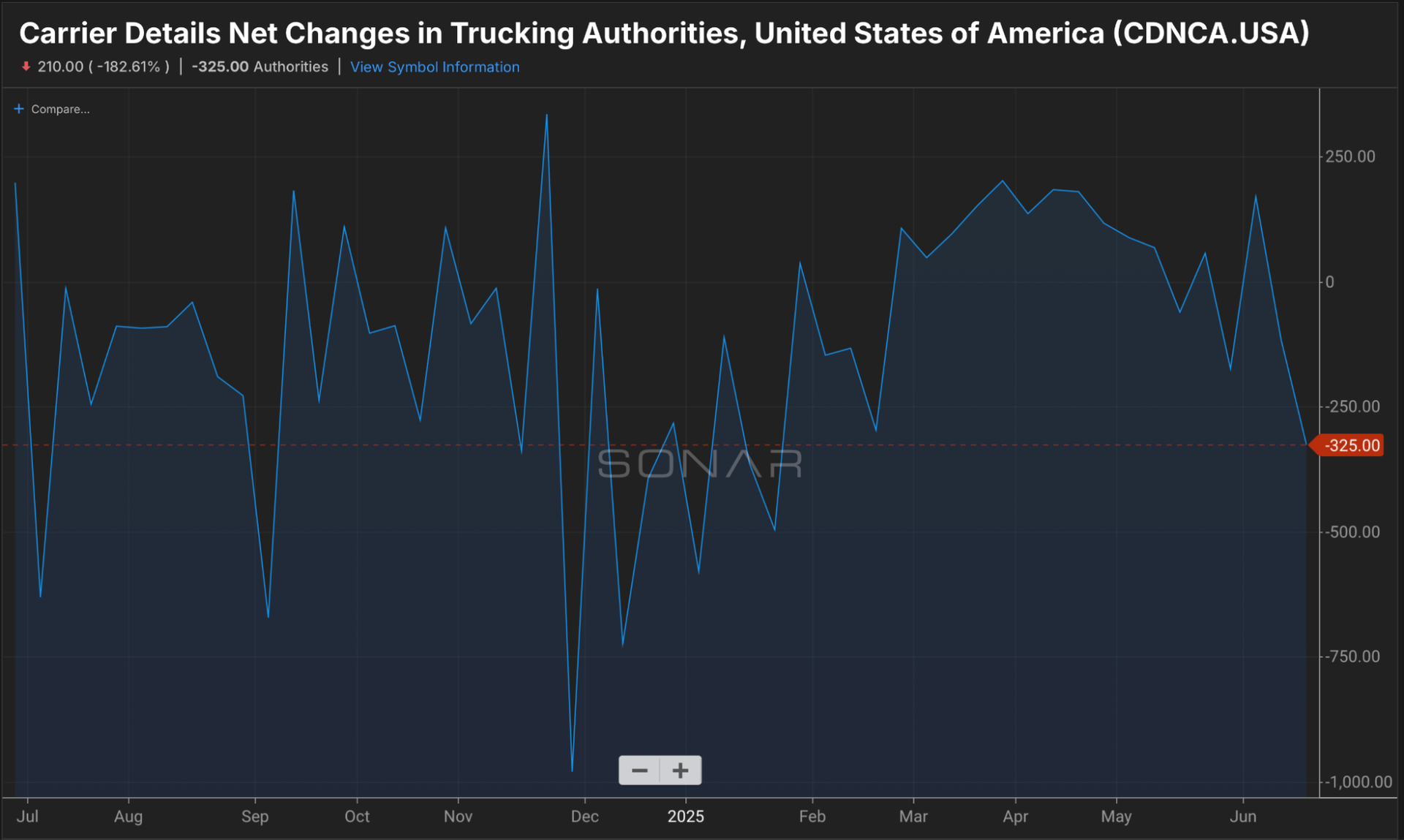
(Chart: SONAR Carrier Details Net Changes In Trucking Authorities (CDNCA.USA). More carriers are calling it quits. Last week saw a net loss of 325 authorities — one of the sharpest drops we’ve seen this year.)
|
Carrier Authority Losses Back in the Red – Net Loss of 325
This past week, the industry saw a net loss of 325 active carrier authorities. That’s not just a number—it’s a real-time sign of how brutal the current market is for small carriers. Compare that to the early days of the pandemic boom, when thousands of new authorities were activated every single month. Back then, fuel was cheap, spot rates were hot, and everybody thought they had the secret sauce. Today? It’s the ones with systems, discipline, and financial clarity who are left standing.
This kind of contraction in authority count means capacity is thinning out. And if you’re still operating, that gives you an edge—but only if you use it. This isn’t the time to haul cheap just to stay busy. It’s time to watch the data, pick better markets, and use tools like The Playbook’s profit calculator to make sure you’re not bleeding out on every mile.
You didn’t survive this long just to run yourself out of business. Watch how this trend moves. If more carriers keep shutting down, the supply-demand curve will eventually shift—and when it does, rate pressure will follow. Stay ready.
The Real Talk
This week isn’t about what’s broken — it’s about what’s possible if you learn how to read the field a little smarter.
Yes, the market’s still tight. Yes, rates are still shaky. But if you’ve been following the data week to week, then you’re starting to notice something: the folks who are adjusting early, making sharper decisions, and fine-tuning their operations — they’re the ones staying steady while others stall.
Now’s the time to lean into your numbers, not lean back in frustration. The chart shifts this week aren’t just noise — they’re telling you where the real freight pressure is building and where opportunity might be hiding in plain sight.
If you’re booking loads, don’t just ask, “What’s the rate?” Ask, “What’s the route? What’s the real profit after fuel, time, and risk?”
If you’re running a fleet, now’s the time to simplify. Drop the complexity, double down on what’s working, and build rhythm into your dispatching and planning.
This isn’t a moment to wait it out. It’s a moment to get sharper. The industry’s not stopping — and neither are you.
Let’s move smarter, not just louder.
|
(Photo: Hyundai’s Xcient Fuel Cell truck just became the front-runner in the U.S. hydrogen game — hitting U.S. roads with over 6 million miles of global experience and a head start most competitors haven’t even earned yet.)
|
Hyundai’s Hydrogen Truck Is Headed to the U.S. – But Will It Work for the Rest of Us?
|
Another headline, another alternative fuel truck. But this one’s got a little more weight behind it.
Hyundai is officially bringing its Xcient hydrogen fuel-cell truck to the U.S. market — and not just as a test. They’re making a real play here, with commercial deployment planned and regulatory partners lined up to help clear the path. California, of course, is first in line, where state incentives and port-based emissions goals make hydrogen-powered trucks more viable out the gate.
Here’s what makes this truck different:
Hyundai’s Xcient isn’t just another “proof of concept.” It’s already running in Switzerland, Korea, and other countries, logging millions of miles in real-world conditions. It runs on hydrogen fuel cells that emit only water vapor, with a reported range of about 450 miles on a single tank. That’s closer to a diesel truck’s range than most battery-electric options, which is exactly why fleets looking to reduce emissions without sacrificing range are paying attention.
But here’s the thing small carriers need to ask:
Is this something that’ll actually impact you in the next 12–24 months? Or is it just another shiny object for megafleets?
Right now, hydrogen fueling infrastructure in the U.S. is still in its infancy — especially outside California. That means you’re not likely to see hydrogen fueling stations in North Carolina, Texas, or Ohio anytime soon. And even if you could, the price tag for early adoption on a fuel cell truck will be sky-high. This rollout is targeting major fleet partners with access to grant funding and dedicated local haul routes.
Still, this matters — and here’s why:
- The technology’s maturing faster than most expected. What seemed impossible five years ago is being quietly normalized overseas. Hyundai isn’t trying to “start” from scratch — they’re scaling something already proven.
- States are watching California. Once California proves this out, you can bet other states will try to copy-and-paste the model, especially where clean air and port compliance are on the line.
- Infrastructure dollars are being allocated. The Department of Energy has already pumped billions into hydrogen corridors. It may seem far off now, but this will trickle into regional fleet requirements first — and those tend to hit subcontracted small carriers the hardest.
So what should you be doing now?
Stay informed, especially if you run port freight or regional routes in regulated zones. Watch how California-based carriers adopt and adapt. Hydrogen might not be your lane today, but if shippers and brokers start requiring low-emissions options to win contracts, you don’t want to be caught flat-footed.
This isn’t a warning to switch fuel types — it’s a heads-up that the game board is shifting. And those who pay attention to where the puck is headed will always have the edge.
|
|
|
Right after a week of wild fuel swings, complex freight maps, and mounting pressure to plan smarter — this week’s podcast takes aim at a problem too many small carriers are quietly wrestling with: why you’re still losing money on high-paying loads.
Adam sat down with Carlos Otero, CEO of efRouting, and Gino Carnevale, VP of Sales and Strategic Partnerships, to pull back the curtain on the math most dispatchers and owner-operators are getting wrong. Carlos brings a rare mix to the table — freight market research meets family trucking bloodline — and what he and Gino break down is the reality most folks don’t want to admit: rate per mile doesn’t mean much if your route is broken.
In this episode, we dig into how to move past the one-day-at-a-time hustle and start planning across multiple days for better profit. The team at efRouting lays out how their system helps carriers avoid dead miles, reduce fuel costs, and stack loads that actually make sense — not just look good on paper. It’s not just about automation, either. It’s about decision clarity.
If you’ve ever felt like you’re doing everything right and still barely coming out ahead, this conversation is your roadmap. Because at the end of the day, it’s not about chasing high rates — it’s about chasing the right strategy.
Listen now and learn how the smartest carriers are moving — on purpose, with purpose.
|
(Photo: Jim Allen/FreightWaves. Nearly 400 trucks were taken off the road during CVSA’s latest Brake Safety Day — a clear reminder that compliance isn’t just paperwork, it’s profit protection. For small carriers, one missed inspection can wreck your week. Stay ahead with routine checks, honest logs, and brakes that don’t gamble with your livelihood.)
|
Nearly 400 Trucks Parked for Brake Violations – What That Tells You About Staying Road-Ready
|
Every time enforcement steps out with a clipboard and some DOT chalk, we get a clearer picture of who’s running tight… and who’s running risky.
That was the case again during CVSA’s Brake Safety Day this spring — a one-day blitz that saw 396 commercial vehicles taken off the road in the U.S. and Canada because of brake-related violations. And while some folks might shrug off these one-day inspections, if you’re a small carrier or an independent running your own show, you can’t afford to ignore what this really means.
According to CVSA, inspectors checked over 4,800 trucks across 45 jurisdictions. Roughly 8.2% of all vehicles inspected were placed out of service due to critical brake issues — the kind that compromise safety not just for the driver, but for everyone sharing the road.
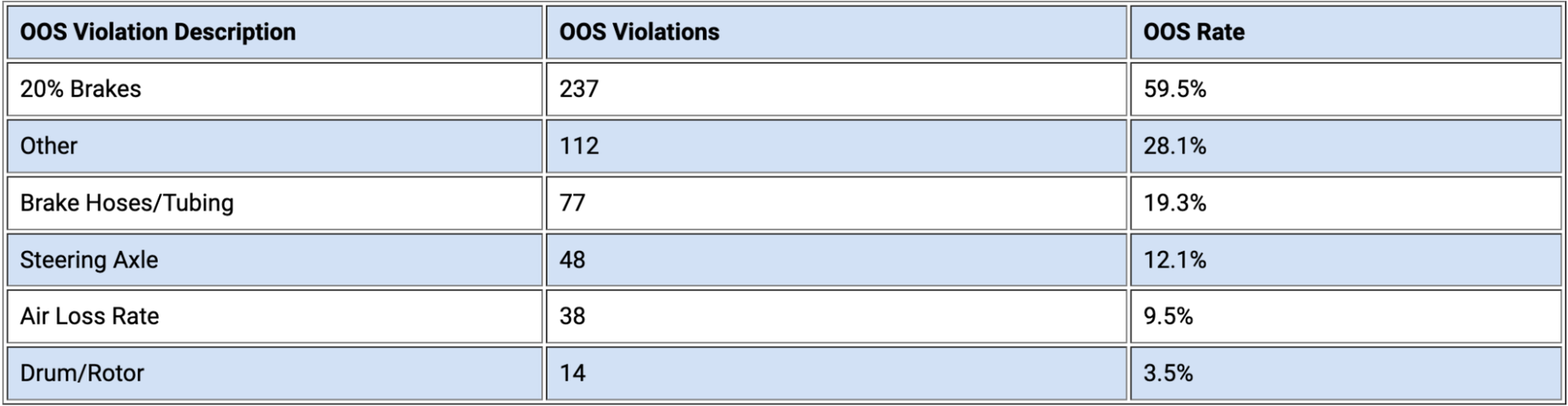
The top violations? 20% brakes. Sounds minor — until you’re trying to stop a fully loaded trailer on a downhill grade. When enforcement drills into a specific component like that, it’s usually because they’ve seen a pattern, and they’re trying to stop a problem before it becomes a tragedy.
|
(Source: CVSA. According to CVSA, 59.5% of brake-related OOS violations were due to vehicles failing the 20% brake rule. That means more than 1 in 2 trucks pulled out of service had dangerously low brake force on multiple wheels. Other major culprits included brake hoses, tubing defects, and steering axle issues. This table (Table 2 – Brake-Related OOS Violations, CVSA) shows exactly where enforcement is focusing—and where you need to be tightening up before the next blitz hits.)
|
Now here’s the part that matters to you:
This Ain’t Just a Compliance Issue — It’s a Business One
For a mega fleet, getting a truck taken out of service is annoying. For a one-truck or three-truck carrier, it can ruin a whole week. It could cost you your load, damage your broker relationship, and lead to CSA points that raise your insurance. And if you’re pulling direct freight? You might be risking more than just your day — you’re risking your contract.
Brake system violations aren’t hard to catch if you’re checking consistently. But they get skipped when you’re hustling, tired, or putting off maintenance for one more week. And that’s when the violations hit — during the random checks, not the planned ones.
Why This Should Be a Wake-Up Call
If nearly 1 in 12 trucks are failing basic brake inspections, that means the bar for standing out is lower than you think. Keeping your equipment tight, your inspection logs honest, and your maintenance up to date is a competitive edge — not just a compliance checkbox.
Here’s the takeaway: Don’t wait for the next CVSA blitz to get serious about your brakes. Use it as a checkpoint for your own standards. Check your slack adjusters. Get that air leak fixed. Make sure your shop isn’t cutting corners.
Because the next time your truck gets pulled into a scale house or roadside inspection, it won’t matter how good your dispatcher is, how well you run lanes, or how much you charge per mile. If your brakes ain’t right, you’re parked.
Stay sharp. Stay compliant. And most importantly — stay on the road.
|
Final Word – The Squeeze Is On
|
This week’s data didn’t drop any shockwaves—but it did reveal something just as critical: clarity. Rates are holding steady but not climbing. Rejections are inching up, signaling early signs of tightening. Diesel is on the move again. And while volumes remain flat, the pressure underneath is slowly building.
The question now isn’t “When will the market rebound?” The real question is, “How are you preparing for what’s coming next?”
Because in this kind of market—slow-moving, data-heavy, regulation-sensitive—success belongs to the carriers who are paying attention. Who are adjusting early. Who are sharpening the way they quote freight, the way they evaluate risk, the way they build relationships. It’s not about having the most trucks. It’s about knowing your business cold and using that knowledge to make better, faster, smarter decisions.
If you’re running on tight margins, now’s the time to revisit your cost-per-mile and renegotiate anything you’ve been “letting slide.”
If you’re onboarding drivers, it’s time to double-check that they’re not just compliant—but capable.
If you’re quoting lanes, check the data first. Don’t lean on last month’s logic in this week’s market.
There’s no playbook for a perfect market. But there is a Playbook for navigating this one—and you’re reading it.
Keep pressing in. Stay sharp. Make your next move with intention, not reaction. You’re not just weathering the storm. You’re learning to read the sky.
Let’s keep building.
|
|
|
|