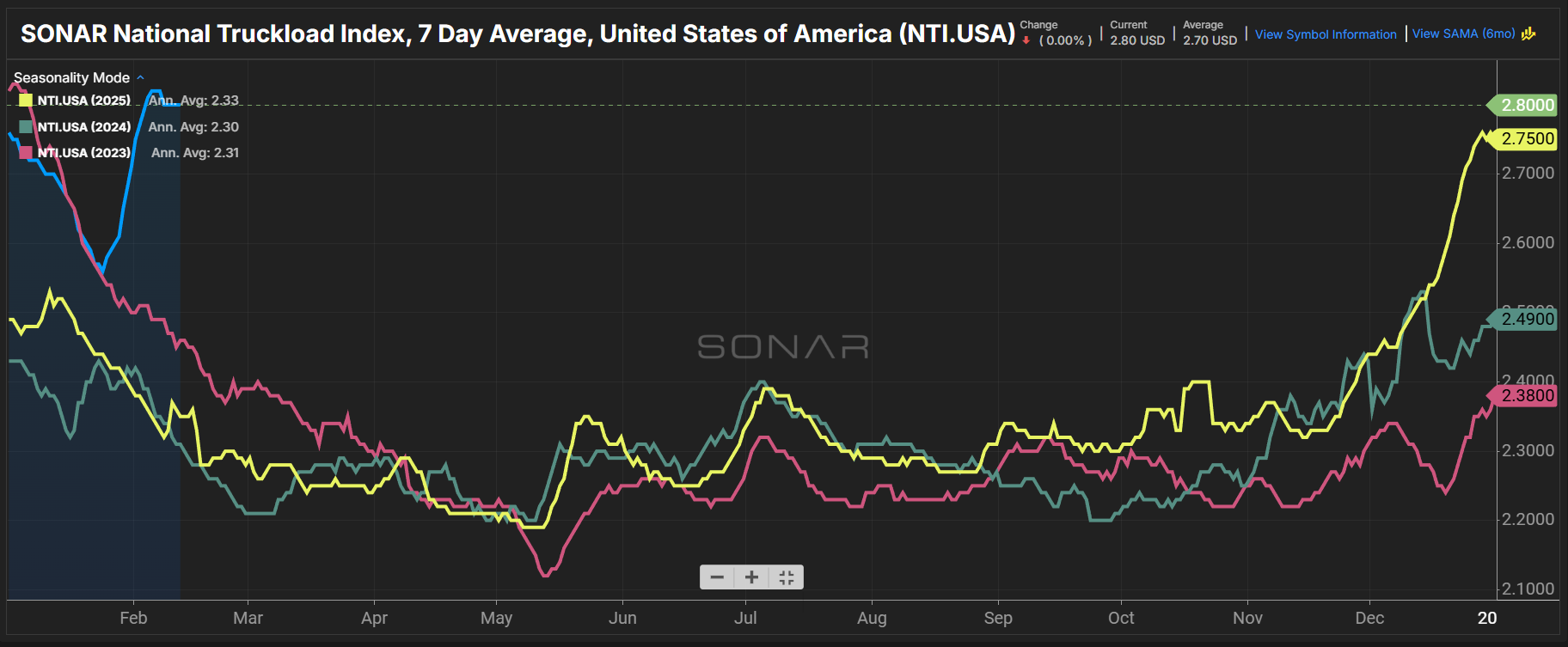
Summary: Dry van spot rates have stabilized in the second week of February, pausing an out-of-season rally that began in the final days of January.
The SONAR National Truckload Index 7-day average (NTI) fell 2 cents per mile, all-in, week over week from $2.82 on Feb. 5 to $2.80. The NTI is 11 cents per mile higher than the $2.69 recorded last month. Compared to last year, the NTI is 45 cents per mile, or 19%, higher than $2.35.
The leveling off of dry van spot rates was followed by a plateau in dry van outbound tender rejection rates and volumes.
The SONAR Truckload Volume Index — Van (STVIV) fell 88.15 points, or 1.1%, week over week from 7,833.96 points to 7,745.81 points. Similarly, the SONAR Truckload Rejection Index — Van (STRIV) fell 78 basis points week over week from 13.19% to 12.41%.
One sign of the significance of truckload capacity attrition relative to truckload demand is year-over-year comparisons. Compared to early February 2025, when van tender rejection rates were 774 basis points lower at 4.67%, dry van tender volumes are 4.3%, or 319.81 points, higher. That indicates more truckload demand relative to supply.
Looking ahead remains difficult. One certainty is that reefer demand will increase ahead of Valentine’s Day for flowers. In the dry van space, a win for cash-strapped carriers would be a sustained elevation of spot and tender rejection rates relative to previous years.
Another indicator to watch is freight brokers, who have a larger share of shipper routing guides than in previous freight cycles. If smaller fleets and owner-operators jump ship and shop around for higher-rate intermediaries, this could cause a potential routing guide failure cascade.
Anecdotally, there have already been instances of both asset-based and non-asset-based carriers renegotiating recently awarded lanes due to the rapid price surge. Whether this strategy is the winning one is uncertain — similar to spinning a roulette wheel in Las Vegas.
But for some carriers, four years of lower rates make it more tempting to risk relationships for a substantial marginal improvement.