AMD and the evolution of trucking technology
|
|
|
Bot Auto, Ryan Transportation partner on driverless freight between Houston and Dallas
|
Autonomous trucking collaboration is expanding. Bot Auto announced Wednesday a strategic partnership with Ryan Transportation to launch driverless autonomous freight operations. The Houston-based autonomous trucking and technology company and the Overland Park, Kansas-based top 20 freight brokerage will launch driverless autonomous freight operations between Houston and Dallas.
The release notes that Ryan Transportation has emerged as a pioneering brokerage partner willing to showcase the viability of autonomous trucking capacity paired with traditional brokerage operations. The driverless runs are expected to begin this spring.
Bot Auto’s deployment will center on an overnight lane starting in Houston before delivering into the southern Dallas-Fort Worth metroplex. The corridor, roughly 200 miles, has historically been difficult to service with human drivers due to tight delivery windows.
Overnight lanes are also challenging from an hours-of-service standpoint, as most drivers operate during daytime shifts, making an overnight run more limited. Driver fatigue is another constraint that Bot Auto’s driverless trucks don’t contend with.
“This is an opportunity to provide a high level of service on a lane for a customer who demands essential attention to detail, and our autonomous technology does exactly that,” said Robert Brown, vice president of business development at Bot Auto. “The overnight run is a perfect use case; the robot doesn’t get tired, doesn’t need a reset, and delivers with the same precision every single time.”
|
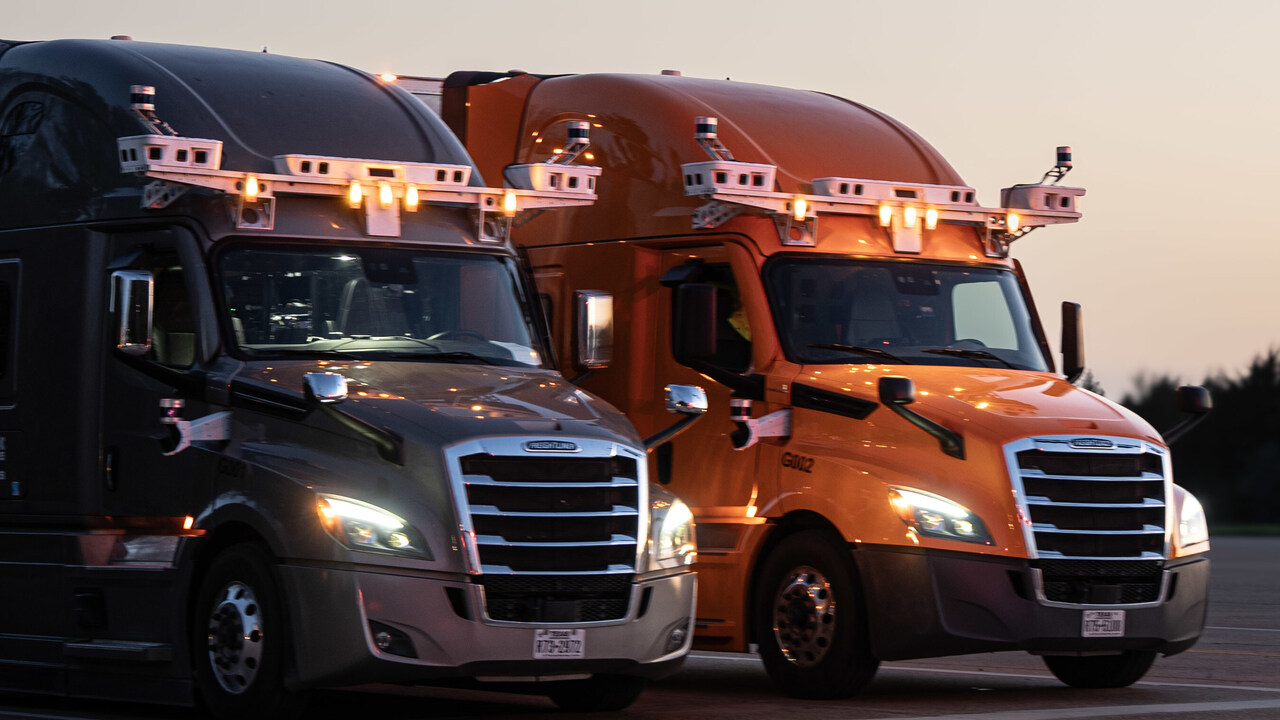
AMD and the evolution of trucking technology
|
(Photo: Jim Allen/FreightWaves)
|
The journey from paper notepads to driverless trucks has unfolded faster than most in the industry anticipated, compressing decades of technological evolution into roughly 15 years of intense innovation. Today, as embedded computing catches up to artificial intelligence ambitions, autonomous trucking stands at an inflection point where software optimization matters more than raw computing power.
“When it comes to truck technology, we’ve come a long way,” said Rehan Tahir, who works on embedded automotive computing at AMD, in a FreightWaves interview. “In the beginning everything was being logged on paper. Notepads. And then they started to do that digitally.”
Early autonomous truck developers faced a major hurdle when they crammed bulky data center components into sleeper bunks, creating systems that were too costly, too power-hungry and unable to meet safety and security regulatory requirements. Those server farms have since shrunk to the size of college dorm refrigerators as the industry transitioned to embedded platforms, moving from single-digit tera operations per second (TOPS) to hundreds or thousands.
Modern Level 4 systems run more than 20 cameras alongside four to six lidar units and similar numbers of radars. Fusing all that sensor data creates what one AMD customer called “almost a bigger compute problem than doing the actual AI.” Automotive chips must meet strict requirements, including AEC-Q100 standards for temperature durability and Automotive Safety Integrity Level (ASIL) B or ASIL D functional safety certifications.
Purpose-built designs eliminating the cab entirely represent the next major frontier, following the robotaxi industry’s lead.
“It’s easier to go to the moon than it is to build an autonomous truck,” Tahir said. “Everyone understands how challenging this is.”
|
Harbinger Acquires Autonomous Driving Startup, Expands into Software Services
|
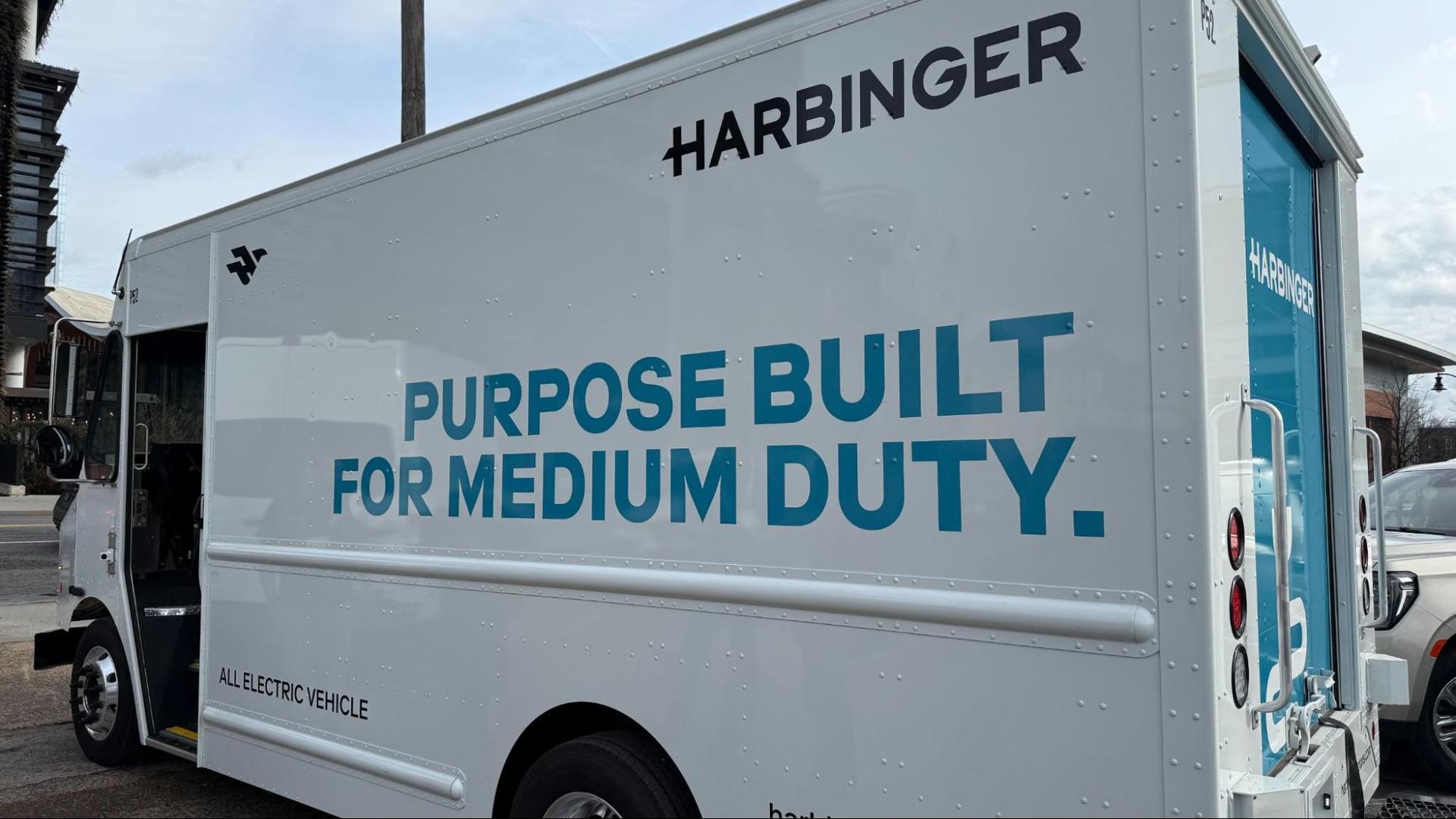
(Photo: Thomas Wasson/FreightWaves)
|
Harbinger, an American medium-duty electric and hybrid vehicle manufacturer, has acquired autonomous driving company Phantom AI. The Garden Grove, Calif.-based company also secured a licensing agreement with ZF Group’s Advanced Driver Assistance Systems (ADAS) business unit for passenger cars. The acquisition, completed in November 2025, was announced Wednesday. It marks Harbinger’s entry into software services and creates a new revenue stream.
Under the licensing agreement, ZF will integrate Phantom AI’s computer vision technology into its passenger car ADAS products while developing more advanced autonomous capabilities.
The 30-employee Phantom AI team will continue to operate in Mountain View, Calif., under co-founders Hyunggi Cho, a former Tesla ADAS engineer, and Chan Kyu Lee, a former Hyundai autonomous-driving engineer.
“Our acquisition of Phantom AI and partnership with ZF are pivotal milestones for Harbinger as we expand beyond commercial vehicles and enter new segments for the first time,” said John Harris, co-founder and CEO of Harbinger.
Christopher Ludwig, vice president of procurement for ZF’s Electronics & ADAS Division, said the collaboration allows ZF to provide a broader selection of products and options at different values to customers while creating a path for future autonomous driving capabilities.
Harbinger plans to incorporate Phantom AI’s computer vision into its electric and hybrid vehicles in 2026, bringing Level 2 autonomous solutions to the medium-duty segment. Features will include automatic emergency braking, adaptive cruise control and lane-keeping. Harris said the integration responds to demand from Fortune 500 fleet customers for safety features standard in passenger cars but often absent in medium-duty vehicles.
|
|
|
IN PARTNERSHIP WITH ACT EXPO
|
Connected vehicles, ADAS safety tech, autonomous advancements and software-defined vehicles drive innovation. Learn More.
|
|
|
Volvo Trucks North America announced the completion of $400 million in upgrades at its New River Valley plant, including a 350,000-square-foot cab welding facility. The Dublin, Va., site now produces both VNR and VNL tractors. Despite stop weeks prompted by weak demand, Volvo Group raised its 2026 North American Class 8 forecast to 265,000 vehicles.
The Commercial Carrier Journal reports that new Federal Motor Carrier Safety Administration regulations on English language proficiency testing and non-domiciled commercial driver’s licenses are driving truck tech adoption. Fleetworthy, Motive and Spotter AI now offer automated compliance tracking, while TruckSafe Consulting’s Brandon Wiseman calls continuous license monitoring “worth its weight in gold.”
Einride, the Swedish autonomous freight technology company, announced Thursday that it raised $113 million in oversubscribed PIPE financing, exceeding its $100 million goal. The capital raise supports its proposed SPAC merger with Legato Merger Corp. III, bringing total committed investments to $213 million at a $1.35 billion valuation.
|
As always, thanks for watching and reading.
Thomas Wasson
twasson@firecrown.com
|
|
|
|