|
View this email in your browser

THE DAILY
Tuesday, March 17, 2026
The five minutes that makes you the most informed person in freight today
|
|
Newsletter Brought to You By — Descartes
 |
The #1 freight visibility platform, Descartes MacroPoint delivers real-time tracking via ELD, mobile app, and agentic AI — meet the future of intelligent visibility. Learn More
|
|
|
The Daily
Truckload linehaul rates reach near 3-year high as supply constraints tighten
Supply, not demand, is driving the rate move that truckload carriers have been waiting for since late 2022, and Cass Information Systems’ February data confirms it has arrived.
Cass’ TL linehaul index rose 2.2% year over year in February and 0.2% from January, reaching its highest reading since April 2023. The dataset, which covers both for-hire spot and contract rates, has increased sequentially in each of the past six months. On a two-year stacked comparison, TL linehaul rates are up 4.1%, the largest increase since early 2023. The report said the current pricing environment reflects "3.5 years of capacity contraction in the for-hire market" translating into a supply-driven recovery "even amid soft freight demand."
The tightening isn’t coming from a freight boom. English-language proficiency requirements, non-domiciled CDL restrictions, a crackdown on ELD providers and forced closures of driver schools are progressively removing drivers from the available pool. Cass’ February report names all of them explicitly, stating that "supply constraints are supporting higher rates — not just weather, but equipment and increasingly drivers." The SONAR Outbound Tender Rejection Index confirms what the Cass data implies: the truckload market has tightened, and carriers are in a position to say no. Spot rates stepped higher through peak season as regulatory constraints on the driver pool took hold, and the National Truckload Index (linehaul only) is still running notably higher on a year-over-year comparison.
The volume picture is more complicated. Cass’ multimodal shipments index declined 7.2% year over year in February, though it recovered 10.4% from January as the market caught up from prior weather disruptions. On a seasonally adjusted basis, volumes were up 4.3% month over month. Netting those volume and spend changes implies freight rates were up in the high-single-digit range year over year — though freight mix shifts can move that math. If seasonal patterns hold, the Cass shipments index is expected to decline roughly 5% year over year in March.
Diesel has surged $1.05 per gallon, a 28% increase, in just two weeks, tied directly to the Middle East conflict and the resulting crude oil spike. Most owner-operators work the spot market and cannot easily recover fuel price swings through surcharges. The high-single-digit rate increases that truckload carriers had penciled into 2026 forecasts are harder to achieve on a net basis under this fuel cost environment.
So What? Shippers still benchmarking off 2024 contract rates are negotiating into a tightening market that does not require their volume to get tighter. The supply-side constraints are regulatory and structural; they do not ease even if freight demand softens. Carriers and owner-operators should watch fuel exposure closely: the rate recovery is real, but diesel is eroding net margin faster than gross rate increases are adding it back.
Read the full story →
|
 |
|
|
Top Stories
Ocean carriers bill importers for Gulf container diversions as nations reject escort request
The "free" carrier accommodations for Gulf container diversions aren’t free. Hapag-Lloyd is offering Gulf shippers an extra 10 days’ free time to return diverted empty containers via truck — for a flat $25 fee per container. Partner Maersk suspended empty returns to Gulf countries entirely; shippers seeking exceptions face charges of as much as $3,000 per box. Importers are required to route empties to Salalah and Sohar in Oman or Jeddah in Saudi Arabia. Meanwhile, Australia, Germany, Greece, Japan, Italy and Spain have all rejected President Trump’s request that they send naval vessels to escort ships through the Strait of Hormuz. European Commission Vice President Kaja Kallas said plainly: "This is not Europe’s war, but Europe’s interests are directly at stake." The IMO convenes March 18-19 with 20,000 mariners, cruise passengers and maritime workers trapped in the Gulf.
So What? The fee structures are hardening what were initially framed as carrier accommodations. Shippers with containers moving through or stuck in the Gulf need to audit their detention and demurrage exposure now. The IMO meeting tomorrow is the next diplomatic pivot point — any framework that shifts insurer risk assessment could change the routing calculus quickly.
Read the full story →
Samsara wins $30.3M arbitration award over Motive’s benchmark studies; ITC clears Motive on patents
February brought split decisions in trucking telematics’ most contentious legal rivalry. A JAMS arbitrator awarded Samsara $30.3 million and ordered Motive to stop using the Virginia Tech Transportation Institute and Strategy Analytics AI dashcam benchmark studies that Samsara called misleading — a disclosure Samsara made in its updated 10-K filed March 16. Motive, meanwhile, won a complete ITC victory: the commission found no patent infringement, invalidated most of Samsara’s claims and ended any threat of an import ban on Motive’s hardware. Motive CEO Shoaib Makani told employees the ITC result "is a win for the nearly 100,000 customers and more than 1 million drivers" relying on Motive’s platform. The Delaware patent case and California trade secrets claims remain stayed, with no trial dates set.
So What? The arbitration award matters most for Motive’s IPO track because the VTTI benchmark appeared in its December 2025 S-1 and can no longer be used. Fleet operators evaluating AI dashcam vendors should ask both companies for updated, independently verifiable performance data.
Read the full story →
Dolly Parton to rebrand Tennessean Travel Stops with truckers and roadtrippers in mind
Country music icon Dolly Parton is partnering with Sachs Capital Group and CTK Enterprises to rebrand the Tennessean Travel Stop network, starting with a flagship in Cornersville, Tennessee relaunching in early summer 2026 as Dolly’s Tennessean Travel Stop. The I-65 location will remain open during renovations. Planned features include ample semi parking, Southern-inspired quick-service dining and local Tennessee retail. A possible nationwide rollout is penciled in for 2026. "I have spent the bulk of my life on the road, and more specifically on a bus," Parton said. "I believe we will fill a void out there on the highways, all while bringing the heart and soul of Tennessee."
So What? Parking shortages are a documented, persistent problem for professional drivers. The industry will watch, as more locations open, whether a celebrity brand can drive real investment in truck-accessible infrastructure.
Read the full story →
Sponsored By ECA
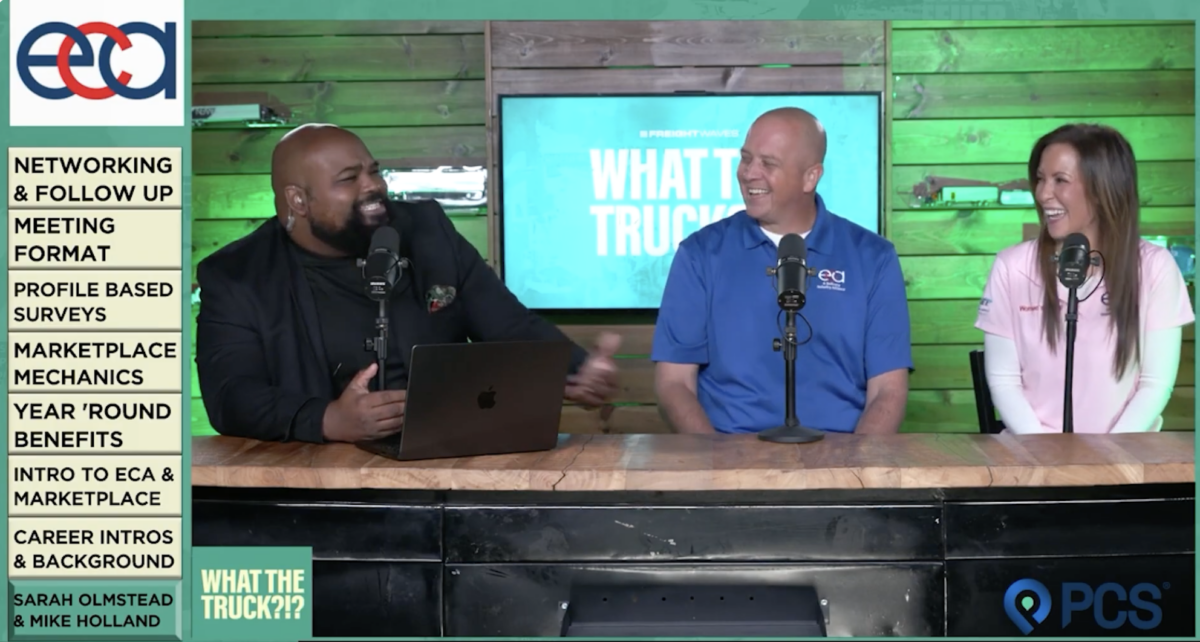
Find Lasting Partnerships Through ECA MarketPlace
The ECA MarketPlace uses structured 12-minute meetings and a pre-event matching survey to connect shippers, carriers and vendors who are serious about doing business. "Every true partner that we work with in the industry came out of ECA," said Five Below’s director of domestic logistics. If your carrier development process relies on load boards and cold outreach, this event is worth a closer look.
Learn more → |
FMCSA warns against buying and selling MC numbers as underground market persists
A new FMCSA bulletin makes the agency’s position explicit: USDOT numbers and MC operating authorities cannot be bought, sold or leased outside legitimate corporate transactions. Violations can trigger inactivation of the USDOT number, revocation of operating authority and cancellation of registrations. The guidance directly addresses a documented underground market where authorities are advertised online, sold in "carrier packages" alongside email accounts and dispatch contacts, or quietly transferred between operators. One investigation found an individual willing to sell their MC number to the first buyer arriving with $20,000 in cash. With more than 1.8 million USDOT-registered entities and limited investigative capacity, enforcement at scale is a structural challenge. Real action typically follows only after a major incident or formal complaint.
So What? A valid MC number is no longer sufficient evidence of legitimate authority control. Brokers and shippers should tighten carrier vetting now. Warning signs including sudden contact changes, reactivated authorities with thin histories, and insurance mismatches appear during onboarding, not after a load is missing.
Read the full story →
Sponsored By SONAR
The State of Freight: Global Disruption and the Freight Market Reset
Between tightening driver regulations, Middle East conflict and a spot market turning in carriers’ favor, the data behind the freight market reset is moving fast. SONAR’s State of Freight event breaks down what the numbers mean for your business and where the market goes from here.
Register now → |
|
|
 |
|
Sponsored Insight
|
Presented by Descartes

Vesta Freight Drives 18x Shipment Growth with Descartes TM Solutions
A unified transportation platform helped Vesta Freight streamline operations, strengthen its carrier network and drive 18x growth in shipment volume. When the technology infrastructure is right, scale compounds. Read the case study to see how Vesta got there.
Read the case study → |
|
|
|
From the Research Desk
|
In partnership with Trimble
2026 Outlook: Spot Market Strategies for Shippers, Carriers, and Brokers
Trimble and FreightWaves surveyed shippers, carriers and brokers on how they’re approaching spot freight in 2026. With the TL linehaul index at a near-3-year high and capacity tightening from the supply side, the question isn’t whether spot will matter — it’s whether you have a strategy for it.
Download the full report → |
|
In partnership with Avalara
Supply Chain Strategies for an Uncertain Trade Environment
Tariffs, geopolitical tension and rapid regulatory shifts are reshaping cross-border supply chains faster than most procurement teams anticipated. FreightWaves and Avalara outline the adaptive strategies that supply chain professionals are deploying to maintain resilience against external shocks.
Download the full report → |
|
In partnership with Descartes
2026 TMS Buyer’s Guide
Selecting the wrong TMS is one of the most expensive operational mistakes a mid-market shipper or 3PL can make. Descartes’ 2026 guide breaks down the capabilities, integration requirements and evaluation criteria that separate platforms built for scale from those that won’t keep pace with growth.
Download the buyer’s guide → |
|
Courtesy of S&P Global Market Intelligence
The Age of Agility: Seeking Advantage Amid Uncertainty
S&P Global identifies three strategic themes shaping 2026: adapting to trade realities, shaky economic foundations and shifting asymmetric power in geopolitics. In a market where global disruption is the operating condition, this framework helps organizations convert risk into competitive positioning.
Download the report → |
|
|
Upcoming Event
FreightWaves 3PL Summit: Partners Through the Freight Cycle
March 18, 2026 | FWTV — Online Event
A premier online event for third-party logistics providers, freight brokers and industry intermediaries navigating the shifting dynamics of the freight market. Join tomorrow for a full day of intelligence on what the freight cycle reset means for 3PLs in 2026.
Register Here → |
|
|
|
What We’re Watching
▸ Whether diesel erodes the rate recovery for owner-operators. Fuel is up $1.05 per gallon in two weeks. The TL linehaul index is near a 3-year high, but most owner-operators can’t recover spot-market fuel swings through surcharges. Watch whether net margins hold — the rate recovery story is real, but it carries a fuel cost asterisk.
▸ The IMO emergency meeting on March 18-19. Twenty thousand maritime workers remain trapped in the Persian Gulf. Nations have rejected Trump’s naval escort request. If the IMO produces any coordinated framework for vessel extraction or a shared risk assessment, it could shift insurer and carrier calculus on resuming Gulf operations. If the meeting produces nothing, the carrier fee structures that began hardening this week will continue to do so.
▸ Broker and shipper response to FMCSA’s MC number bulletin. The policy is clear; enforcement at scale is not. Watch for technology providers and load boards to announce updated carrier identity verification tools as a direct response. Brokers that don’t update onboarding procedures now will be answering harder questions after the next cargo theft incident — and that timeline is shorter than most compliance teams assume.
|
|
|
That’s your Daily for today. See you tomorrow.
Was this forwarded to you? Subscribe here | Have a tip? Just reply to this email.
FreightWaves 405 Cherry St., Chattanooga TN 37402
Unsubscribe | Forward to a Friend | FreightWaves.com
|
|