|
View this email in your browser

THE DAILY
Wednesday, June 3, 2026
The five minutes that makes you the most informed person in freight today
|
|
Newsletter Brought to You By — Chevron
|
|
The Daily
Bot Auto recruits a freight veteran to build the autonomous trucking network that actually works
Completing a humanless commercial load on a public highway is the easy part. Turning that milestone into a repeatable, scalable freight business and that’s where most autonomous trucking companies have stumbled. Bot Auto is betting it won’t, and the hire it just made tells you exactly why.
Brett Suma is joining as president and chief operating officer, alongside David Stemm as VP of commercial operations and Jessica Kane as VP of commercial finance. The three co-founded TrailerHawk.ai, which Wabash acquired in 2025, and they are now reuniting at Bot Auto to tackle the hardest problem in the AV space: not making the truck drive itself, but making the network around it profitable. Suma spent nearly three decades in trucking, including formative years at Knight Transportation during its explosive growth phase in the early 2000s — precisely the experience Bot Auto needs right now.
The Knight playbook Suma learned was formulaic by design: identify corridors with sufficient freight density, match them to a driver population, build supporting infrastructure for 125 to 150 trucks per market. Bot Auto strips out one variable entirely. "The one great benefit that we have at Bot Auto is that we don’t have to really worry about the driver population piece from a support perspective in order for us to scale," Suma said. "But the freight still has to work for us and the market still has to be able to support the amount of investment in tractors." Same network-design discipline, no driver recruiting problem. The math changes substantially.
Suma is direct about what separates Bot Auto from competitors retrofitting autonomous tractors onto existing operations. Traditional drivers average 7 to 8 hours of actual drive time during an 11-hour shift because origin-destination pairs don’t align efficiently. Deploying expensive AV assets into the same broken network doesn’t fix the underlying inefficiency — it inherits it. Mixed-fleet dynamics make this worse. A carrier with a 12-year veteran who owns the Houston-to-Phoenix lane will give Johnny the load over the autonomous truck every time. "None of those are good outcomes," Suma said. Bot Auto sidesteps the conflict by starting clean: no legacy network, no driver priority conflicts, every freight decision optimized for autonomous deployment from the first mile. "We’re building a native AI freight network," Suma said. "Deploying physical AI as opposed to saying, ‘We already have this network that exists and now we’re going to figure out how to make AV work in it.’"
The near-term plan is methodical. Bot Auto is targeting 2026 milestones in Texas — growing its autonomous fleet, increasing humanless trips, expanding lane coverage corridor by corridor. "Texas is the ideal starting point, and we’re thinking corridor by corridor until we’ve built something the traditional trucking model simply can’t compete with," Suma said.
So What? The autonomous trucking question has shifted from "can the truck drive itself?" to "can you build a network that makes it worth deploying?" Bot Auto’s answer is purpose-built corridors, not retrofitted fleets. Carriers watching the AV space should pay attention to which lanes Bot Auto targets in Texas — those corridors will tell you where the company thinks autonomous economics first close. Shippers on those lanes may face a different pricing dynamic than their current contract structures assume.
Read the full story →
|
|
|
Top Stories
|
Texas resumes non-domiciled CDL issuance for H-2A agricultural workers
The Texas Department of Public Safety is once again processing commercial driver’s license applications for temporary agricultural workers on H-2A visas, after receiving federal approval under revised FMCSA rules. Texas suspended the program earlier this year to review compliance with updated federal requirements — the same review that prompted California, Washington, Colorado and Pennsylvania to pause their own non-domiciled CDL programs. Eight other states have also received approval to resume. H-2B and E-2 guidance is still pending.
So What? The scale of the underlying change is the real story. FMCSA projects the non-domiciled CDL population will fall from 200,000 today to roughly 6,000 as existing licenses expire, which is a 97% reduction. Texas alone has issued more than 51,000 non-domiciled CDLs over the past decade. Carriers dependent on H-2A-credentialed drivers for agricultural hauls need to understand which licenses are still valid and for how long.
Read the full story →
|
 |
Border Patrol arrests 36 commercial truck drivers in Arizona immigration operation
U.S. Border Patrol’s Yuma Sector arrested 52 individuals during Operation Checkmate (May 11-15), 36 of whom were operating semi-trucks. Of those drivers, 29 held CDLs issued by California, New York, Washington and Virginia. Thirty of the arrested drivers were Indian nationals; the remaining six were from Mexico, El Salvador and Russia. A parallel Oklahoma enforcement operation, "Operation Guardian," identified more than 600 truck drivers as allegedly unlicensed, improperly trained or in the country illegally — and uncovered what authorities called "pop-up" trucking schools issuing fraudulent CDLs.
So What? Federal CDL enforcement is no longer a paperwork exercise, it’s producing arrests and fleet disruptions. Carriers that use owner-operators or lease-on drivers should treat license verification as an ongoing compliance function, not a one-time onboarding step.
Read the full story →
|
Sponsored by Trimble
With tender rejections at cycle highs and contract rates rising, shippers who don’t have a clear read on where rates are headed in Q2 are operating blind. The Q2 2026 Shipper Rate Report, presented in partnership with Trimble and backed by SONAR’s proprietary datasets, gives you the rate and demand outlook built by FreightWaves’ market analysts, including key themes to watch this quarter, shipper survey insights, and specific takeaways for navigating the current cycle. Download your complimentary copy →
|
The case for RPS as the greatest transportation startup ever built
With FedEx having just spun off its Freight division, ShipMatrix founder Satish Jindel — a key member of the original RPS start-up team — makes the case that FedEx wouldn’t be a major parcel player today without the 1998 Caliber System acquisition that brought RPS into the fold. FedEx Express delivered 3 million packages a day when the deal closed; RPS handled 1.3 million. Today, FedEx Ground (the renamed RPS) moves 13 million pieces daily against Express’s 1.8 million. Since rebranding in 2000, FedEx Ground generated $333 billion in cumulative revenue at a 12.49% CAGR and $40 billion in operating income at a 12.9% average margin, compared to Express’s 5.6% average margin over the same period. Former FedEx CFO Alan Graf called it "the greatest transportation start-up," and former UPS CFO Kurt Kuehn credited it with waking up "Big Brown."
So What? RPS pioneered the independent contractor ground delivery model that Amazon, Better Trucks, Jitsu and OnTrac have since copied. Now that FedEx Freight is independent, the remaining FedEx entity is essentially a play on the Ground network, the Chevy that generates a higher margin than the Cadillac.
Read the full story →
|
Manufacturing PMI hits 54.0 as industrial demand drives the freight upcycle
The ISM Manufacturing PMI printed 54.0 in May — its highest reading since May 2022 and the fifth consecutive month above the expansion threshold. New Orders reached 56.8 and 16 of 18 manufacturing industries reported growth, a breadth of expansion that characterizes a self-sustaining cycle rather than a sector-specific bounce. The Logistics Managers’ Index corroborates: May’s 69.5 reading is the second-fastest expansion pace since March 2022, with Transportation Prices at 96.0 — the highest single component reading in the index’s history. Tender rejections printed at 16.99%, the highest of the current cycle. Flatbed rejection rates exceeded 38%, more than double the all-in market rate, driven by data center construction, defense production and reshoring investment.
So What? This upcycle is structurally different from the post-pandemic surge. Orders are concentrated in end markets with multi-year investment horizons — data centers, defense hardware, energy infrastructure — not short-cycle consumer demand. Shippers still pricing off 2024 benchmarks will feel the contract renewal cycle before they see it coming. Carriers are in the best pricing environment since 2022, and unlike that episode, the freight volumes backing these rates are real.
Read the full story →
|
Sponsored by Amazon Supply Chain Services
Supply chain complexity isn’t shrinking and neither is the cost of managing it in-house. Amazon Supply Chain Services offers an end-to-end solution that handles storage, fulfillment, shipping and returns across channels, so brands can focus on the business rather than the logistics of the business. For shippers looking to reduce overhead and reclaim time lost to operational friction, this is worth a look. Learn more →
|
Sponsored by Taylor & Martin
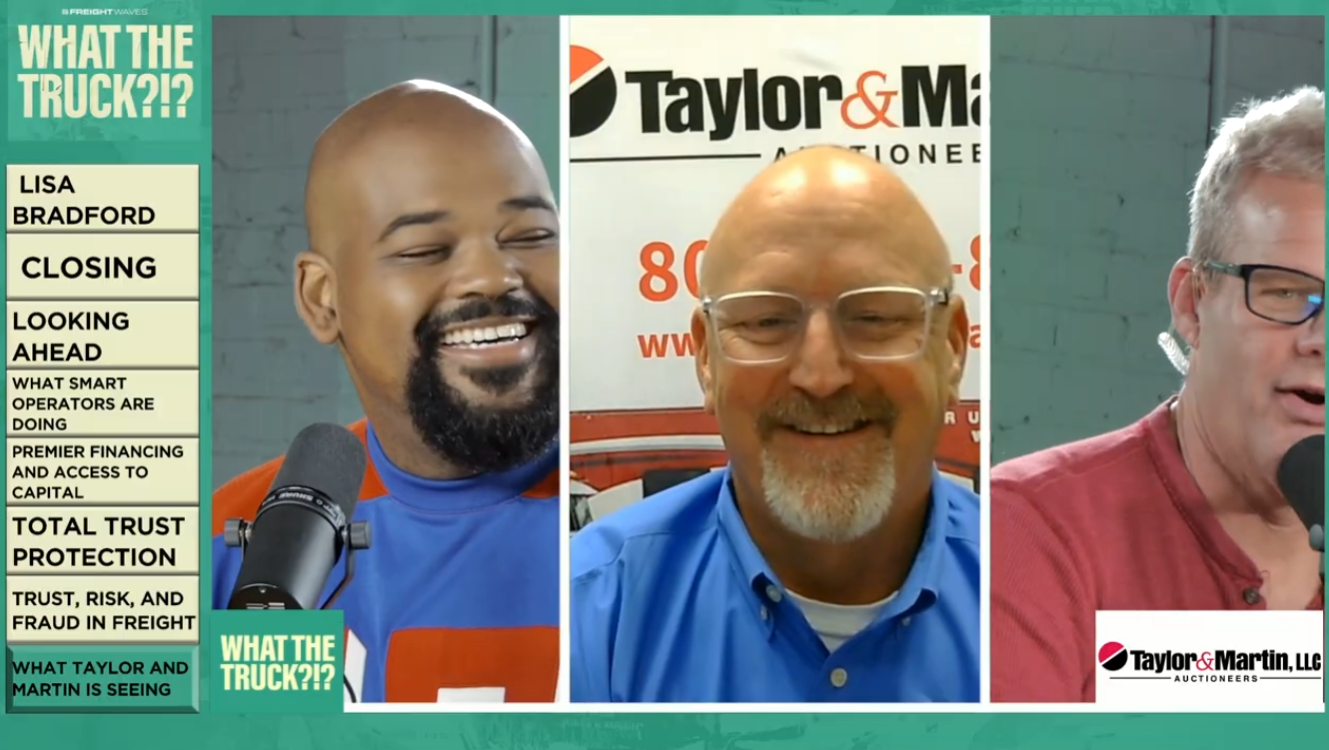
Used truck values are moving off the floor. Steve Oliver, VP of sales and marketing at Taylor & Martin — which sells close to 20,000 pieces of transportation equipment annually across 12 locations — says auction attendance jumped as soon as freight rates started ticking up in early 2026. Owner-operators who sat out the last two years are buying again. With new truck production still constrained from the downturn, limited supply should keep upward pressure on used values through the balance of the year — giving carriers who overpaid during the pandemic a genuine window to sell and recoup. Read more →
|
 |
|
|
FreightWaves Today is brought to you by Samsara
|
 |
|
Samsara AI helps fleets reduce crashes by ~75%. New data from 2,600+ fleets worldwide reveals how Samsara AI helps dramatically reduce crash rates and risky driving behaviors. Get the report now.
Special thanks to our sponsors: Highway, Love’s, OTR Solutions, Pallet, Premier Trailer Leasing, RXO and SONAR
|
|
Today’s Guests
| 12:10 |
Tom Madine — CEO, ShipStation Global |
| 12:30 |
Dennis Monts — President & COO, PayCargo Labs |
| 1:00 |
Bill Stephens — Editor, Trains Magazine |
| 1:20 |
Harish Abbott — CEO & Co-Founder, Augment |
|
|
FreightWaves Today is LIVE at 12PM ET at tv.freightwaves.com/today and streamed on LinkedIn, FB and X.
|
|
 |
|
|
From the Research Desk
In Partnership with Trimble
2026 Outlook: Spot Market Strategies for Shippers, Carriers, and Brokers
The spot market is no longer a last resort, it’s a deliberate strategic lever. FreightWaves and Trimble surveyed industry participants on how sourcing strategies are shifting as the market tightens, covering contract vs. spot allocation, technology adoption and procurement channels. With tender rejections at cycle highs right now, the findings land at exactly the right moment.
Download the full report →
In Partnership with Avalara
Supply Chain Strategies for an Uncertain Trade Environment
Tariff volatility and regulatory change are no longer exceptional events, they’re the baseline. FreightWaves and Avalara surveyed supply chain professionals on how companies are building resilience and adapting sourcing strategies in a trade environment where the rules keep shifting. If your freight network crosses a border, this one’s worth reading.
Download the full report →
In Partnership with Amazon Supply Chain Services
Solutions That Save: How Amazon’s Supply Chain Services Give Back Time, Money, and Peace of Mind
As logistics complexity grows and margin pressure intensifies, the case for outsourcing non-core supply chain functions is strengthening. This piece from Amazon Supply Chain Services breaks down how shippers are recapturing time and reducing costs by leaning on end-to-end fulfillment solutions.
Read more →
Courtesy of Werner
Werner Doubles Down on Mexico With Asset-Based Intermodal Expansion
As nearshoring reshapes cross-border freight flows, Werner is expanding its Mexico intermodal footprint with asset-based capacity, a bet on durable volume growth in one of freight’s most competitive lanes.
Read more →
|
|
FreightWaves Events
Supply Chain AI Symposium
July 15, 2026 | The Old Post • Chicago, IL
The industry’s leaders are converging in Chicago for one reason: to build a bulletproof supply chain. An intimate, high-stakes gathering designed to discuss the issues and tackle the escalating crisis head-on — past the hype, focused on deployment.
Register Now →
|
|
|
What We’re Watching
▸ Bot Auto’s Texas lane announcements. The company says it’s building corridor by corridor. Which specific lanes it targets next will reveal exactly where autonomous freight economics first close — and which incumbents need to start paying attention.
▸ Non-domiciled CDL expiration dates. FMCSA expects the population to collapse from 200,000 to 6,000 as licenses expire. Carriers running agricultural freight or food supply lanes need to audit their driver rosters now — not when a license check fails at a weigh station.
▸ Flatbed market tightness. Tender rejections above 38% on flatbed aren’t a blip — they’re a function of data center construction, defense production and reshoring investment, all of which have multi-year runways. Shippers with exposed flatbed capacity in the contract renewal cycle should move sooner rather than later.
|
|
|
That’s your Daily for today. See you tomorrow.
Have a tip? Reply to this email.
Subscribe to The Daily | Forward to a Friend | Unsubscribe
FreightWaves • 405 Cherry St., Chattanooga TN 37402
|
|