|
View this email in your browser

THE DAILY
Friday, June 12, 2026
The five minutes that makes you the most informed person in freight today
|
|
Newsletter Brought to You By — Chevron
|
|
The Daily
TIA asks FMCSA to set federal carrier selection standard after Montgomery ruling
The Supreme Court handed plaintiff attorneys a new avenue into freight brokers’ pockets last year. Now the brokerage industry is asking Washington to set the rules before every jury in America does it for them.
The Transportation Intermediaries Association filed a formal petition for rulemaking with the Federal Motor Carrier Safety Administration this week, asking the agency to establish a federal safety standard governing how brokers and shippers evaluate carriers before booking them. The petition — signed by TIA President Chris Burroughs and not yet publicly available but obtained by FreightWaves — is a direct response to the Supreme Court’s ruling in Montgomery v. Caribe Transport II, which stripped away the assumption that a carrier holding a valid MC number was, by extension, safe enough to book.
The stakes are plain in TIA’s own language. "Brokers and shippers continue to face an untenable burden in attempting to evaluate, develop, and apply disparate methodologies and standards (using potentially suspect data) in an effort to discern whether a federally-licensed motor carrier will nevertheless be deemed unsafe according to judges and juries in every state and federal jurisdiction across the country," the petition reads. Montgomery removed the legal floor that federal licensure once implied. Without a replacement standard, every carrier-selection decision a broker makes is potential litigation waiting to happen.
The numbers make the problem concrete. More than 90% of authorized motor carriers currently operate without an FMCSA safety rating, Burroughs noted in his LinkedIn post disclosing the petition. Even for the 10% that carry a rating, FMCSA has acknowledged that its Safety Measurement System data is meant to prioritize enforcement interventions, not to serve as a proxy for a carrier’s overall safety condition. That leaves brokers with a vast carrier pool, minimal FMCSA-blessed guidance, and active legal exposure in every jurisdiction.
What TIA is actually requesting is specific: a federal Safety Selection Standard that tells brokers and shippers whether using a given carrier is "reasonable" based on objective criteria FMCSA determines to correlate demonstrably with safety performance. The proposed criteria are relatively narrow — carriers must be registered under Title 49, meet minimum insurance requirements, and must not have been determined unfit to operate. TIA also asked FMCSA to publish an immediate list of carriers the agency considers high risk. The modernized Safety Fitness Determination rule that dates back to 2015, TIA argues, was withdrawn in 2017 and has stalled since. Small carriers, the petition notes, bear the most collateral damage from risk-averse broker selection practices driven by litigation exposure.
FMCSA deputy administrator Jesse Elison acknowledged at last month’s FreightWaves Freight Fraud symposium in Cleveland that the agency has a key role in the post-Montgomery environment, while also saying it is not a "ratings agency." That framing sets up the tension the TIA petition is trying to resolve.
So What? A federal standard, if FMCSA acts, gives brokers a defensible baseline — carriers that pass the test, and carriers that don’t. Until that standard exists, document every step of your carrier selection process, because that paper trail is your courtroom defense. The petition itself doesn’t change the legal landscape today, but it starts the clock on whether Washington moves faster than the plaintiffs’ bar.
Read the full story →
|
|
|
Top Stories
Craig Fuller: Amazon should buy Forward Air to fill the gap in its LTL network
Amazon opened its LTL network to all businesses this week, and legacy carrier stocks barely moved. But FreightWaves CEO Craig Fuller argues the real play is what Amazon does next: acquire Forward Air, the distressed expedited LTL carrier currently in strategic review, at a $2 billion enterprise value. Amazon’s 30-terminal network competes at the economy, three-to-four-day tier; Forward Air’s 80-airport road feeder network is purpose-built for time-definite premium freight and airport-to-airport linehaul. Fuller’s case is structural — Forward’s Columbus, Ohio central sort at Rickenbacker International sits roughly 100 miles from Amazon Air’s CVG hub, enabling a combined air-and-ground expedited system neither carrier could build from scratch. Forward’s stock trades near $10 on balance-sheet problems, not network problems: operating and EBITDA margins both expanded year over year despite volume declines, and the Omni Logistics overhang that dragged the equity is separable.
So What? For LTL shippers, Amazon’s economy-tier launch alone won’t move rates. A Forward Air acquisition changes that. The first carrier to offer shippers a two-tier national option — economy and expedited — at Amazon’s technology and visibility standard resets the pricing benchmarks for everyone else. Watch the Forward Air strategic review closely.
Read the full story →
Ag retailers warn UP-NS rail merger will raise rates, squeeze captive shippers
The Agricultural Retailers Association is pressing the Surface Transportation Board to block the proposed Union Pacific-Norfolk Southern merger, warning that consolidating four Class I carriers into three will concentrate pricing power over the agricultural supply chain at exactly the wrong moment. ARA President Daren Coppock, writing in Agri-Pulse, said the group’s 5,000-plus retail locations supplying feed, seed, and equipment to farms nationwide are already absorbing rail freight rates that have risen more than 40% over 20 years adjusted for inflation — about 70% faster than truck rates. Two-thirds of all fertilizer for U.S. crops moves by rail. Captive shippers, those served by a single carrier, face the sharpest exposure: past mergers, Coppock argued, "consistently reduced competition, resulting in higher transportation costs and less negotiating leverage." Both UP and NS contend the merger will eliminate interchange delays and improve efficiency.
So What? If you’re a captive ag shipper moving fertilizer or chemicals by rail, the STB comment process is the only near-term lever available. The window to file formal objections and document impacts is now, not after a merger is approved. Shippers not currently captive should model what reduced competition does to your contract renewal terms beginning in 2027.
Read the full story →
Mexico posts record $86B in April trade with U.S. as USMCA renewal hangs in doubt
Mexico extended its run as the largest U.S. trading partner in April with $86.04 billion in two-way commerce, up 23.4% year over year — the highest monthly figure since WorldCity began tracking the data in 2013. Canada ranked second at $64.8 billion; China slipped to fourth at $29.2 billion, one of its lowest rankings in decades as tariffs and supply-chain diversification continue to reshape global trade flows. The record April numbers arrived the same week President Trump said the U.S. may not renew the United States-Mexico-Canada Agreement. "I’m not looking to renew it," Trump told reporters. "We don’t need anything that Canada has. We don’t need anything that Mexico has." USMCA parties must signal intent to renew by July 1. Despite the presidential rhetoric, a second round of U.S.-Mexico talks was scheduled in Washington this week, with additional discussions set in Mexico City during the week of July 20. Port Laredo, the busiest U.S.-Mexico gateway, handled $33.35 billion in April trade — nearly 39% of the total bilateral volume.
So What? The trade flows are real and growing; the policy uncertainty is the variable. July 1 is the date to watch. Cross-border carriers and shippers moving volume through Laredo should be pressure-testing what a renegotiation period does to their capacity, pricing, and compliance infrastructure before the deadline forces the question.
Read the full story →
Sponsored By Link

Industrial Real Estate Is Tightening Again, and Last-Mile Owner-Operators Are First in Line
National industrial availability is declining for the first time since 2021, and new construction starts are at 10-year lows. Link Logistics EVP Glenn Wylie explains why infill small-bay product — availability running at 5.5-6%, well below the national 8-9% average — is the segment to watch as e-commerce demand and data center spillover accelerate absorption heading into the second half of 2026.
Read the full story → |
FreightWaves opens nominations for 2026 AI Excellence in Supply Chain Award
FreightWaves announced the 2026 AI Excellence in Supply Chain Award, to be presented live at the Supply Chain AI Symposium in Chicago on July 15. The award recognizes companies deploying AI across two categories: AI Solution Providers (technology vendors and FreightTech startups building AI tools for logistics) and Operational AI Integration (carriers, 3PLs, shippers, and forwarders who have put AI to work inside their own operations and can show measurable results). Nominees will be judged on innovation, effectiveness, and real-world impact. The nomination fee is $450 and the deadline is 5 p.m. ET on July 10.
So What? If your company has deployed AI that delivers measurable supply chain results, nominations close July 10. The award is presented in front of the operators and investors shaping AI adoption across logistics.
Read the full story →
Sponsored By Amazon Relay

Amazon Relay Tackles Freight Fraud, Adds Safety Rewards Ahead of Prime Day
Prime Day is moving to June this year, which means the window to position for Amazon’s biggest volume surge is right now. Amazon Relay’s direct-tender model, layered driver verification, and new dashcam-based safety rewards program — up to $0.04 per collision-free mile on up to 400,000 miles — give carriers a reason to look twice at the platform. New carriers who complete seven loads by July 11 earn $1,500.
Read the full story → |
Brought to You By Trimble
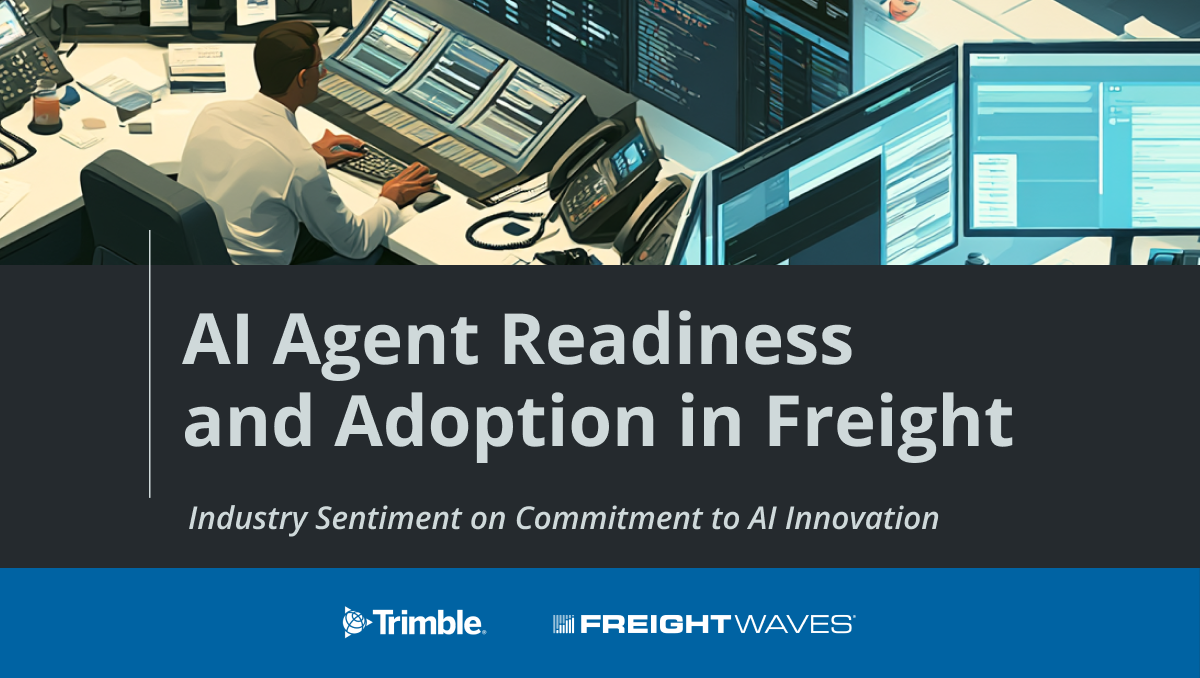
White Paper: AI Agent Readiness and Adoption in Freight
FreightWaves and Trimble surveyed carriers, brokers, shippers, and owner-operators on where AI adoption stands today, what’s slowing implementation, and where organizations are actually investing. The results reveal the gap between AI ambition and operational reality across the freight industry.
Download the report → |
|
 |
|
|
FreightWaves Today is brought to you by Samsara

Samsara AI helps fleets reduce crashes by ~75%. New data from 2,600+ fleets worldwide reveals how Samsara AI helps dramatically reduce crash rates and risky driving behaviors. Get the report now.
Special thanks to our sponsors: Highway, Love’s, OTR Solutions, Pallet, Premier Trailer Leasing, RXO and SONAR
|
Today’s Guests
12:00 PM ET — Drew Wilkerson, Chairman & CEO, RXO
12:30 PM ET — Thom Albrecht, Chief Revenue Officer, Reliance Partners
|
FreightWaves Today is LIVE at 12PM ET at tv.freightwaves.com/today and streamed on LinkedIn, FB and X.
|
|
|
From the Research Desk
|
In Partnership with Trimble
2026 Outlook: Spot Market Strategies for Shippers, Carriers, and Brokers
FreightWaves and Trimble surveyed shippers, carriers, and brokers on how the spot market fits into 2026 procurement strategy. The findings show an industry treating spot not as a last resort but as a deliberate tool for managing flexibility, cost, and capacity — directly relevant as contract bid cycles accelerate and tariff disruptions put a premium on agile sourcing.
Download the full report → |
|
In Partnership with Avalara
Supply Chain Strategies for an Uncertain Trade Environment
With USMCA renewal in doubt and tariffs continuing to reshape global sourcing, this FreightWaves/Avalara white paper maps how supply chain professionals are building resilience against rapid regulatory change. With the July 1 USMCA deadline approaching, it’s timely reading for anyone managing North American trade flows.
Download the full report → |
|
Courtesy of Amazon Supply Chain Services
Solutions that Save: How Amazon’s Supply Chain Services Give Back Time, Money, and Peace of Mind
Amazon Supply Chain Services offers flexible, end-to-end logistics support — from AI-powered demand forecasting to dynamic inventory placement — designed to eliminate the tradeoffs between cost, speed, and reliability. Learn how consolidating to a single provider can cut overhead and reduce returns.
Download the full report → |
|
Courtesy of Werner
Werner Doubles Down on Mexico with Asset-Based Intermodal Expansion
Werner is scaling an asset-based intermodal service into Mexico — Werner-owned containers, C-TPAT protocols, and 27 years of cross-border expertise — to meet what its leadership sees as a structural shift in North American supply chains. With record FDI flowing into Mexican manufacturing, transit times approaching truck-like performance, and capacity constraints at the border intensifying, the timing for intermodal adoption is compelling.
Read the full story → |
|
|
|
Upcoming Event
Supply Chain AI Symposium
July 15, 2026 | The Old Post Office • Chicago, IL
The industry’s leaders are converging at The Old Post Office for one reason: to build a bulletproof supply chain. An intimate, high-stakes gathering designed to move past the hype and tackle how AI is actually being deployed in freight and logistics operations.
Register Now → |
|
|
|
What We’re Watching
▸ FMCSA’s response timeline on TIA’s carrier selection petition. The agency acknowledged a post-Montgomery role at last month’s Freight Fraud symposium but hasn’t committed to rulemaking. Until a federal standard exists, every broker’s carrier-selection documentation is its courtroom defense. Watch for a formal agency response or Congressional action before year-end.
▸ Forward Air’s strategic review outcome. The carrier has been in review since January 2025. Craig Fuller’s analysis names Amazon as the logical buyer, but private equity is also circling the expedited LTL asset. A deal announcement before year-end reshapes the LTL competitive picture — watch for a transaction or a standalone restructuring in Q3.
▸ USMCA’s July 1 renewal deadline. Trump said the U.S. may not renew. Mexico posted a record $86 billion in April trade with the U.S. The second round of talks was scheduled this week. Cross-border shippers should be modeling the renegotiation scenario now, before the clock forces the decision.
|
|
|
That’s your Daily for today. See you tomorrow.
Was this forwarded to you? Subscribe here | Have a tip? Reply to this email.
FreightWaves 405 Cherry St., Chattanooga TN 37402
Unsubscribe | Forward to a Friend | FreightWaves.com
|
|