|
View this email in your browser

THE DAILY
Monday, February 23, 2026
The five minutes that makes you the most informed person in freight today
|
|
|
Newsletter Brought to You By — J. J. Keller
 |
As a leader in safety and compliance for the transportation industry, J. J. Keller protects people and the businesses they run®. Learn More.
|
|
|
|
|
The Daily
Mexico’s most-wanted cartel boss is dead. Your cross-border freight is exposed.
The Mexican military killed Nemesio Oseguera Cervantes, known as “El Mencho” and ranked by the U.S. government as the most dangerous drug trafficker in the world, in a federal operation in Tapalpa, Jalisco, on Sunday. By nightfall, western Mexico was on fire.
Roadblocks, burning vehicles, and armed clashes erupted in Jalisco, Michoacán, Colima, and Guanajuato within hours of the Jalisco New Generation Cartel (CJNG) leader’s death. At the Port of Manzanillo, a critical gateway for Asian container imports into Mexico, port authorities initially announced operations were “suspended until further notice.” The cargo most exposed: automotive parts and electronics routed inland through Guadalajara. Mexico’s Secretariat of the Navy later denied any closure, but the conflicting statements left shippers, carriers, and brokers managing inbound container freight with no clear answer. Guadalajara’s airport descended into chaos. Flights at Puerto Vallarta and Manzanillo were canceled.
The freight impact is immediate and concentrated in western Mexico. “The security situation in western Mexico is a significant disruption to freight,” said Veronica Gonzalez, who leads Mexico operations for C.H. Robinson. Gonzalez told FreightWaves that roadblocks “have cut off some of the region’s most important freight corridors, including the routes connecting the Port of Manzanillo to Guadalajara and moving freight northeast,” as carriers hesitated to send drivers into active conflict zones. Truckload capacity in the region tightened fast.
The longer concern is succession. El Mencho left no clear heir — his brother and son are in U.S. federal custody, his daughter also behind bars. When a cartel with CJNG’s territorial reach loses its leader with no obvious successor, regional bosses fill the vacuum through force. That power struggle typically means sustained, expanding violence across freight corridors, not a swift return to normal.
For supply chains running through Mexico, the risk geography is specific. The U.S. Embassy has issued shelter-in-place advisories for Jalisco, Tamaulipas, parts of Michoacán and Guerrero, and Nuevo León — corridors that collectively move the bulk of cross-border freight. Operations teams with Manzanillo exposure need to be on the phone with their Mexico freight providers today, not tomorrow.
So What? The killing of El Mencho is a law enforcement victory with an unknowable aftermath. Any supply chain with Manzanillo exposure carries elevated risk until CJNG’s power structure settles. Automotive parts, electronics, and consumer goods routed through Guadalajara are the primary exposure categories. That timeline is anyone’s guess. Which is exactly the problem.
Read the full story →
|
|
|
Top Stories
Judge clears UPS to pay 105,000 drivers $150,000 to walk away
A federal judge dismissed the Teamsters’ request to block UPS from rolling out $150,000 voluntary buyouts to its full-time package car drivers, ruling that arbitration provisions in the existing contract can address the union’s concerns. UPS can now begin notifying its 105,000 eligible drivers this week, with voluntary separations scheduled to start at the end of April. The Teamsters expect roughly 10,000 drivers to accept. The program is dramatically more attractive than UPS’s first buyout last fall, which offered $1,800 per year of service and drew just 3,000 takers.
So What? UPS cut 34,000 frontline positions in 2025 and is targeting 30,000 more in 2026, driven by a 50% reduction in Amazon volume. The Teamsters won historic wages in their 2023 contract. Now those wages make it easier for UPS to justify paying workers to leave rather than carrying underutilized headcount. The outcome sets precedent for every unionized carrier restructuring ahead.
Read the full story →
Trucking reform’s opening bell rang last week. The full fight takes years.
On Feb. 20, Transportation Secretary Sean Duffy and Federal Motor Carrier Safety Administration (FMCSA) Administrator Derek Barrs delivered what analysts called the most aggressive enforcement announcement the trucking industry has seen in years. It was an opening bell, not a finish line. Insurance reform requires legislation. The SAFE Act, targeting the chameleon carrier problem, is moving through Congress with ATA support and bipartisan appeal — but it still needs committee approval, a floor vote, and a signature. Rulemaking layered on top of that legislation extends the implementation timeline further still.
So What? The non-domiciled CDL rule is the cautionary benchmark. FMCSA skipped the public comment process on an earlier version, lost in court, and spent years redoing it properly. The final rule published Feb. 13 — and drew a new legal challenge one day later from the same coalition. Skipping the process doesn’t save time. It costs it.
Read the full story →
82% of Mexico cargo thefts are violent. The West region is accelerating.
Overhaul’s 2025 Annual Cargo Theft Report found that 82% of robberies against Mexican truckers involved violence. The State of Mexico and Puebla together accounted for 38% of all national incidents. The more significant trend is geographic: the West region, which includes Jalisco, grew its share of national thefts by 7% in 2025. Trucks in motion remain the primary target at 64.1% of incidents, while parked-truck thefts rose 11.9% year over year, many occurring at roadside diners and clandestine fuel stops. Auto parts theft climbed 3%, fuel 3%, and electronics 2%.
So What? That 7% growth in the West region was the pre–El Mencho baseline. With CJNG in a leadership transition and rival factions moving to expand their turf, western Mexico’s cargo theft environment gets worse before it improves. Cross-border supply chains with automotive and electronics exposure should be reassessing their Mexico risk profiles now.
Read the full story →
2026 may be the year TL carriers take back pricing power
Supply-side discipline is reshaping the truckload market before demand has fully recovered. Carriers trimmed fleets through three years of downturn, pivoted capacity toward dedicated contracts, and now face regulatory constraints tightening the driver pool — English-language proficiency rules, non-domiciled CDL restrictions, ELD enforcement crackdowns, and driver school closures. “The capacity environment is more fragile than at any point over the past two years, and a modest spike in demand and/or continuation of capacity exits could lead to rate volatility in 2026,” said Jared Weisfeld, chief strategy officer at RXO. Analysts are forecasting spot rates up roughly 8.1% year over year, with peak gains near 13.5% in Q4.
So What? Supply-side tightening alone doesn’t sustain a recovery — demand has to show up. But it sets a shorter fuse. Shippers who haven’t locked in 2026 contract rates are entering negotiations at the wrong time, against carriers who cut capacity on purpose and have no reason to give ground.
Read the full story →
|
|
|
Sponsored Insights
|
Presented by Werner Enterprises
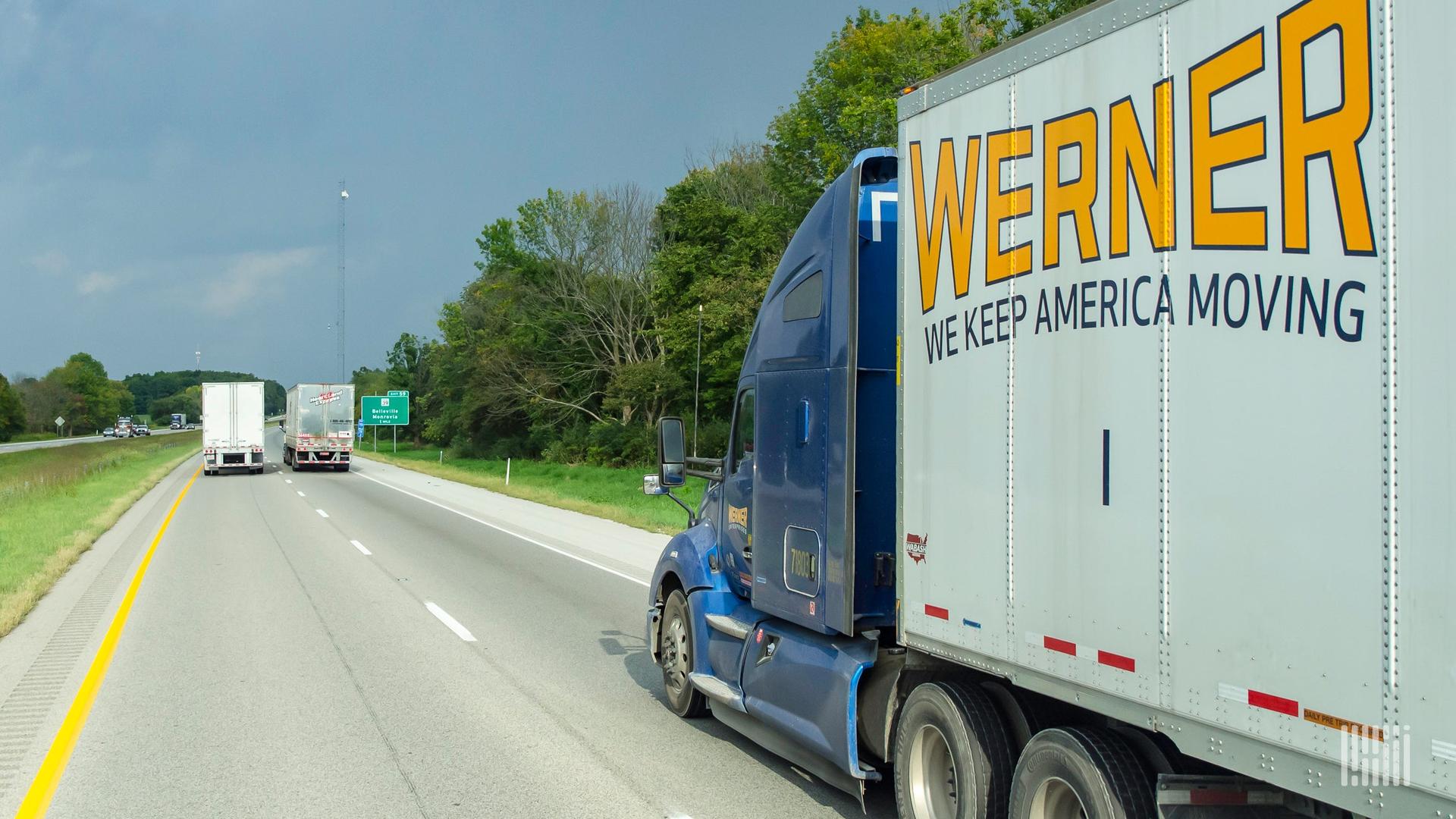
Capacity Is Tightening. Dedicated Fleets Lock In Service Before the Crunch.
As one-way truckload capacity shrinks and regulatory enforcement thins the available driver pool, shippers relying on the spot market are running out of room. Werner — now the fifth-largest dedicated provider in the U.S. after its acquisition of FirstFleet — offers dedicated fleet solutions backed by the EDGE® technology platform, which powers nearly 90% of Werner’s dedicated trips. Fixed service levels, predictable costs, and a compliance buffer in a market where carrier reliability is the new competitive advantage.
Learn more about Werner Dedicated → |
|
|
|
From Our Library
|
In Partnership with Ryder
State of the Industry: February 2026
Ryder’s latest State of the Industry report benchmarks fleet performance, maintenance trends, and cost pressures shaping 2026. A useful baseline for fleet operators and shippers gauging where the market stands as the cycle turns.
Download the full report → |
|
In Partnership with Trimble
2026 Outlook: Spot Market Strategies for Shippers, Carriers and Brokers
Trimble’s 2026 spot market outlook models rate scenarios across the cycle turn. If you’re managing procurement or carrier pricing strategy heading into a tightening market, this is the framework to work from.
Download the full report → |
|
In Partnership with Avalara
Supply Chain Strategies for an Uncertain Trade Environment
Tariff policy remains unpredictable and cross-border compliance demands are growing. Avalara’s guide breaks down how to protect margins when trade rules keep shifting — relevant reading given today’s Mexico situation.
Download the full report → |
|
|
|
From Our Partners
|
Courtesy of LJM Logistics Managed
Cost Transformation 2026: A Guide to Integrated Shipping
LJM Logistics Managed walks through the operational and financial levers shippers can pull to reduce total shipping costs in 2026 — from carrier diversification to technology integration. Actionable guidance for procurement teams entering a tightening market.
Download the full report → |
|
Courtesy of Descartes
2026 TMS Buyer’s Guide
Choosing a transportation management system in this market means balancing cost control, compliance visibility, and real-time carrier data. Descartes’ buyer’s guide breaks down what to prioritize and what to avoid in 2026.
Download the full report → |
|
Courtesy of S&P Global Market Intelligence
The Age of Agility: Seeking Advantage Amid Uncertainty
S&P Global Market Intelligence examines how leading shippers and logistics providers are building adaptive supply chains designed for disruption, not just efficiency. Today’s Mexico situation is a real-time case study in why agility matters.
Download the full report → |
|
|
|
Upcoming Event
FreightWaves Roadshow
March 3, 2026 | Charlotte, N.C.
From AI integration to fraud prevention and a full array of pressing industry topics, you’ll gain the exclusive intelligence needed to protect your margins and scale in 2026.
Register Here → |
|
|
|
What We’re Watching
▸ Western Mexico freight corridor stability. How quickly violence settles after El Mencho’s death will determine the scope of disruption to Manzanillo port operations and Guadalajara-bound freight. Watch for updates from Mexico’s Secretariat of the Navy and carrier advisories out of Jalisco this week. Manzanillo-to-Guadalajara lanes are the primary risk zone.
▸ UPS/Teamsters buyout rollout. With the court ruling clearing UPS to proceed, the Teamsters’ next move is arbitration. Watch for union communications to membership about whether to accept or decline the $150,000 offer. The outcome sets precedent for parcel labor negotiations across the industry, and 30,000 more positions are still on the line in 2026.
▸ TL contract rate negotiations. Carriers trimmed capacity on purpose and have little incentive to give ground. Watch for Q1 contract rate announcements from public carriers in the next 30 days. Shippers who haven’t locked in 2026 rates are entering a tightening market at exactly the wrong time.
|
|
|
That’s your Daily for today. See you tomorrow.
Was this forwarded to you? Subscribe here | Have a tip? Just reply to this email.
FreightWaves 405 Cherry St., Chattanooga TN 37402
Unsubscribe | Forward to a Friend | FreightWaves.com
|
|