|
View this email in your browser

THE DAILY
Tuesday, May 26, 2026
The five minutes that makes you the most informed person in freight today
|
|
Newsletter Brought to You By — Amazon Supply Chain Services
|
|
The Daily
FMCSA’s enforcement overhaul is pushing non-compliant capacity out of trucking
The freight market is voting with its rates.
SONAR’s National Truckload Index (NTI.USA) climbed above its COVID-era highs over the past week, reaching $3.58 per mile as of Monday. FMCSA Administrator Derek Barrs says the connection to enforcement is not coincidental. Barrs sat down with FreightWaves CEO Craig Fuller and the “Armchair Attorney” Matt Leffler in Chattanooga this week for a live taping of Freight Expectations, offering the most substantive public account yet of why this administration is producing measurable market impact that previous ones did not.
The governing philosophy is direct. "If we don’t enforce the rules that we have on the books, we can add all that we want to," Barrs said. "But if we don’t enforce the rules that we have on the books, what good are we?" Between 20,000 and 30,000 drivers have been placed out of service for failure to meet the English language proficiency standard since enforcement was reactivated, a standard that has been on the books since 1937, but laid dormant for years by deliberate choice. Last week’s International Roadcheck wrapped with a combined out-of-service rate around 30%, split roughly 20% on vehicles and 10% on drivers. At three and a half million roadside inspections per year, that is not a statistical blip. That is a market-clearing event.
On self-certification, perhaps the structural root of fraud in ELD registration, entry-level driver training, and substance abuse evaluation programs, Barrs drew a hard line. "The self-certification pieces need to go," he said, naming all three as targets. Active federal investigations are underway targeting overseas-operated ELD platforms that enable back-door log manipulation. "FMCSA has active investigations with our law enforcement partners on the federal level," Barrs confirmed. MODUS, the registration overhaul consolidating nine legacy databases into a single verified-identity platform, is already live with known bugs. "I am sorry, but I’m not sorry," Barrs said. "You cannot fix things unless you roll it out, and let’s figure out what the bugs are." That is what a regulator who intends to finish the job sounds like.
The freight downturn that began in mid-2022 was built on a 28% capacity expansion that arrived during a demand collapse. That overhang defined the market for nearly three years. What NTI.USA is reflecting now is not a demand surge; it is the enforcement environment finally removing non-compliant capacity from the system at scale. Higher insurance minimums, full ELDT reform, MODUS at full scale, and sustained proficiency enforcement are all still in progress. Barrs has two and a half years left on his tenure. None of these have run to completion.
So What? Compliant carriers are already seeing the benefit in rates. Shippers still pricing off 2024 benchmarks need to recalibrate now: the supply side of this market is structurally tighter than it was six months ago, and the enforcement posture driving that tightening has not peaked. Budget for the market that’s in front of you, not the one from last year.
Read the full story →
|
|
|
Top Stories
|
|
Atlanta-based fulfillment platform Stord announced a $250 million Series F on Tuesday, doubling its valuation to $3 billion in 12 months. The company manages e-commerce logistics for more than 1,000 brands and plans to launch Stord Labs — a development hub training agentic AI and robotics on live fulfillment data from nearly 100 facilities. Gross merchandise value on the platform has hit $15 billion, a 50% jump since late last year. CEO Sean Henry’s thesis: give independent brands the infrastructure to match an Amazon Prime experience without handing Amazon the customer relationship or the data.
So What? Brands shipping fewer than a few million units annually should watch this carefully. If Stord’s vertically integrated tech-plus-logistics model scales as investors believe, the economics of building vs. buying fulfillment infrastructure shift sharply against the patchwork 3PL-and-software approach most independent brands built post-pandemic.
Read more →
|
 |
|
A jury in Ector County, Texas, returned a $49 million verdict last week against OPG Logistics in the January 2025 death of 29-year-old Steffan Mick, killed when the truck made an unsafe left turn. Both OPG and driver Biorkys Sanchez Fernandez were found grossly negligent. The jury awarded $40.5 million in compensatory damages and $8.5 million in punitive. The defense had requested a $5 million cap. OPG does not appear in FMCSA’s SAFER WEB database, and the defense told the court the company may no longer be in business.
So What? The collectability problem doesn’t erase the judgment; instead, it shifts to insurance and remaining assets. With the Cornejo SCOTUS ruling now exposing freight brokers to negligent hiring liability, a carrier that doesn’t show up cleanly in SAFER WEB has become a liability risk for every party in the transaction. Brokers and shippers need to treat invisible-carrier risk as a hard disqualifier, not a yellow flag.
Read more →
|
|
One week after the Supreme Court’s 9-0 decision in Montgomery v. Caribe Transport II, which held that federal law does not preempt state negligent hiring claims against freight brokers, spot rates have hit record levels. Large brokerages are pulling back from non-domiciled CDL drivers. Enterprise shippers are pausing broker relationships to reassess liability exposure. Insurance premium estimates for brokerage liability are coming in at 3x to 10x current rates. One broker-liability case that had been dismissed was amended this week to add the freight broker back as a defendant. "The era of the broker as a low-liability matchmaker is officially over," Fuller wrote.
So What? Shippers running meaningful spot volume should expect capacity gaps on specific lanes as brokers narrow their carrier pools. Move volume into managed transportation relationships where the vetting burden sits with an operator who has the systems to manage it or accelerate building a direct carrier roster with carriers you’ve already qualified.
Read more →
|
 |
|
Sen. Tom Cotton asked the Justice Department to investigate China-backed last-mile carriers including Gofo, SpeedX, UniUni, and Zongteng subsidiaries, citing data security concerns, subsidized pricing, and potential customs fraud. Logistics analysts acknowledge the carriers are gaining market share against FedEx, UPS, and regional operators through ultra-low cost structures, with analysts disagreeing on whether the national security framing overstates the risk. Hovership CEO John Zendejas argued the concentration of foreign capital in last-mile infrastructure mirrors the TikTok problem: "I think that with package delivery, you could infer consumer buying habits in the same way."
So What? The de minimis closure already disrupted Chinese marketplace volume flows. If DOJ acts on Cotton’s referral, the cost structure underpinning these carriers gets significantly more complicated. U.S. regional parcel operators should be building Capitol Hill relationships now while the momentum exists.
Read more →
|
|
|
Presented by Amazon Supply Chain Services
|
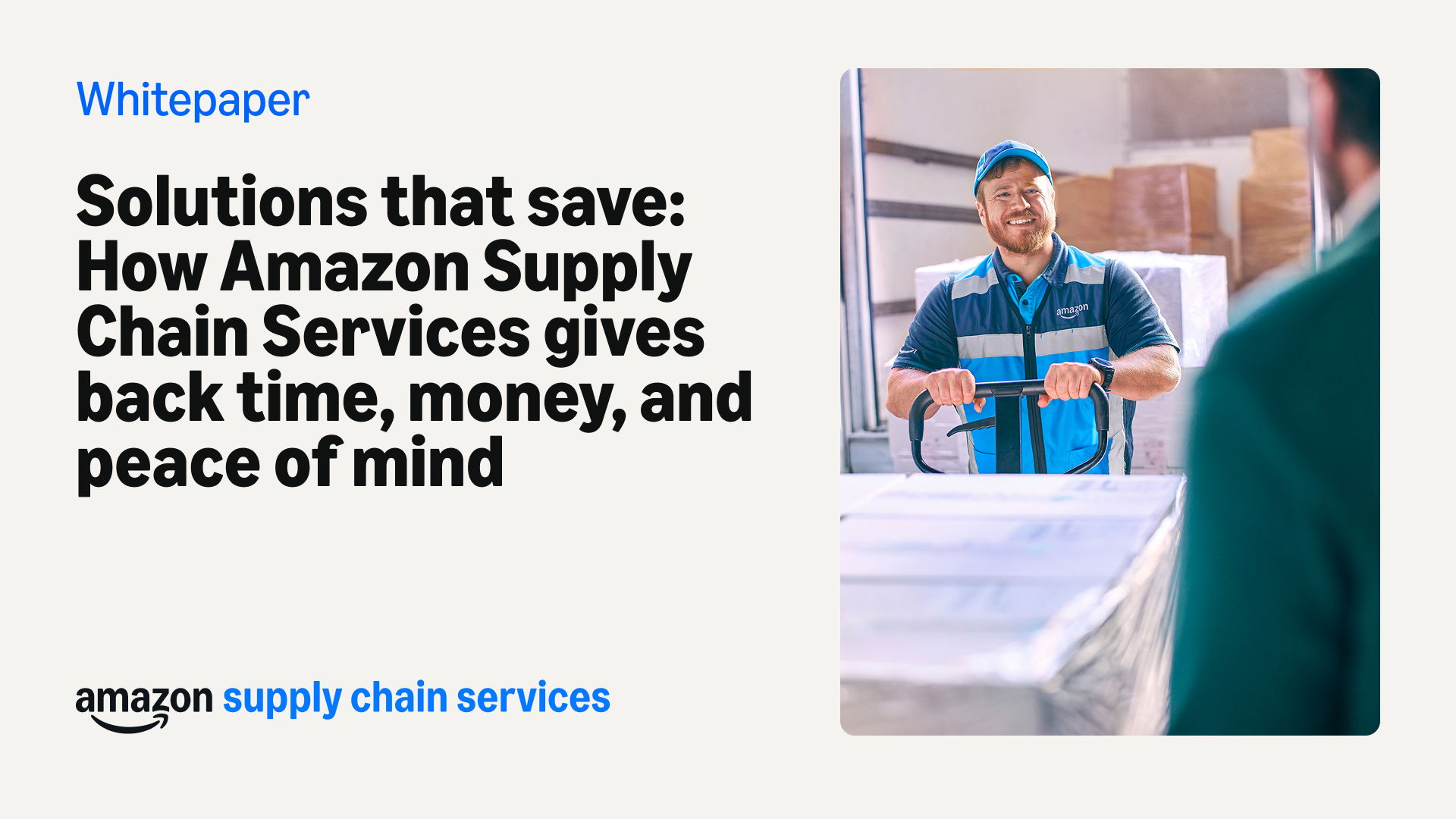 |
Solutions that save: How Amazon’s Supply Chain Services give back time, money, and peace of mind
Managing a supply chain shouldn’t mean choosing between cost, speed, and peace of mind — but for many businesses, it does. Amazon Supply Chain Services (ASCS) offers flexible, resilient logistics support that eliminates those tradeoffs, helping businesses of every size reduce complexity, cut costs, and reclaim time. With access to Amazon’s global infrastructure and no lock-in required, ASCS gives you the freedom to build the supply chain that works for your business.
Read more →
|
|
|
Announcing FreightWaves Today
|
 |
FreightWaves Today, launching June 1st.
The supply chain moves fast. Now your news does too. Craig Fuller and Julie Van De Kamp bring you a daily live show — real-time market analysis and interviews with the leading executives who are shaping freight and logistics. Live every weekday at Noon ET on FreightWaves socials and tv.freightwaves.com/today.
Watch live starting June 1 →
|
|
 |
|
|
From the Research Desk
|
In Partnership with Avalara
Supply Chain Strategies for an Uncertain Trade Environment
The tariff environment keeps moving, and companies that built adaptive sourcing and compliance strategies before the disruption hit are outperforming those that didn’t. This FreightWaves/Avalara research documents how supply chain professionals are navigating rapid regulatory change and continuing to find ways to operate efficiently.
Download the full report → |
|
Courtesy of Werner
Werner doubles down on Mexico with asset-based intermodal expansion
Werner is doubling its owned container fleet in Mexico from 400 to 800 units by year-end as nearshoring demand accelerates. A recent FreightWaves interview with SVPs Nate Browne and Lance Dixon covers how Werner’s C-TPAT protocols, origin-clearance intermodal, and 27 years of cross-border expertise give shippers a differentiated option as cross-border truckload capacity tightens.
Read more → |
|
|
|
Upcoming Event
Supply Chain AI Symposium
July 15, 2026 • The Old Post Office, Chicago
The industry’s leaders are converging at The Old Post Office for one reason: to build a bulletproof supply chain. An intimate, high-stakes gathering designed to discuss the issues and tackle the escalating challenges head-on. Past the hype — join operators, founders, and enterprise leaders deploying AI in supply chain for real.
Register Now → |
|
|
|
What We’re Watching
▸ CORCA in the Senate. The Combating Organized Retail Crime Act has passed the House with 160-plus bipartisan sponsors and is sitting in the Senate. FMCSA Administrator Barrs and FreightWaves’ Matt Leffler both flagged it as the most important cargo theft legislation currently moving. Freight executives with Senate relationships should be using them.
▸ Conditional ratings post-Cornejo. Roughly 300,000 trucks carry an FMCSA conditional rating, and the Cornejo broker-liability ruling has made that rating functionally toxic for carrier selection. FMCSA has limited investigator bandwidth to clear the review backlog. Carriers sitting on conditionals need to initiate the review process now, before the queue gets longer and the market penalty gets worse.
▸ Werner’s Mexico intermodal buildout. Werner is doubling its owned Mexico container fleet from 400 to 800 units by year-end. Record foreign direct investment in Mexican manufacturing over the past three years is converting to freight volume now — watch for cross-border truckload capacity constraints to intensify as demand builds ahead of intermodal infrastructure.
|
|
|
That’s your Daily for today. See you tomorrow.
Have a tip? Reply to this email.
Subscribe to FreightWaves Daily
Forward to a Friend | Unsubscribe
FreightWaves 405 Cherry St., Chattanooga TN 37402
|
|