|
View this email in your browser

THE DAILY
Friday, March 13, 2026
The five minutes that makes you the most informed person in freight today
|
|
Newsletter Brought to You By — Descartes
 |
The #1 freight visibility platform, Descartes MacroPoint delivers real-time tracking via ELD, mobile app, and agentic AI — meet the future of intelligent visibility. Learn More
|
|
|
The Daily
Persian Gulf closure exposes decades of underinvestment in bypass infrastructure
The Strait of Hormuz processes nearly one-third of the world’s seaborne crude oil and handles 33 million TEUs of container cargo each year. A new Drewry analysis has confirmed what port planners have quietly known for decades: there is no real alternative to it.
Drewry senior associate Eirik Hooper’s report takes inventory of every potential bypass option in the region and arrives at a blunt conclusion. "The region’s liner connectivity depth is its greatest strength," Hooper writes, "and, in a closure scenario, its greatest single point of failure." Jebel Ali in Dubai — the busiest container hub in the Gulf and ninth-largest globally, processing around 15.5 million TEUs annually — holds a Port Connectivity Index score of 16.0. A Strait closure would eliminate more than three-quarters of that connectivity immediately. There is no port in the region built to absorb that displacement.
Drewry identified bypass ports with collective latent capacity exceeding 20 million TEUs, a substantial number that shrinks fast once you apply geography and logistics. Khorfakkan, UAE, is the only bypass option with genuinely high utility — 80 miles from Dubai via a two-lane highway, with emergency customs clearance already in place for direct road transfer to Jebel Ali free zones. Beyond Khorfakkan, the math gets ugly quickly. Salalah in Oman carries 3 million TEUs of latent capacity but sits 1,000 miles from Dubai with no rail connection. Trucking a 40-foot container from Salalah costs $3,000 to $5,000. The same move from Jebel Ali costs $200 to $400. Saudi Arabia’s Red Sea ports lack the rail connection to their domestic interior; construction on a planned 600-mile inland freight corridor has not started. Qatar, Bahrain, Kuwait and Iraq have no viable overland bypass routes at all — every alternative requires crossing either Hormuz or Saudi territory.
The transshipment problem compounds everything. Jebel Ali runs a 65 percent transshipment ratio, meaning that cargo losses from a Strait closure extend well beyond UAE gateway trade. Gulf feeder services handling 1.2 to 1.5 million TEUs annually to Kuwait, Qatar and Bahrain can only function if cargo reaches Jebel Ali through Khorfakkan, Fujairah, or Sohar first. Abu Dhabi’s Khalifa Port holds the same 65 percent transshipment exposure. The $1 billion that attracted Cosco and CMA CGM to Khalifa is now effectively stranded. Etihad Rail’s connection to Fujairah provides just 50,000 TEUs per year of bypass relief — a rounding error against the volume at risk.
Hooper’s three-stage outlook is worth reading in full. For the first six months of a closure, severe disruption is the baseline for the upper Gulf states — Qatar, Bahrain, Kuwait and Iraq face acute shortages with no adequate bypass, and food security and reefer cargo are the critical stress points within weeks. Liner operators have already announced emergency surcharges and rerouting costs. Over six to 24 months, logistics costs across the Gulf are expected to rise to three to five times current levels; mitigation exists but it is economically brutal. Beyond 24 months, transformative infrastructure investment becomes possible, including the long-deferred GCC Railway and the Jeddah-Dammam-Kuwait rail corridor. The problem with that timeline is that it is measured in years, and the freight market needs solutions measured in days.
So What? If any portion of your supply chain runs through Jebel Ali or another Persian Gulf port, the Drewry analysis is the clearest map of your exposure. The cost differential between Jebel Ali and every viable bypass is not a rounding error — it is the difference between your current landed cost and a number that could be three to five times as high. Shippers sourcing from Asia with Gulf-region distribution need a disruption scenario on paper today: which bypass port, what trucking cost, what lead time extension, and which product categories would hit food security criticality first. The infrastructure that would make alternatives viable does not yet exist, and no combination of current bypass capacity can fully replace Hormuz access in the short term.
Read the full story →
|
 |
|
|
Top Stories
USTR opens Section 301 probes targeting 16 trading partners over manufacturing overcapacity
The Trump administration launched Section 301 investigations Wednesday into 16 economies — including Mexico and China — over alleged manufacturing overcapacity that the White House argues is suppressing U.S. wages and undercutting domestic investment. The investigations, announced by the Office of the United States Trade Representative, will examine whether government subsidies, state-owned enterprises, or labor practices give foreign producers an unfair advantage. Mexico’s inclusion stands out: it is the top U.S. trading partner at $872.83 billion in 2025 trade, and the probe lands just ahead of the USMCA formal review process. A public comment period opens Tuesday; hearings begin May 5. Officials expect findings in approximately 150 days — roughly the same window as the temporary tariffs imposed under a separate statute after the Supreme Court struck down IEEPA-based duties.
So What? Section 301 is the same legal instrument behind the existing China tariffs, which cover hundreds of billions in goods and have survived multiple administrations. Shippers routing through Mexico and China cross-border lanes now have another regulatory countdown running in parallel with the USMCA review. If tariff authority under IEEPA expires and Section 301 findings generate new duties by fall, the combined trade policy environment becomes the most complex import compliance challenge since 2018.
Read the full story →
Uber Freight first-quarter report: First-tender acceptance at 85 percent, spot rates 25 percent above last year
Uber Freight’s Q1 market update documents a truckload market that is structurally tighter than most shippers planned for heading into 2026. First-tender acceptance has fallen to around 85 percent, down from 92 percent a year ago, pushing rejected shipments down routing guides or into a spot market that is running more than 25 percent above year-over-year levels. Organic supply reductions, weak equipment sales, and regulatory pressures are limiting new carrier entries even as consumer-oriented sectors — retail and CPG particularly — show strengthening freight demand. Industrial sectors remain soft, though manufacturing output and new orders are showing early recovery signals. For LTL, the picture is similarly tight: rates hit record levels even as overall demand has been relatively weak. "Planning cycles are shortening, and flexibility is becoming more valuable than ever," the report said. Cross-border shippers on Mexico and Canada corridors are already running early mini-bids and third-quarter routing guide resets in response to policy-driven disruptions.
So What? A routing guide with 85 percent first-tender acceptance means one in seven loads is already rolling to secondary carriers or hitting spot. Uber Freight’s own recommendation is direct: avoid chasing lowest prices in the short-term, because losing routing guide performance costs more than the initial rate savings. Shippers without a 30-to-90-day lane-level pricing reset already in motion are operating with a guide built for a different market.
Read the full story →
Flexport launches port visibility tool, tariff refund calculator in winter platform update
At a Manhattan event held weeks before the Middle East conflict upended global freight markets, Flexport CEO Ryan Petersen rolled out a winter platform update that has grown more relevant with each passing news cycle. The centerpiece is Flexport Atlas — a free, publicly accessible tool that maps real-time vessel movements, port congestion levels, and terminal activity worldwide. It was built for customers tracking shipment status; the Persian Gulf crisis has made it useful for anyone monitoring global freight flows. Also in the release: a tariff refund calculator designed to help shippers quantify potential duty refunds following the Supreme Court’s IEEPA ruling; a digital routing guide using agentic AI to assign containers based on cost, speed, or allocation preferences rather than static carrier lists; and live translation in Vietnamese, Thai, Korean, Italian, German, and Spanish. Petersen noted the top user of Flexport’s tariff simulator — built ahead of the IEEPA decision and updated within 72 hours of the ruling — is U.S. Customs and Border Protection.
So What? The Atlas tool is worth bookmarking regardless of which forwarder you use — real-time port congestion data has direct operational value when Hormuz-adjacent rerouting is changing vessel schedules in real time. The tariff refund calculator matters if you imported under IEEPA duties; Petersen’s caution is appropriate ("don’t start spending that money") but quantifying the potential exposure now is a reasonable CFO conversation.
Read the full story →
Sponsored By ECA
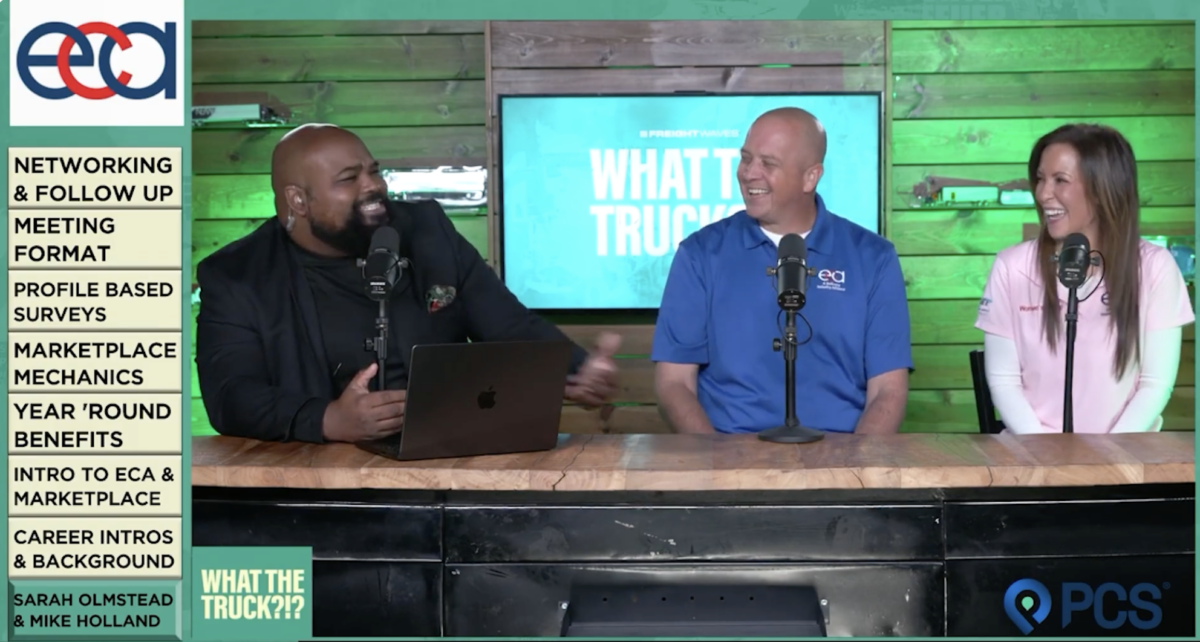
Find Lasting Partnerships Through ECA MarketPlace
The Express Carriers Association MarketPlace uses a survey-driven, timed meeting format that shippers and carriers say produces real business partnerships. "ECA is the conference that I leave with true partnerships," said Mike Holland of Five Below. Every structured 12-minute meeting is matched by survey, so the introductions that matter most get made first.
Learn more → |
Federal proposal would open Pell Grant eligibility to CDL training programs
A Department of Education proposal published this week would make up to $7,395 in annual federal grant funding available to students in CDL training programs lasting 8 to 15 weeks — the first time Pell Grant eligibility would extend to most commercial driver training. The Workforce Pell Grant framework comes with accountability requirements: a 70 percent program completion rate, a 70 percent job placement rate within 180 days of graduation and a tuition threshold tied to graduate earnings. The proposal lands directly on top of the largest federal crackdown on fraudulent CDL schools in the industry’s history — FMCSA removed nearly 7,200 training providers from the national Training Provider Registry between December 2025 and February 2026, including 109 schools that voluntarily withdrew the moment federal investigators showed up. Schools offering programs under eight weeks won’t qualify under the current proposal. The comment period closes April 8; if finalized, the rule takes effect July 1.
So What? Carriers should pay close attention to this comment period — and file comments supporting the accountability metrics as written. Primary liability insurance for owner-operators is already running $14,000 to $22,000 annually per truck, a cost that traces directly to large jury verdicts tied to driver qualification failures. The schools still standing after FMCSA’s cleanup, now eligible for Pell funding if they meet placement and completion thresholds, represent a structurally different training environment from what existed 18 months ago. Pell-funded drivers who chose the profession independently also enter without the locked-in carrier contracts that limit negotiating position for the first 18 months. The downstream quality improvement depends on whether those accountability provisions survive finalization intact.
Read the full story →
Sponsored By SONAR
State of Freight: Global Disruption and the Freight Market Reset
With Hormuz under pressure, tariff architecture shifting, and spot rates climbing, FreightWaves is hosting an in-depth look at what global disruption means for the freight market reset. Join the conversation and get the SONAR-backed data you need to position your business ahead of the next move.
Register now → |
|
|
|
Sponsored Insight
|
Presented by Descartes

Vesta Freight Drives 18 Times Shipment Growth with Descartes TM Solutions
A unified transportation platform helped Vesta Freight streamline operations, strengthen its carrier network, and drive 18 times growth in shipment volume. When the technology infrastructure is right, scale compounds. Read the case study to see how Vesta got there.
Read the case study → |
|
 |
|
|
From the Research Desk
|
In partnership with Trimble
2026 Outlook: Spot Market Strategies for Shippers, Carriers, and Brokers
Trimble surveyed shippers, carriers, brokers and 3PLs on how spot freight fits into 2026 strategies. The results show an industry treating spot not as a last resort but as a deliberate strategic tool — which aligns directly with what today’s first-tender acceptance data is telling us. Any procurement team still working off 2024 contract benchmarks needs a new model before Q2 rate negotiations begin.
Download the full report → |
|
In partnership with Avalara
Supply Chain Strategies for an Uncertain Trade Environment
With 16 new Section 301 trade investigations announced this week and Hormuz disruptions compounding ocean routing complexity, adaptive supply chain strategy isn’t a planning exercise — it’s an operational requirement. Avalara and FreightWaves partnered on this white paper to map how supply chain professionals are responding to rapid regulatory and geopolitical change. Practical frameworks, not theory.
Download the full report → |
|
In partnership with Descartes
White Paper: 2026 TMS Buyer’s Guide
Selecting the wrong TMS is one of the most expensive operational decisions a mid-market shipper or 3PL can make. This guide breaks down the capabilities, integration requirements, and evaluation criteria that separate platforms built for scale from those that won’t keep pace with your growth — covering when to upgrade, how AI is reshaping planning and execution, and what to look for in a long-term partner.
Download the full report → |
|
Courtesy of S&P Global Market Intelligence
The Age of Agility: Seeking Advantage Amid Uncertainty
S&P Global identifies three themes driving 2026 strategic recalibration: adapting to trade realities, shaky economic foundations and shifting geopolitical power. With today’s Hormuz analysis and the new Section 301 trade probes as the backdrop, this report maps how organizations convert the current volatility into competitive advantage. Required reading for anyone in a market-facing role.
Download the full report → |
|
|
|
Upcoming Event
FreightWaves 3PL Summit
March 18, 2026 | FWTV Online Event
Join FreightWaves for the 3PL Summit: Partners through the Freight Cycle — a premier online event built for third-party logistics providers, freight brokers and industry intermediaries navigating a freight market shaped by rising rates, geopolitical disruption, and shifting trade flows. If the current cycle is changing your carrier relationships and customer conversations, this is where you need to be.
Register Here → |
|
|
|
What We’re Watching
▸ Whether bypass ports can absorb Gulf cargo as the disruption extends. Khorfakkan is the only viable short-haul option from Dubai — and its road capacity is finite. Watch for UAE authorities expanding emergency customs clearances at Fujairah and Sohar, and for trucking rates on the Jebel Ali bypass corridors, which will tell you when capacity is saturated.
▸ USTR Section 301 comment filings starting Tuesday. The 16-country probe’s public comment period opens this week, with hearings scheduled to begin May 5. Shippers with Mexico cross-border exposure should treat this as an active regulatory risk, not a future one — especially with USMCA’s formal review process beginning simultaneously.
▸ Truckload capacity and routing guide performance heading into Q2. First-tender acceptance at 85 percent is the current floor, with spot rates 25 percent above last year. If consumer demand in retail and CPG continues strengthening while industrial recovery is delayed, the capacity-demand imbalance tightens further before it eases. Shippers without Q2 lane-level rate resets already in motion are entering the most expensive part of this cycle unprepared.
|
|
|
That’s your Daily for today. See you tomorrow.
Was this forwarded to you? Subscribe here | Have a tip? Just reply to this email.
FreightWaves 405 Cherry St., Chattanooga TN 37402
Unsubscribe | Forward to a Friend | FreightWaves.com
|
|