Ohio reviews 5,000 nonresident CDLs amid federal compliance crackdown
|
|
|
|
This week’s top stories in trucking
|
|
|
|
Kevin Knight Retires From Knight-Swift After Decades at the Helm
|
Kevin Knight retired as executive chairman of Knight-Swift Transportation effective Wednesday, closing a leadership run at the $7.5 billion diversified freight provider he co-founded.
Knight served as chief executive officer from 1994 to 2014 and played a pivotal role in the 2017 merger with Swift Transportation. “For me, our merger with Knight and Swift was our greatest collective achievement,” Knight said. He will serve as a consultant for two years under a $20.3 million agreement, with half payable June 12 and the remainder in monthly installments.
David Vander Ploeg, former Schneider National chief financial officer, has stepped in as chairman. CEO Adam Miller praised the “deeply rooted” culture of safety, operational excellence and financial discipline Knight instilled.
|
|
|
|
Ohio Contacts 5,000 Non-Domiciled CDL Holders Amid Federal Crackdown
|
Ohio is contacting roughly 5,000 non-domiciled commercial driver’s license holders to verify their credentials comply with tightened Federal Motor Carrier Safety Administration (FMCSA) standards issued in September 2025. The review affects a small portion of Ohio’s 406,000 total CDL holders but signals intensifying federal pressure on states.
Drivers whose documentation falls short will have their CDLs downgraded to Class D passenger driver’s licenses 30 days after receiving notice, stripping their commercial driving privileges. Ohio has already halted new non-domiciled CDL issuance and will not renew existing credentials.
California, Washington, Colorado and Pennsylvania have also paused processing of non-domiciled CDLs. New York and California are challenging federal funding threats tied to compliance.
|
|
|
|
DACA Recipient Petitions FMCSA for CDL Eligibility Restoration
|
A California DACA recipient is challenging the Federal Motor Carrier Safety Administration to restore commercial driver’s license access for Dreamers with valid work authorization.
Jenifer Sanchez Vilchis filed an exemption request seeking permission for states to issue Class B passenger-vehicle CDLs to DACA holders. The petition follows FMCSA’s March 16 rule restricting non-domiciled CDLs to specific visa categories, effectively barring most DACA recipients despite their federal employment authorization.
The stakes are significant: Approximately 194,000 of 200,000 current non-domiciled CDL holders face ineligibility under the new standards. Public comments close July 2.
|
|
|
|
Massive Visa Revocations Hit Mexican Truckers Over Cabotage Violations
|
More than 3,200 Mexican truck drivers have lost U.S. entry authorization as federal authorities crack down on cabotage violations across the border region.
The revocations stem from newly merged U.S. Department of Transportation and Customs and Border Protection databases that automatically flag drivers with prior cabotage warnings. Cabotage occurs when foreign carriers haul freight between two domestic U.S. points without authorization.
“The DOT and CBP systems merged, and all operators who had any warnings about possible cabotage were automatically identified,” Pedro Lozano Martínez, president of the Nuevo Laredo Freight Carriers Association, told Agencia Rn Noticias.
The Otay Mesa Chamber of Commerce warns of driver shortages and increased pricing ahead.
|
|
|
|
Texas Supreme Court Shields Shippers From Crash Liability
|
One day after the Montgomery v. Caribe Transport II decision raised alarms about expanded broker liability, the Texas Supreme Court delivered a counterweight for shippers.
In a case stemming from a fatal 2024 Houston crash involving a Werner Enterprises driver transporting Home Depot freight, the court ruled shippers are not liable for a carrier’s negligence. Judge John Phillip Devine wrote that the plaintiffs’ theory “transforms the commonplace act of shipping goods into a basis for sweeping tort liability untethered from control, conduct and risk.”
The ruling reaffirms Texas precedent: Independent contractor liability rests with the contractor, not those who hire them.
|
|
|
|
SONAR spotlight: June volumes resume, but so does tender rejection rates
|
Summary: The first week of June brought an uptick in tender volumes and rejection rates as shippers resumed ordering following the Memorial Day weekend lull. Tender rejection rates continue to rise relative to volumes, underscoring a capacity-driven upcycle in the freight market that is becoming more evident amid these out-of-season gains.
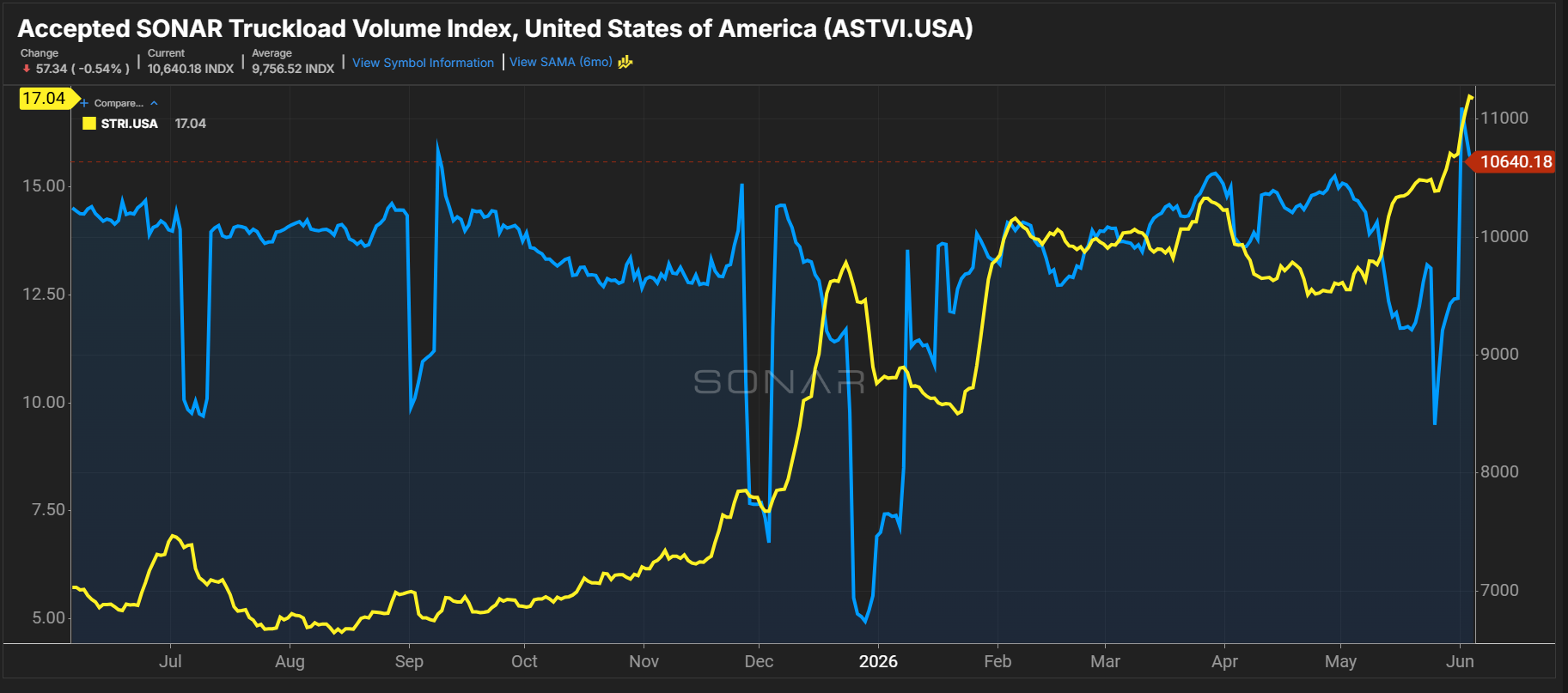
In the past week, the SONAR Truckload Rejection Index (STRI) rose 163 basis points to 17.04 percent from 15.41 percent on May 28. The index stood 391 basis points above the 13.13 percent level a month earlier and 1,131 basis points above the 5.73 percent level a year earlier.
Nationwide outbound tender volumes also increased. The Accepted SONAR Truckload Volume Index (ASTVI.USA) climbed 1,313.63 index points to 10,640.18 from 9,326.55. The index was 333.23 points, or 3.2 percent, higher than 10,306.95 a month earlier and 393.49 points, or 3.8 percent, higher than 10,246.69 a year earlier.
Looking ahead, the market is expected to face continued upward pressure on rates. Freight brokerages and third-party logistics providers that serve smaller fleets and owner-operators booking spot-market loads are under heightened compliance scrutiny. C.H. Robinson last week notified carriers that it was restricting their access to the Navisphere Carrier load board until they meet certain safety criteria.
Separately, a major third-party carrier validation platform reported that customers are requesting more robust filters to vet carriers before tendering loads, reflecting concerns about potential negligence liability in the event of accidents.
This upcycle has been notable. Government regulators are limiting new capacity and removing existing capacity through stricter enforcement. At the same time, the growing risk of litigation over truck accidents is prompting carriers with weaker safety records to be sidelined or exit the market, leaving even fewer trucks available. Rates are likely to remain elevated until the freight market recalibrates to these dynamics.
|
|
|
|
The Routing Guide: Links from around the web
|
|
|
|
FWTV EVENT | JUNE 17, 2026
|
|
|
|
THE OLD POST OFFICE, CHICAGO | JULY 15, 2026
|
|
|
|
Like the content? Subscribe to the Newsletter!
|
|
|
Loaded and Rolling Podcast links:
|
|
|
Download the FreightWaves App
|
|
|
|
|