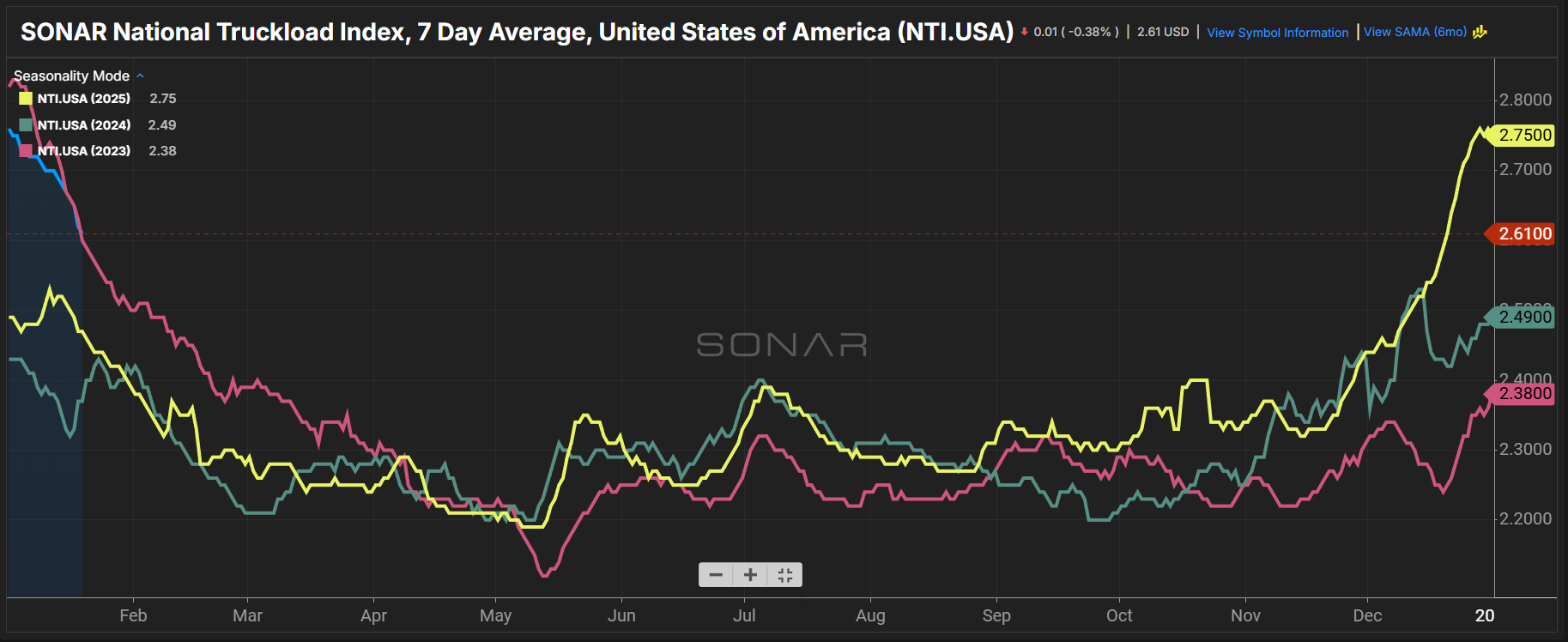
Summary: Spot market rates continue to slide into the third week of January. This decline in dry van rates is in line with seasonal expectations. The SONAR National Truckload Index 7-day average (NTI) fell 9 cents per mile week over week from $2.70 on Jan. 12 to $2.61 per mile. The NTI is flat compared to last month and is 15 cents per mile, or 6.1%, higher than last year.
While spot rates are falling, dry van contract outbound tender rejection rates appear to be leveling off for now. The SONAR Truckload Rejection Index Van (STRIV) fell 20 basis points week over week from 9.28% to 9.08%. The STRIV is 227 basis points lower than last month’s 11.35% but 223 basis points higher than last year’s 6.85%.
The recent Cass Freight Index reading for December noted that weather was one factor that helped create pockets of pent-up demand.
“The three winter storms that hit the Midwest in the first two weeks of December slowed the highway network and created some pent-up demand that was still evident in the spot market in the first half of January,” the report said. “Holiday consumer spending data suggest retail inventories destocked in recent months as freight shipments across modes were below spending trends.”
Looking ahead, absent an uptick in demand, upcoming winter weather could be a catalyst for slowing the gradual seasonal decline—at least temporarily—by reducing available truckload capacity. A major winter storm is forecast to impact the South and East from Friday through Sunday, according to a recent update from the Weather Prediction Center. States in the South are more likely to experience road closures and delayed transits.
There have been similar instances in which major winter weather events prolonged elevated spot market rates. Unfortunately for carriers, winter weather events create temporary spikes, and unlike a hurricane, once conditions warm up or improve, the supply chain will resume at its current demand levels.