Welcome to this week’s Supply Chain Radar, where intelligence moves to the edge, cross-border walls get shorter, and resilience is being rewritten in real time. 📦🌎🤖
Midmo is pushing visibility closer to the physical world with Edge Intelligence, while new U.S.–Canada logistics partnerships are quietly removing friction from cross-border commerce. Meanwhile, PMI is hovering near stall speed, and compliance, tariffs, and consolidation are reshaping how supply chains prepare for what comes next.
👉 Scroll on for edge innovation, cross-border simplification, soft demand signals, safety crackdowns, AI market tremors, tariff shocks, and the leadership moves shaping 2026 strategy.
Owning the Edge: Midmo’s Big Manifest Moment 📦
Midmo unveiled its Edge Intelligence (Ei) modules at Manifest, expanding its mission to “own the edge” for AIDC. Powered by MotionView, the modular suite transforms everyday devices, like handheld RFID scanners, into always-on, AI-enabled visibility systems. From dock doors to cold chain monitoring, Midmo is pushing intelligence closer to where physical work happens.
Straightship and Dragonfly are launching a turnkey cross-border service designed to give U.S. retailers seamless access to Canadian consumers. The partnership combines Straightship’s export and consolidation expertise with Dragonfly’s network reaching 96% of Canada’s population, offering unified customs handling, predictable landed costs, and single-integration simplicity.
Global manufacturing ended 2025 barely above water, with PMI hovering around 50.5—one of the softer readings in the second half of the year. Demand remains cautious heading into 2026, and that hesitation is rippling through air and ocean markets. With pre–Lunar New Year front-loading masking underlying softness, February may prove more fragile than it first appears.
Following years of aggressive investment into electric vehicle technology, the Detroit Big Three—GM, Ford, and Stellantis—are now facing massive combined write-downs. These significant financial adjustments highlight the cooling demand and shifting market realities that continue to challenge the American automotive giants as they pivot away from traditional combustion engines. Learn more here.
Roadcheck 2026: ELDs in the Crosshairs 🚨
International Roadcheck returns May 12–14, with inspectors zeroing in on ELD tampering, falsification, and hours-of-service manipulation. Last year’s 72-hour blitz logged 56,178 inspections across the U.S., Canada, and Mexico, with cargo securement also drawing heavy scrutiny. More than 50,000 falsification violations were recorded by FMCSA in 2025 alone, making compliance discipline non-negotiable this spring.
A $6 million former karaoke company rebranded as an AI logistics platform, and Wall Street panicked. After touting freight volume gains of 300–400%, the announcement sent the Russell 3000 Trucking Index down 6.6%, with broker stocks like C.H. Robinson and Landstar plunging double digits. Analysts call it emotional and overdone, but the message is clear: no sector is “AI resistant” anymore.
Ford Motor Co. took a roughly $2 billion tariff hit in 2025, double prior estimates, after confusion over when auto part levy offsets would take effect. Layer on another $2 billion headwind from aluminum supply disruptions tied to a Novelis plant fire, and costs keep climbing. Even with credits now active, Ford expects another $1 billion tariff impact in 2026.
Hapag-Lloyd is in advanced talks to acquire Zim Integrated Shipping Services for a reported $3.5 billion. The deal would expand Hapag-Lloyd’s global capacity and strengthen its Gemini network with Maersk, though Israel would retain “golden share” control of Zim’s strategic assets. Regulatory approval could push closing into 2027.
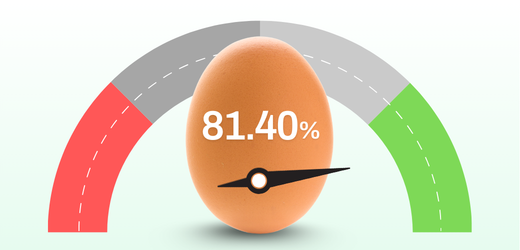
Here’s the scoop on the SCR Egg-O-Meter: It’s a brand-new rating tool that checks out what the media said about business and supply chain execs in the past 30 days and scores them based on the tonality of mentions from a natural language processing algorithm.
The “Egg-o-Meter” is like a quirky kitchen gadget for measuring how well a supply chain leader can cook up success. It cracks open key traits—like adaptability, collaboration, and innovation—and scrambles them into a perfect leadership recipe. The goal? To avoid being a hard-boiled traditionalist or a runny risk-taker. It’s all about being the ideal sunny-side-up mix to lead teams through the ever-changing heat of the supply chain kitchen! 🍳📦
Rob Ferguson and The J.M. Smucker Co. are playing a pivotal role in strengthening modern consumer packaged goods supply chains through leadership realignment, targeted capital investment and operational discipline. Together, their approach reflects a shift toward more integrated, resilient and demand-aligned supply networks.
Ferguson stepped into the newly created Chief Product Supply Officer role in February 2026, consolidating oversight of operations, procurement, distribution and supply chain strategy. The move came during a broader restructuring designed to simplify leadership and sharpen execution across Smucker’s coffee, pet and away-from-home businesses. Having joined the company in 2015 after the Big Heart Pet Brands acquisition, Ferguson built his career inside Smucker through supply chain services, procurement and business leadership roles, giving him end-to-end visibility across sourcing, manufacturing and commercial demand. This integrated leadership model is critical for improving agility, cost control and margin resilience in today’s volatile input and transportation environment.
At the company level, Smucker has reinforced its supply chain through large-scale manufacturing investments and portfolio optimization. The company committed more than $120 million to expand Hostess production in Georgia, part of a broader network redesign that includes closing less efficient facilities and streamlining SKUs to stabilize operations and improve throughput. Additional investments in Kansas pet food manufacturing and prior expansions in Milk-Bone and Uncrustables production further demonstrate a strategy centered on capacity modernization, geographic diversification and automation-driven efficiency.
Beyond infrastructure, Smucker has focused on tightening distribution, refining product portfolios and aligning production with shifting consumer demand. Together, Ferguson’s integrated supply leadership and Smucker’s disciplined capital strategy are strengthening supply reliability, improving operational execution and positioning the company for long-term, resilient growth.
.png?width=1196&upscale=true&name=Header-Image-SCR%20(1).png)