From Aluminum coils to electric rigs: RoadOne deepens ties with Tesla
|
|
|
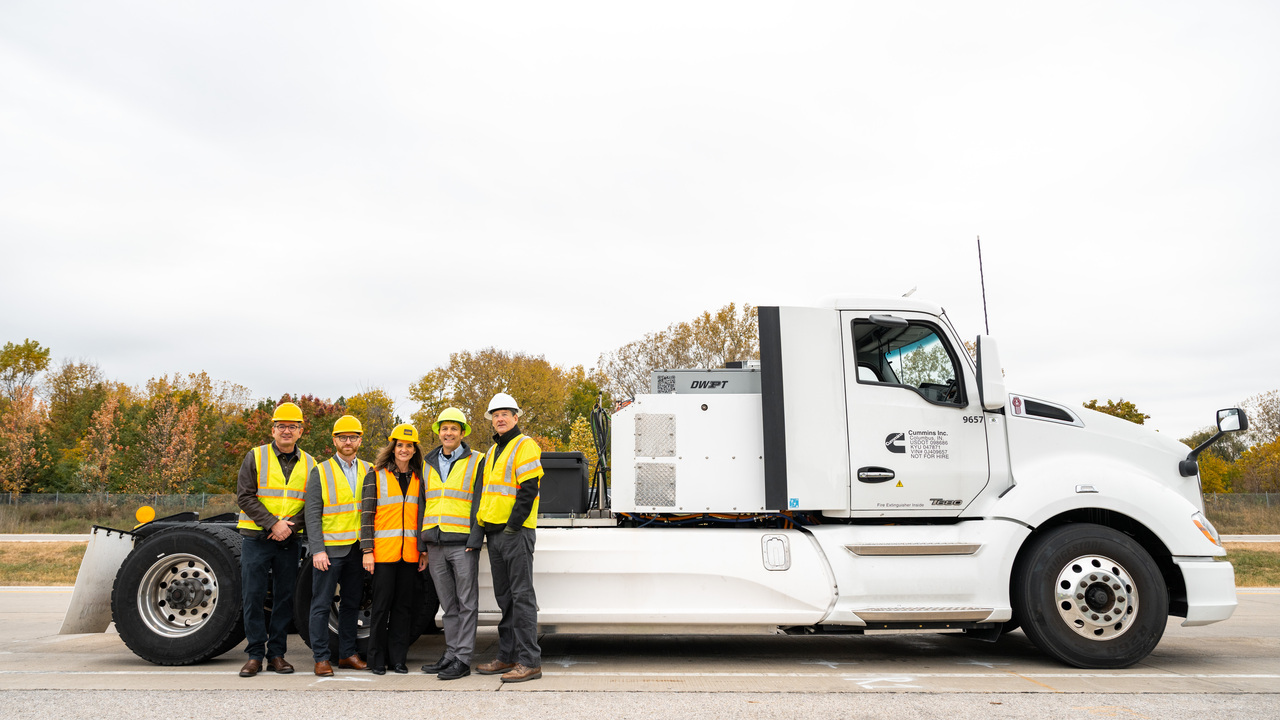
Purdue achieves first U.S. wireless charging of heavy-duty truck at highway speeds
|
(Photo: Purdue University/Kelsey Lefever)
|
Charging an electric truck may soon be easier than plugging it in. Researchers at Purdue University have announced that, for the first time in the U.S., a roadway has wirelessly charged a heavy-duty electric truck while it was driving at highway speeds. Tests on the experimental highway segment used patent-pending systems designed by Purdue engineers.
The segment was built by the Indiana Department of Transportation along a quarter-mile stretch of U.S. 52/U.S. 231 in West Lafayette.
Purdue designed a wireless charging system that operates at power levels much higher than previously demonstrated in the U.S. The test segment in West Lafayette, Indiana, delivered 190 kilowatts to a truck traveling at 65 mph.
It takes a lot of juice to charge a commercial truck. “To put that in perspective, 200 kilowatts are on the scale of about a hundred homes,” said Steve Pekarek, Purdue’s Edmund O. Schweitzer III Professor of Electrical and Computer Engineering, in the announcement.
Read the full article here.
|
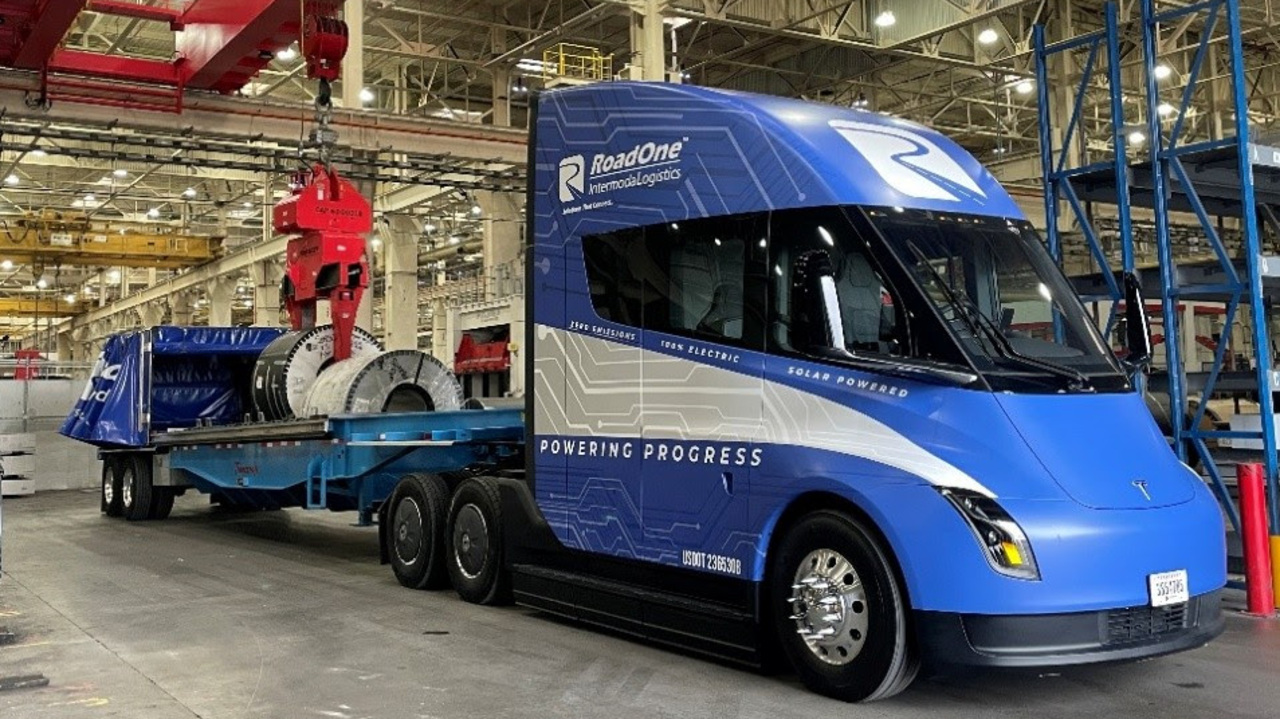
From Aluminum coils to electric rigs: RoadOne deepens ties with Tesla
|
The long-awaited Tesla Semi continues to garner attention with its most recent partnership with RoadOne IntermodaLogistics. The Massachusetts-based company broadened its relationship with Tesla earlier this week with the purchase of a fully electric Tesla Semi.
The company’s relationship with Tesla dates back to 2012, when it began delivering containers of aluminum coils that were then transloaded and shipped to Tesla’s stamping facility in Fremont, California. By 2014, RoadOne created a storage program with Tesla to help with its just-in-time delivery program.
There is growing buzz that this EV semi will be seen as an attractive option for fleets looking to electrify, based on conversations with carriers that have placed preorders for these units.
The partnership reflects a wider trend that may give Tesla a competitive edge: its focus on vertical integration. The Tesla Semi uses in-house 4680 battery cells developed and manufactured at its Gigafactories in Texas and Nevada. The powertrain is also produced in-house at the Gigafactory in Nevada.
Read the full article here.
|
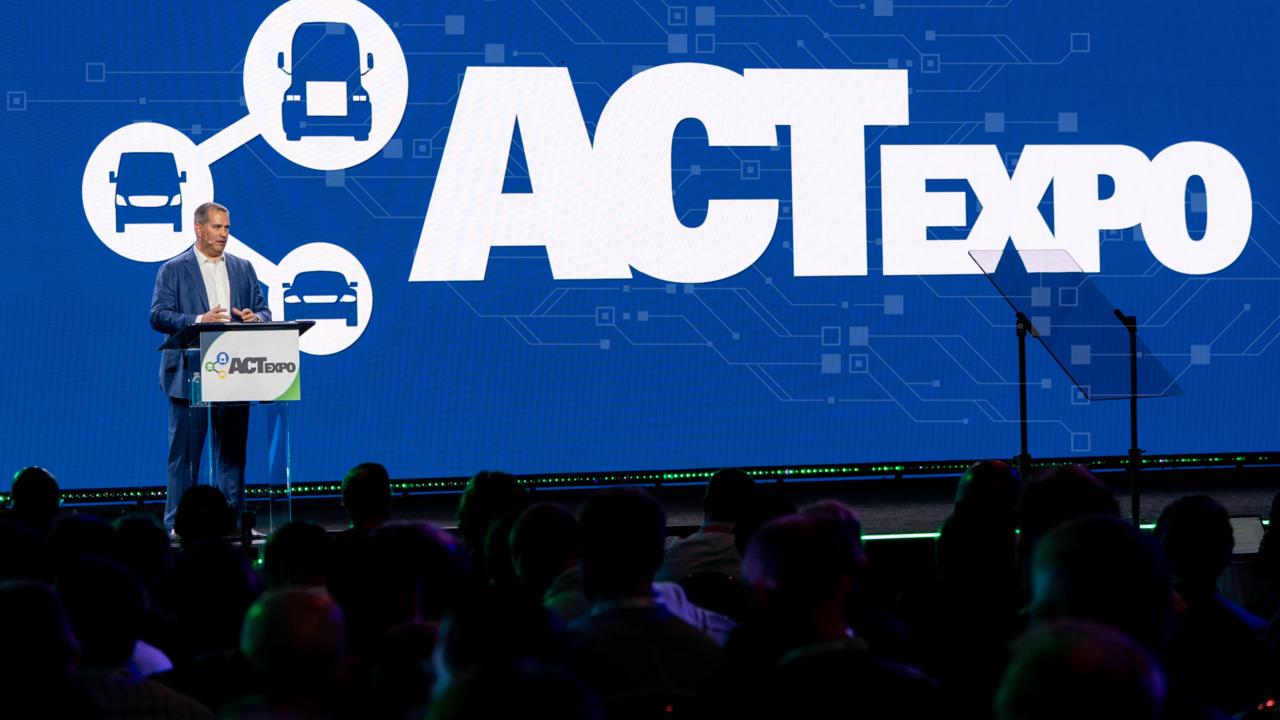
Rivian CEO, Mack Trucks Leader to Keynote ACT Expo 2026
|
ACT Expo, the largest fleet technology conference in North America, has announced its keynote speakers for its upcoming event in Las Vegas. Stephen Roy, president of Mack Trucks and chairman of Volvo Group North America, and RJ Scaringe, founder and CEO of Rivian, will deliver keynote addresses.
The event takes place May 4-7, 2026, at the Las Vegas Convention Center and focuses on new digital technologies defining commercial transportation, in addition to its longstanding focus on zero-emission vehicles.
ACT Expo is massive. The four-day event is anticipated to draw more than 12,000 attendees, including over 2,400 fleet operators, with more than 500 sponsors and exhibitors.
This comes as fleets are seeking ways to navigate higher costs, faster technology cycles and increasing expectations around efficiency, productivity, safety and reliability. The release notes that the keynote conversations will deliver firsthand insights into how OEMs are turning innovation into real-world fleet performance.
Tech leaders in the autonomy sector are also making appearances, including executives from Plus, Kodiak, Aurora, Torc and Waabi.
Read the full article here.
|
|
|
Aurora Innovation and McLeod Software announced Thursday that their planned Transportation Management System (TMS) integration is ahead of schedule and now available. Through an API connection, the integration unlocks autonomous trucking capacity for carriers nationwide. It enables seamless tendering, dispatching and tracking of autonomous trucks. Aurora notes that this is the industry’s first connection between autonomous trucks and a TMS.
FreightWaves’ Rob Carpenter writes about growing concerns over risks posed by Chinese companies that operate U.S. port terminals, manufacture critical equipment used in the U.S. and own farmland next to military bases. Carpenter notes that the FMCSA should establish a registry of carriers approved for defense freight, with background check requirements that go beyond standard CDL vetting.
TechCrunch reports that NVIDIA has launched Alpamayo, a family of open-source AI models that includes models, simulation tools and datasets to train robots and autonomous vehicles. NVIDIA CEO Jensen Huang said at CES, “The ChatGPT moment for physical AI is here – when machines begin to understand, reason, and act in the real world,” adding, “Alpamayo brings reasoning to autonomous vehicles, allowing them to think through rare scenarios, drive safely in complex environments, and explain their driving decisions.”
|
As always, thanks for watching and reading.
Thomas Wasson
twasson@firecrown.com
|
|
|
|