Bennett CIO on 24 years of trucking tech transformation
|
|
|
|
This week’s top stories in trucking
|
|
|
|
Truckload Carriers Gear Up for Multi-year Rate Upcycle
|
The truckload market is primed for a prolonged period of rate increases as regulatory crackdowns purge noncompliant drivers from the industry. Large, well-capitalized carriers are benefiting, while shippers that failed to build sustainable partnerships during the freight recession face significant pricing pressure.
"This industry is behind," said Spencer Frazier, executive vice president of sales and marketing at J.B. Hunt Transport Services. "It’s been four years in a cost-inflationary environment and a rate-deflationary environment."
Routing guides are crumbling as contract rates set early in the 2026 bid season fail to hold. Mini-bid activity has spiked, with carriers now targeting mid- to high-single-digit increases.
|
|
|
|
Bennett’s 24-year Tech Transformation: From Paper Logs to AI
|
When Praveen Boppana started as a programmer at Bennett International Group more than two decades ago, drivers mailed in paper logs weekly. Today, as chief information officer overseeing roughly 4,500 pieces of equipment, he is leading a three-year migration to an AI-powered transportation management system.
The 2017 electronic logging device mandate accelerated change. Bennett adopted Motive early but faced owner-operator resistance. "There was a lot of resentment. They don’t want anything tracking their trucks," Boppana told FreightWaves.
Dash cam adoption proved harder without regulatory backing. Bennett pitched faster exoneration for not-at-fault drivers, covered all costs and made cameras mandatory for new hires.
|
|
|
|
Cross-Border Freight Markets Tighten Faster Than Expected
|
Uber Freight’s Q2 market update warns shippers that peak season conditions are already here. Cross-border rates have jumped 8 percent to 15 percent since February, with some major corridors up nearly 30 percent in two months. Mexico produce volumes through Laredo hit one of the heaviest seasons on record, with March citrus, fruit and nut shipments up more than 36 percent year over year.
Diesel prices at $5.64 per gallon, declining B-1 driver availability and capacity shifts toward reefer lanes are squeezing dry van shippers hard. Uber Freight advises tendering cross-border freight four to five days in advance and securing reefer capacity now.
|
|
|
|
Montgomery Ruling Sparks Cross-Border Carrier Vetting Overhaul
|
The U.S. Supreme Court’s Montgomery v. Caribe Transport II decision dominated the ninth annual Modernization of Cross-Border Trade conference in Laredo, Texas, this week, with more than 500 stakeholders confronting new broker liability realities.
Insurers are now scrutinizing broker-carrier agreements and vetting processes more intensely than ever. "No longer are we in a position to say, as freight brokers, ‘I’ve done my minimum due diligence,’" said Luca Winters of Kuehne + Nagel. "Now we’re all going to have to become experts in how to mitigate risk."
Panelists predicted carrier vetting will become increasingly standardized and technology-driven, with larger brokers gaining market share as customers prioritize risk management.
|
|
|
|
Commerce Duties Could Aid Wabash as Debt Gets Another Downgrade
|
Van trailer builder Wabash National caught a potential lifeline just as S&P Global Ratings downgraded its debt to B- from B, matching Moody’s recent cut. The Commerce Department issued preliminary countervailing duties on van trailer imports from China ranging from 82.3 percent to 128.7 percent — with the steepest levies targeting CIMC.
The American Trailer Manufacturers Coalition, comprising Wabash, Great Dane and Stoughton Trailers, filed the complaint. The coalition estimates imports now average 80,600 trailers annually, up from 48,000 between 2015 and 2017 — roughly 40 percent of the U.S. market from China, Mexico and Canada combined.
S&P Global noted the duties "may be somewhat beneficial over the next several years" if higher import prices make domestic trailers more attractive.
|
|
|
|
SONAR spotlight: Mid-May linehaul rally takes a slight pause
|
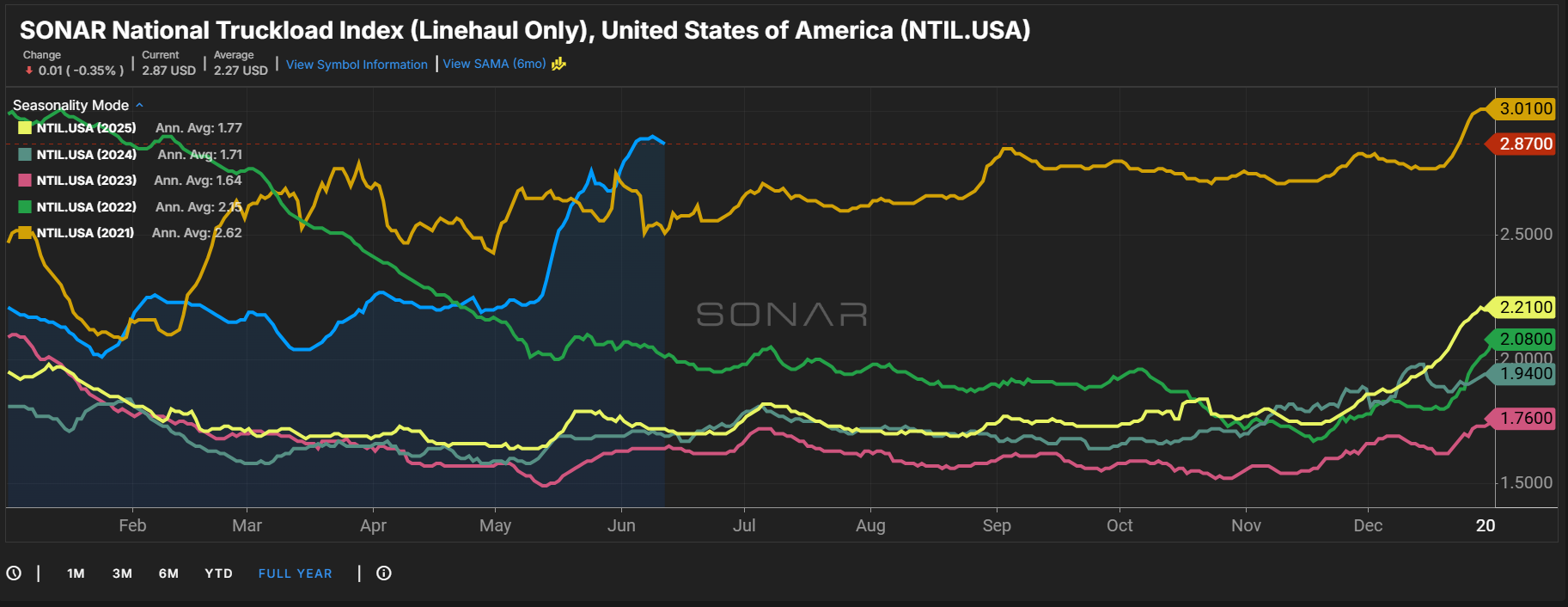
Summary: The spot rate rally that began in mid-May took a temporary pause by mid-June, with linehaul rates remaining at record levels. The SONAR National Truckload Index (linehaul only), or NTIL, fell 1 cent per mile week-over-week from $2.88 on June 4 to $2.87 per mile. The NTIL is 61 cents per mile, or 27%, higher than $2.26 last month. Compared with last year, spot market linehaul rates are $1.16 per mile, or 68%, higher.
Linehaul rates, which exclude fuel, are calculated using the formula NTID minus (DTS.USA divided by 6.5), based on the average retail price of diesel fuel and a fuel efficiency of 6.5 miles per gallon. Linehaul rates serve as a useful directional benchmark for showing the extent of the capacity-driven upcycle. The NTIL stands at a higher rate in June than at any point in the last five years.
The impacts of produce season, paired with higher fuel costs, are causing additional tightening ahead of the summer produce peak. For the trucking sector, commentary from freight brokers provides a picture of the extent of this capacity crunch.
Nathan Adams, vice president of transportation procurement at Uber Freight, told Transport Topics: “What’s unusual is that we’re seeing peak-season behavior before demand has fully ramped. Spot rates are already above contract rates in many lanes, fuel costs are rising and carriers are shifting equipment toward higher-paying produce freight.”
Looking ahead, executives at Traffix believe higher rates lie ahead, at minimum through the end of the year. Alex Fuller, senior director of revenue management and solutions at Traffix, noted in that same article: “You had COVID, you had a bunch of carriers enter the market. We probably got oversaturated, and then over the last two, three, four years, carriers were leaving. … I think it’s pretty safe to say this upcycle in rates is going to continue at least through the end of the year, if not another year or more. This is the new baseline we’re at.”
Amazon represents a wildcard for trucking. In a recent report by Transportation Insight, the company noted: “Amazon’s entry into full-service supply chain and UniUni’s IPO path are signals that the parcel and logistics landscape will look meaningfully different 12 months from now.”
|
|
|
|
The Routing Guide: Links from around the web
|
|
|
|
FWTV EVENT | JUNE 17, 2026
|
|
|
|
THE OLD POST OFFICE, CHICAGO | JULY 15, 2026
|
|
|
|
Like the content? Subscribe to the Newsletter!
|
|
|
Loaded and Rolling Podcast links:
|
|
|
Download the FreightWaves App
|
|
|
|
|