 |
|
|
Welcome to this week’s Supply Chain Radar, where Washington cuts California’s safety checks, Walmart’s pallets get smart, and diesel debates heat up in D.C.
The Trump DOT is freezing $40 million in California safety funds over truck driver English rules, while Walmart rolls out millions of ambient IoT sensors to make inventory tracking instant and precise. Meanwhile, Sen. Cynthia Lummis’ “Diesel Truck Liberation Act” could upend EPA authority—and emissions enforcement along with it.
Scroll on for policy shifts, smart pallets, and supply chain sparks.
|
|
|
|
|
DOT Puts the Brakes of Cali Safety Funds
|
|
|
|
|
The Trump administration’s Department of Transportation is withholding over $40 million from California for failing to enforce new English Language Proficiency (ELP) rules for truck drivers. Transportation Secretary Sean Duffy accused Gov. Gavin Newsom of “obstructing federal law,” citing safety risks from drivers unable to read road signs or communicate with officers. California must adopt and enforce ELP checks to restore its Motor Carrier Safety Assistance Program funding.
Read more about the funding freeze and its impact on California’s trucking sector.
|
|
|
|
|
Walmart’s intros Smart Pallets
|
|
|
|
|
Walmart is launching the largest-ever retail Internet of Things (IoT) rollout, deploying millions of battery-free ambient sensors across 4,600 U.S. locations by 2026. Partnering with Wiliot, the tech powers real-time visibility into 90 million pallets—tracking temperature, humidity, and location to boost AI-driven inventory accuracy and cold chain compliance. The move transforms data from prediction to precision.
Read how Walmart’s ambient IoT is redefining supply chain intelligence.

|
|
|
|
|
|
|
Diesel Truck Act Sparks EPA Showdown
|
|
|
|
|
Sen. Cynthia Lummis (R-Wyo.) has introduced the Diesel Truck Liberation Act, seeking to vacate prison sentences for mechanics convicted of tampering with emissions systems and to strip the EPA of authority over vehicle emissions enforcement. The bill would ban federal mandates on emission control devices, effectively decriminalizing diesel “tuning.” Supporters call it rural justice; critics warn it undermines clean-air progress.
Read more on the proposed rollback of emissions enforcement.
|
|
|
|
|
|
Stellantis Supercharges U.S. Production
|
|
|
|
|
Stellantis is pouring $13 billion into U.S. manufacturing—its largest domestic investment ever—to boost vehicle output by 50% and add 5,000 new jobs across Illinois, Ohio, Michigan, and Indiana. The automaker will reopen its Belvidere Assembly Plant with $600 million, fund EV and SUV upgrades, and launch a new mid-size pickup by 2028. CEO Antonio Filosa called it a “commitment to American growth and jobs.”
Read more about Stellantis’ historic manufacturing expansion.
|
|
|
|
|
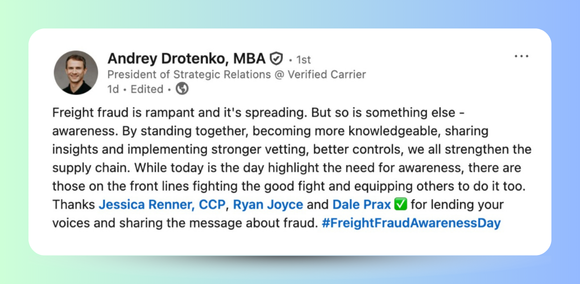
Freight fraud continues to surge—but so does awareness. Verified Carrier’s Andrey Drotenko thanked leaders recently for talking about the issue, sharing insights, and improving controls. Still, we have to ask: Is an awareness day enough to curb the problem? What steps did you or your company take to make others aware?
Check out the post and share your thoughts
|
|
|
|
|
USPS Expands for Peak Season
|
|
|
|
|
The U.S. Postal Service will open 14 new sorting and delivery centers on Nov. 1, with seven in California, as part of its Delivering for America plan. The move consolidates delivery-unit work into larger hubs to boost efficiency and compete with FedEx and UPS. USPS also plans new high-speed sorters that can handle 7,000 packages per hour to improve peak-season performance.
Read more about USPS’s latest network expansion.
|
|
|
|
|
|
|
|
|
|
Nestlé plans to cut 16,000 jobs worldwide—about 6% of its workforce—over the next two years as it accelerates automation and AI adoption. CEO Philipp Navratil said the move aims to save $3.7 billion by 2027, with 12,000 white-collar roles and 4,000 manufacturing jobs on the line. The cuts follow CEO turnover and reflect a broader industry shift toward tech-driven efficiency.
Read how automation is reshaping Nestlé’s global operations.
|
|

|
|
|
3PLs: From Vendors to Visionaires
|
|
|
|
|
A Third-Party Logistics Study reveals a major shift as shippers and 3PLs move from transactional deals to strategic, tech-driven partnerships. Regular performance reviews, AI adoption, and digital supply chain tools are redefining efficiency, with 90% of shippers citing tech capabilities as a top selection factor. Still, cost barriers persist—making co-investment models the new path for shared innovation and growth.
Read how strategy and tech are reshaping 3PL partnerships.

|
|
|
|
|
|
|
Here’s the scoop on the SCR Egg-O-Meter: It’s a brand-new rating tool that checks out what the media said about business and supply chain execs in the past 30 days and scores them based on the tonality of mentions from a natural language processing algorithm.
The “Egg-o-Meter” is like a quirky kitchen gadget for measuring how well a supply chain leader can cook up success. It cracks open key traits—like adaptability, collaboration, and innovation—and scrambles them into a perfect leadership recipe. The goal? To avoid being a hard-boiled traditionalist or a runny risk-taker. It’s all about being the ideal sunny-side-up mix to lead teams through the ever-changing heat of the supply chain kitchen!
Learn more about the meter here.
Ewan Andrew, Diageo – 65.8%
|
|
|
|
|
|
|
|
 |
| Ewan Andrew, Diageo’s President of Global Supply and Procurement and Chief Sustainability Officer, has emerged as one of the world’s most influential supply chain leaders—steering the beverage giant through both environmental recalibration and global disruption. Over his two decades at Diageo, Andrew has guided supply and procurement operations that deliver iconic brands like Guinness, Johnnie Walker, and Smirnoff to more than 180 countries.
Under his leadership, Diageo is rebalancing ambition with realism. In its 2025 Annual Report, the company revised its Scope 3 and packaging sustainability targets to reflect the “complexities of the challenges faced by society and the environment.” The updates—such as shifting its net-zero goal for indirect emissions to 2050 and adjusting recycled packaging content to 50%—reflect a data-driven approach shaped by evolving regulations and market pressures. Andrew describes this recalibration not as retreat, but as refinement: a “stronger, more credible path forward” toward net zero.
These sustainability shifts coincide with supply chain restructuring, including plans to close Diageo’s Crown Royal bottling plant in Ontario to streamline North American operations and move production closer to U.S. consumers. Amid trade tensions and $200 million in annual tariff costs, Andrew’s focus remains on resilience—optimizing inventories, reallocating investments, and leveraging Diageo’s global network to maintain efficiency.
Despite these headwinds, Andrew’s leadership continues to blend operational excellence with sustainability advocacy—ensuring that Diageo’s supply chain remains both profitable and principled in an increasingly complex global marketplace.
Check out past Egg-O-Meter mentions and past newsletters here.
|
|
|
|
|
|
|
|
|
|
|
|
|
|
|
|
|