|
View this email in your browser

THE DAILY
Monday, February 16, 2026
The ten minutes that make you the most informed person in freight today
|
|
The Daily
UPS tells a federal judge to kill the Teamsters’ lawsuit over $150,000 driver buyouts
Transportation capacity is tightening up, but the biggest parcel carrier in the country is trying to pay 347,000 union workers to walk away.
UPS on Friday asked a federal judge to throw out a Teamsters union complaint seeking to block the company from offering $150,000 voluntary buyouts to package car drivers. The company says any concerns can be adequately addressed through arbitration provisions already in the existing contract — and that courts shouldn’t intervene where a meaningful grievance process exists.
The Teamsters, representing roughly 347,000 delivery and warehouse workers, sued UPS last Monday in U.S. District Court in Massachusetts, alleging the pending buyouts violate the national contract ratified in September 2023. The union’s argument: the Driver Choice Program wasn’t negotiated, and anything that changes compensation or separation terms must be bargained collectively. The Teamsters also say UPS is reneging on its contractual commitment to create 30,000 jobs, a quarter of which were supposed to come from moving part-timers to full-time status.
UPS’s position: arbitrators have already ruled that the national master agreement allows agreements with employees that don’t specifically conflict with its provisions, and incentive programs like Driver Choice aren’t addressed in the contract. A federal court in Illinois last year denied a Teamsters local’s injunction against UPS’s first voluntary separation program on similar grounds.
The backdrop is brutal: UPS cut 34,000 frontline positions last year and plans to eliminate another 30,000 this year while closing 24 sort facilities. The driver behind the cuts is a 50% reduction in business with Amazon, its largest customer. The $150,000 buyout offer applies to full-time U.S. drivers regardless of tenure, on top of any pension and healthcare benefits earned.
So What? This isn’t just a labor dispute — it’s a structural reshaping of the parcel workforce. The Teamsters’ 2023 contract delivered historic wage gains, but those gains made UPS less competitive against FedEx, Amazon, and regional carriers paying drivers far less. Now UPS is trying to right-size through buyouts, and the union is fighting to hold the line on headcount commitments that were the core of the deal. The outcome sets precedent for every unionized carrier negotiation ahead.
Read the full story →
|
|
|
Top Stories
International Roadcheck 2026 puts ELDs in the crosshairs — and your compliance calendar just got a deadline
CVSA announced International Roadcheck 2026 will run May 12–14, with electronic logging devices as this year’s primary driver safety focus and cargo securement as the vehicle target. Last year’s Roadcheck produced 56,178 inspections with a vehicle pass rate of 81.6% and a driver pass rate of 94.1% — meaning roughly one in five trucks failed. With ELDs in the spotlight, expect scrutiny on device registration, data transfer compliance, and hours-of-service accuracy. Carriers running older or non-compliant units should audit now, not during Roadcheck week.
So What? The enforcement calendar is stacking up. CVSA’s new out-of-service criteria take effect April 1. International Roadcheck hits six weeks later. If your carrier partners dodge Roadcheck week — and many do — plan for a capacity crunch May 12–14.
Read the full story →
17 changes to CVSA out-of-service criteria take effect April 1 — here’s what small carriers need to know
CVSA has approved 17 changes to the 2026 North American Standard Out-of-Service Criteria, effective April 1. While some updates are technical, several directly affect how drivers and small carriers operate day-to-day. The changes land just six weeks before International Roadcheck 2026, meaning carriers who wait to review the updated criteria are gambling with their on-road compliance. Last year, approximately one out of every five trucks failed its inspection—numbers that could get a lot worse when the rules change and you haven’t read the memo.
So What? April 1 is six weeks out. If you’re a small carrier or owner-operator, the time to review these changes is now — not during Roadcheck week when an inspector is pointing at your truck. The combination of new OOS criteria and an ELD-focused enforcement blitz creates a compliance gauntlet that will catch the unprepared.
Read the full story →
Trucking spot rates are up 23%. Intermodal hasn’t moved. That gap is about to close.
Truckload spot rates are holding around $2.80 per mile nationally — up 23% year over year from $2.33. Tender rejections are hovering near 14%, levels not seen consistently since the post-COVID unwind in 2022. But domestic intermodal spot rates sit at $1.39 per mile excluding fuel, actually down 5% from $1.48 a year ago. The spread between trucking and intermodal has widened dramatically, and that gap is historically unsustainable. As truckload capacity tightens, railroads won’t be able to hold pricing flat forever — expect selective intermodal rate increases, especially on high-volume lanes.
So What? Shippers locked into long-term intermodal contracts may see renewal pressure sooner than expected. The pricing advantage that fueled modal conversion is narrowing. If trucking tightness accelerates — through tariff-driven frontloading or unexpected demand surges — intermodal’s discount could evaporate on key lanes by summer.
Read the full story →
Hapag-Lloyd moves to acquire Zim for $3.5 billion — reshuffling the ocean carrier leaderboard
Germany’s Hapag-Lloyd confirmed it is in advanced negotiations to acquire Zim Integrated Shipping Services, Israel’s national flag carrier, in a deal initially valued at $3.5 billion. Hapag-Lloyd is partnering with Israeli private equity firm FIMI Opportunity Funds on the purchase. A completed deal would delist Zim from NASDAQ, where it went public in 2021 at a $1.5 billion valuation and currently trades around $2.7 billion. The addition of Zim’s 704,000 TEUs to Hapag-Lloyd’s 2.38 million TEU fleet would widen the gap between the world’s fifth-largest carrier and sixth-place Ocean Network Express. Zim employees have protested the deal, citing national security concerns over Saudi and Qatari sovereign fund stakes in Hapag-Lloyd.
So What? Ocean carrier consolidation continues to shrink the number of independent players shippers can negotiate with. If this deal closes, it removes one of the more aggressive spot-market-oriented carriers from the board. Shippers with Zim contracts should be watching for service network changes and rate renegotiation triggers.
Read the full story →
|
|
|
From the Research Desk
2026 capacity is tightening — is your procurement strategy ready?
With rejections climbing, carrier counts shrinking, and spot rates firming across truckload and intermodal, your 2025 benchmarks are already stale. Our latest research breaks down the lane-level data, seasonal patterns, and rate trajectories shippers need to navigate what’s shaping up to be the tightest market since 2022.
Browse the latest research → |
|
|
|
Upcoming Event
FreightWaves Roadshow
March 3, 2026 | Charlotte, NC
From AI integration to fraud prevention and a full array of pressing industry topics, you’ll gain the exclusive intelligence needed to protect your margins and scale in 2026. Don’t pay full price — grab our limited-time "LTL" (Less Than List-price) rate and join the conversation for only $245!
Register Here → |
|
|
|
Sponsored Insight
|
Presented by OTR Solutions

White Paper: The Backbone of the Resilient 3PL — How Automation is Driving Brokerage Success
The freight brokerage industry is at a pivotal moment. Market volatility, rate swings, and cash-flow pressure continue to strain operations, pushing brokerages to strengthen resilience through smarter processes and strategic automation. Learn more in this white paper.
Download the white paper → |
|
|
SONAR Market Movers
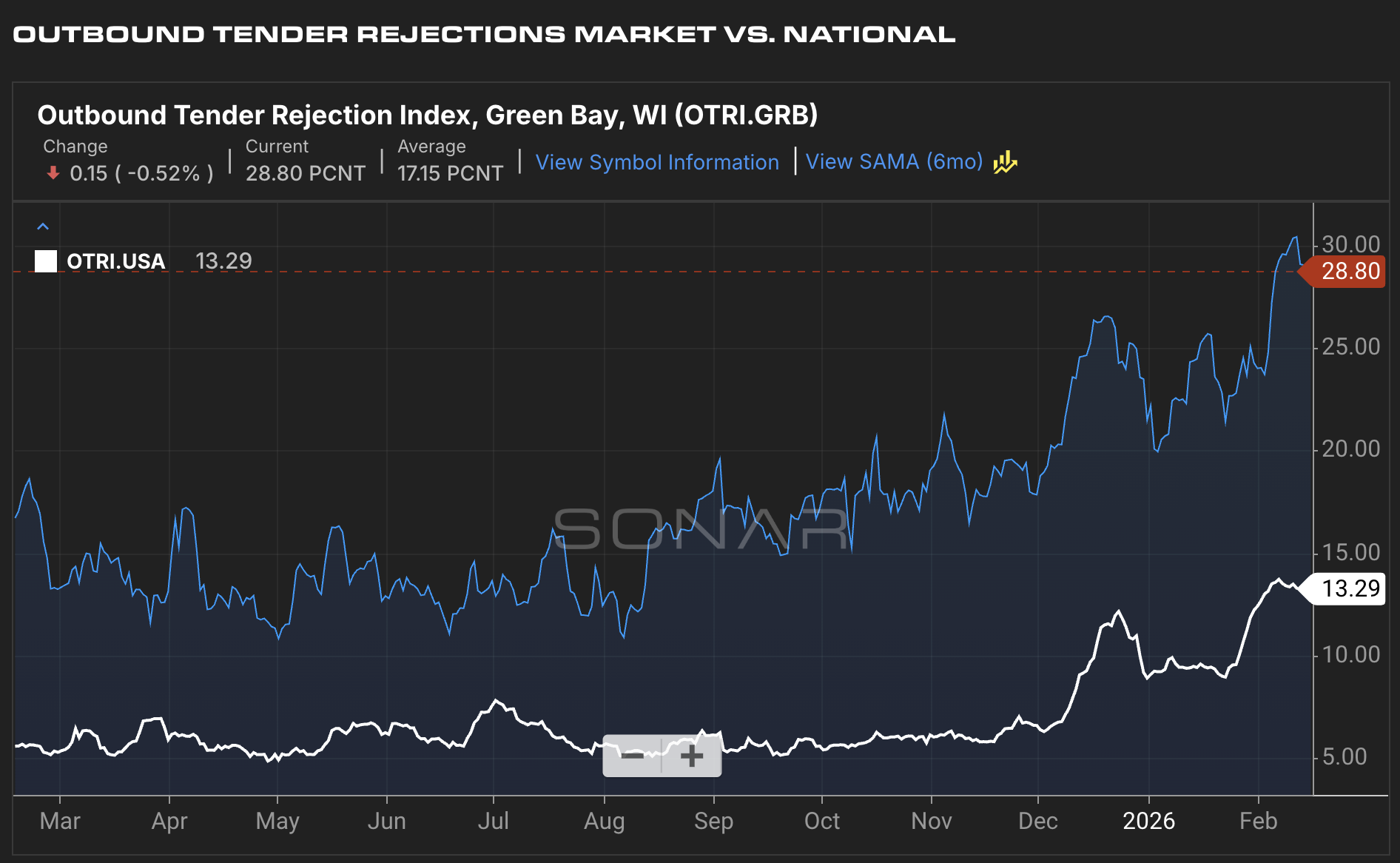
Green Bay continues its climb to the top
Green Bay, Wisconsin, continues to be the market topping the outbound tender rejection chart. Rejection rates are sitting at 29.13% with little change week over week — more than double the national average of roughly 14%. When nearly three in ten loads are being rejected in a single market, that’s not a blip. That’s carriers with pricing power, and shippers in Green Bay are feeling it on every outbound load.
Stay ahead with SONAR →
|
These insights are brought to you by SONAR’s Blue to Blue — freight intelligence on your phone, updated in real time.
|
|
|
|
What We’re Watching
▸ UPS buyout legal battle heads to arbitration — or stays in court. The federal judge’s ruling on UPS’s motion to dismiss will determine whether the Teamsters can block the Driver Choice Program through the courts or whether it gets pushed back to contract arbitration. Either way, 30,000 more jobs are on the line in 2026.
▸ CVSA out-of-service criteria changes take effect April 1. That’s 17 updates carriers need to review before the spring enforcement season ramps up. Pair that with an ELD-focused International Roadcheck six weeks later and the compliance calendar is stacked.
▸ Intermodal rate convergence with truckload. The $1.41/mile gap between trucking spot rates and intermodal is historically wide. If truckload continues firming, intermodal rate increases on high-volume lanes could hit by Q2 — watch for railroad pricing signals in the next 30 days.
|
|
|
That’s your Daily for today. See you tomorrow.
Was this forwarded to you? Subscribe here | Have a tip? Just reply to this email.
FreightWaves 405 Cherry St., Chattanooga TN 37402
Unsubscribe | Forward to a Friend | FreightWaves.com
|
|