Joint venture aims to create a standardized software platform for commercial vehicles
|
|
|
Volvo Group and Daimler Truck partner to launch Coretura
|
(Photo: Volvo Group/AB Volvo)
|
On Tuesday, Volvo Group and Daimler Truck officially launched Coretura, a joint venture dedicated to developing a standardized software-defined vehicle platform for commercial vehicles. The launch followed binding agreements between the two companies, signed in October 2024. By early June, the companies obtained all required regulatory approvals and began operations in Gothenburg, Sweden.
Coretura aims to build a non-differentiating core software platform and dedicated commercial vehicle operating system, as OEMs jockey to position themselves at the forefront of digital transformation in the transportation industry.
“With Coretura, we are setting a clear strategic focus on software development for commercial vehicles,” said Karin Rådström, President and CEO of Daimler Truck in the release. “This is a big and really exciting step — not just for us, but for the entire industry and our customers. Together we are starting the digital-driven future of trucks and buses, ultimately making commercial vehicles smarter, more connected, and more efficient than ever before.”
Coretura’s activities include the specification and procurement of centralized high-performance control units designed specifically for commercial vehicles. These units will be capable of handling large amounts of data, allowing for decoupled software and hardware development cycles. A major benefit will enable end customers to purchase and update digital applications wirelessly “over the air.”
The joint venture will be led by a four-member Executive Management team composed of two representatives from each shareholder company. Johan Lundén, previously responsible for Strategic Product Planning, Project and Innovation management at Volvo Group, has been appointed CEO.
“This joint venture blends the agility of a start-up with the stability and expertise of our major shareholders,” said Lundén. “We are proud and energized to lead the digital transformation in the commercial vehicle industry—backed by strong shareholder support and committed to shaping the industry’s future.”
Despite the partnership, Volvo Group and Daimler Truck will remain competitors, continuing to differentiate their product and service offerings, including their respective digital solutions. Coretura is open to cooperation with new and traditional suppliers and partners who share its values.
Starting with approximately 50 employees, the company plans to grow incrementally, with its first products expected to launch in vehicles by 2030.
|
|
|
ACT Research: Trailer Orders Decline Seasonally in May
|
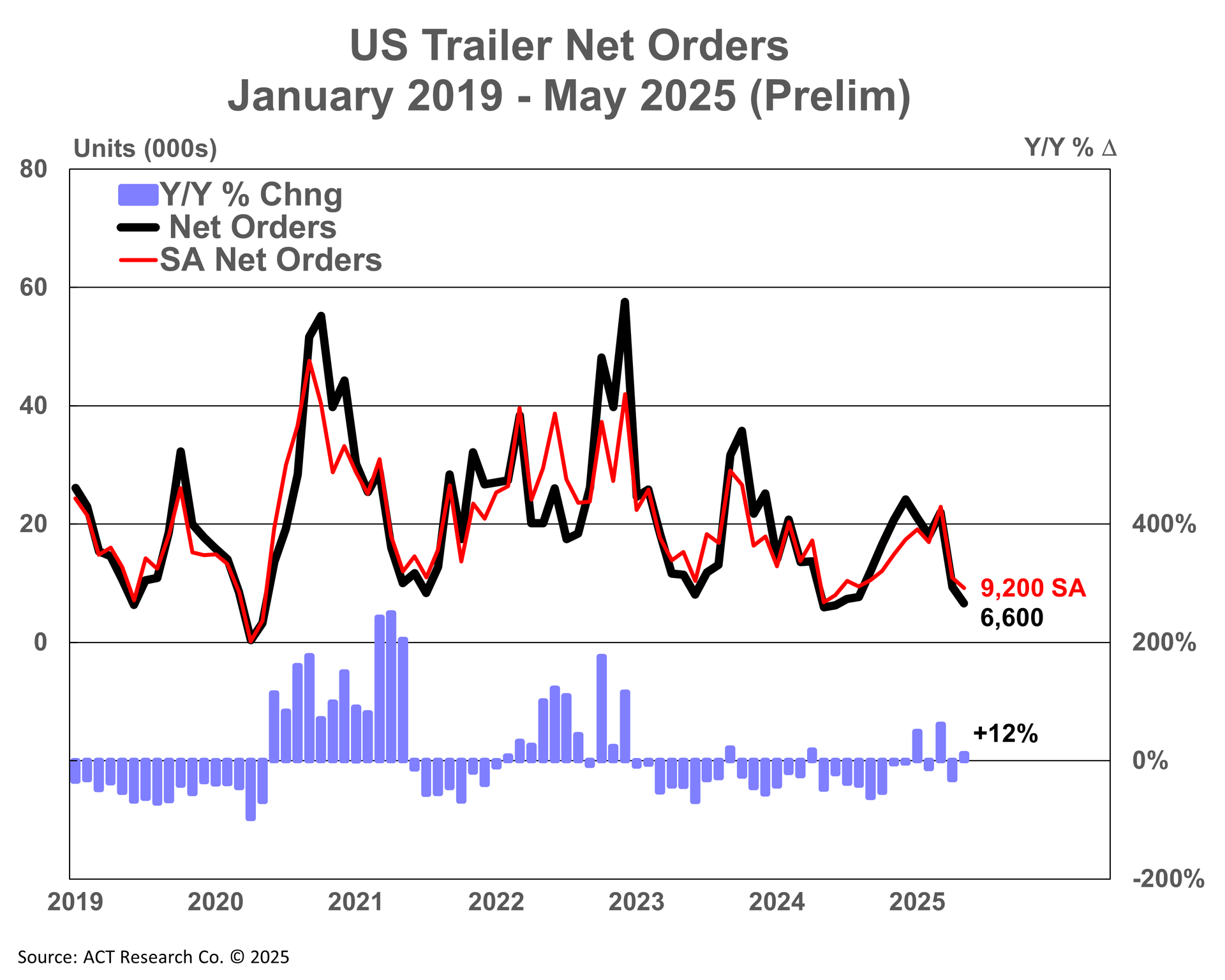
Preliminary net trailer orders in the U.S. dropped by over 2,300 units from April to May, a 26% decline to 6,600 units, according to the latest data from ACT Research. Despite the monthly decline, orders remained nearly 12% higher compared to May 2024. When seasonally adjusted, May’s order intake rises to 9,200 units, with final results expected later in June. ACT notes final order numbers typically fall within 5% of the preliminary data.
The May decline aligns with expected seasonal patterns, but broader concerns about market stability remain. “Lower May net order intake was expected, as it is one of the weakest order months of the annual cycle. More concerning, though, is this level of order acceptance does nothing to support backlog growth, particularly with the elevated cancellation rates reported in the past several months,” said Jennifer McNealy, director CV market research & publications at ACT Research in the release.
Multiple factors continue to cause trailer market headwinds for manufacturers and suppliers. Notably, weak for-hire truck market fundamentals, depressed used equipment valuations, and relatively full inventories. High interest rates and uncertainty surrounding potential policy shifts related to tariffs were also mentioned.
Looking ahead, ACT Research remains cautious. McNealy added, “With weak for-hire truck market fundamentals, low used equipment valuations, relatively full inventories, high interest rates, and the ambiguity of policy shifts still in play, ACT’s expectations for subdued build and order intake levels during 2025 remain intact.”
|
|
|
May Cass Freight Index: shipments decline while expenditures rise
|
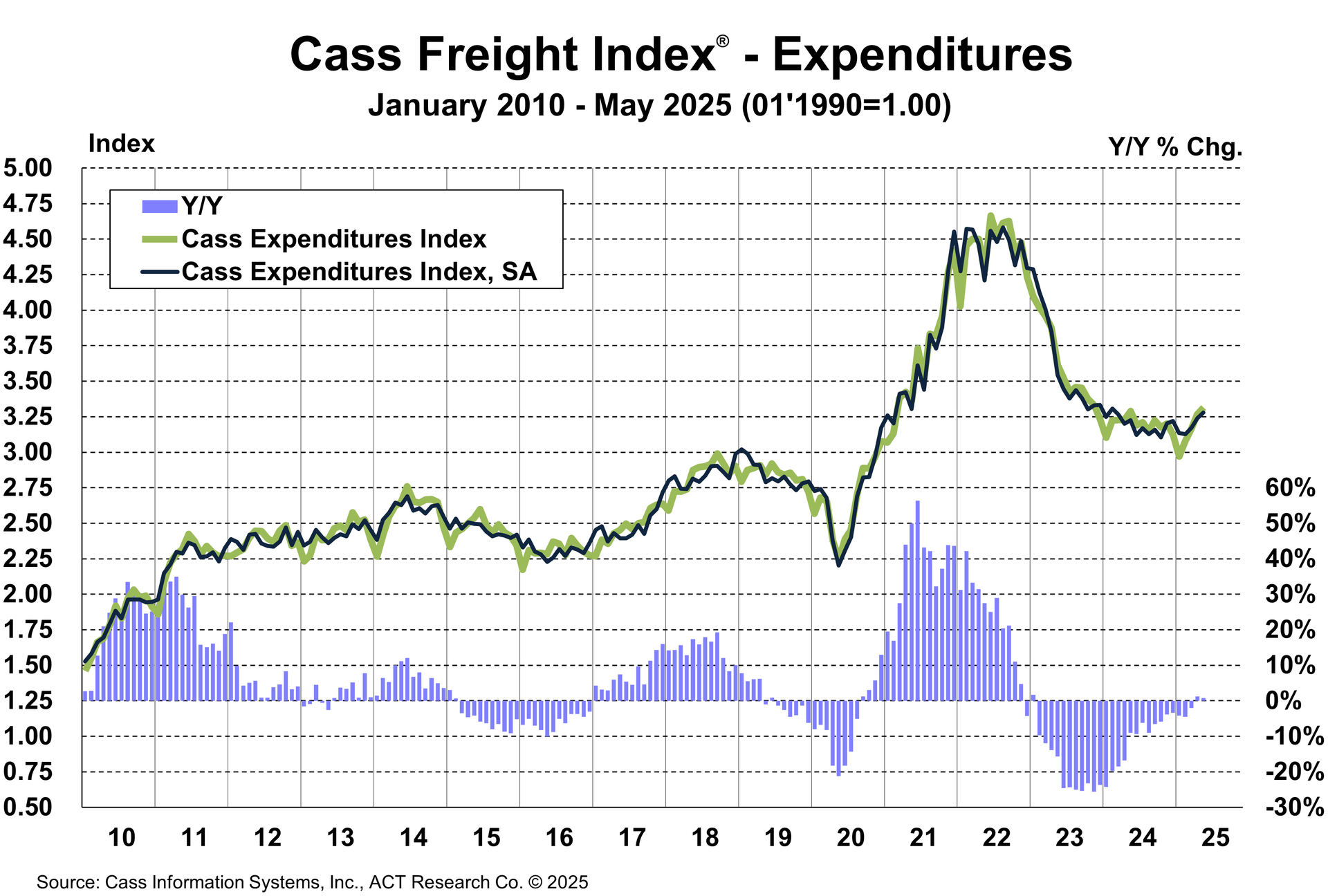
Freight audit and payment provider Cass Information Systems recently released its May Cass Freight Index, which reported mixed results for May 2025. The shipments index declined 0.4% month-over-month (-3.4% seasonally adjusted) while freight expenditures increased 1.4% from April. Year-over-year comparisons showed shipments down 4.0%, the 28th consecutive month of annual declines, while spending on freight rose 0.8% compared to May 2024.
The shipment decline reflects weakening freight demand as the industry continues to be impacted by trade tensions. According to the release, pre-tariff inventory stocking that boosted earlier activity are now transitioning to destocking, a trend likely to continue in coming months regardless of trade negotiation outcomes.
“The trade war is having a variety of effects, with pre-tariff consumer spending still supporting freight demand,” wrote Tim Denoyer, vice president and senior analyst at ACT Research. “The negative consequences of tariff effects are partly reflected in May data, as pre-tariff inventory stocking has started to turn to destocking, and those stocks will start to thin in the coming months.”
Despite lower volumes, carriers appear to have successfully implemented pricing initiatives, with inferred freight rates rising approximately 5% year-over-year. This marks a notable improvement from last year when the inferred rate dataset was down 7% annually. The modal mix is currently shifting toward truckload from less-than-truckload, a positive sign for the freight cycle but potentially a temporary effect related to pre-tariff shipping patterns.
The Cass Truckload Linehaul Index, which tracks rates excluding fuel and accessorial surcharges, posted its fifth consecutive year-over-year increase at 0.6%, though it declined 0.8% m/m from April.
Looking ahead, market visibility remains limited because of policy uncertainties. “The trade war is likely to extend the for-hire freight recession further as higher prices reduce goods affordability and consumers’ real incomes,” Denoyer added. The report adds that while rate momentum appears to be building, the equipment cycle could eventually create tighter capacity conditions as Class 8 tractor sales fall below replacement levels this year.
|
|
|
SONAR spotlight: Dry van drought continues ahead of July 4th
|
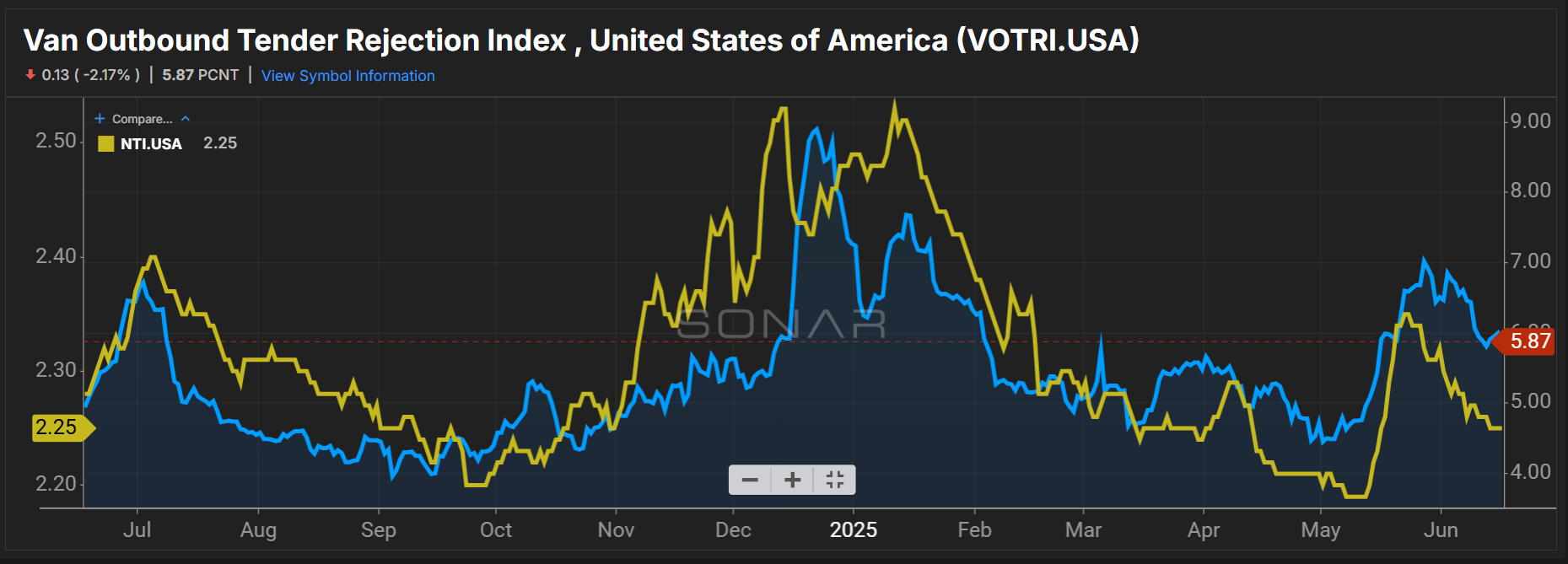
Summary: The second week of June saw continued softening in the dry van segment with declines in outbound tender rejection and spot market rates. Dry van outbound tender rejection rates fell 20 basis points w/w from 6.07% on June 9 to 5.87%. Compared to last year, VOTRI is 93 bps higher than 4.94% on June 17, 2024.
Spot market rates also saw declines, and are trending lower compared to last year. The SONAR National Truckload Index 7-Day Average fell 2 cents per mile all-in from $2.27 on June 9 to $2.25 per mile. This is 3 cents per mile lower than last year, when NTI was at $2.28 per mile on June 17, 2024.
Dry van outbound tender volumes also fell, with VOTRI falling 172.78 points in the past week or 2.4% from 7,199.55 points to 7,026.77 points. Compared to last year, VOTVI is 1,549.32 points or 18% lower than 8,576.09 points last June.
The impacts of tariff and supply chain related uncertainties continue to make forecasting difficult. Looking at seasonal trends, there is an expectation that both spot market and outbound tender rejection rates will rise ahead of the July 4th holiday. However, the extent of the gains remains in question. As compared to the previous year, there are less outbound tender volumes, yet higher rejection rates.
|
|
|
[New Webinar] Retention Reimagined: How to Support a Loyal Driving Workforce
Driver turnover is costly, but avoidable. Join FreightWaves and PCS Software on June 24 for a free webinar exploring practical, proven strategies to improve driver loyalty through better communication, smarter scheduling, and a culture of respect. Register here.
|
|
|
Routing Guide: Links from around the web
|
|
|
Registration Now Open for Supply Chain AI Symposium in Washington, D.C.
The future of freight is intelligent. Are you ready?
The Supply Chain AI Symposium, which will be held at the International Spy Museum in Washington, D.C., on July 30, is your exclusive opportunity to delve into the transformative power of artificial intelligence. Join business leaders, pioneering technologists and leading supply chain companies to explore how AI is revolutionizing transportation, logistics and supply chain management.
Whether you lead a Fortune 100 supply chain, build AI models or sling freight for a living, this symposium offers a unique opportunity to explore how AI is being implemented in the world of the supply chain. Gain insights into cutting-edge advancements, practical applications and trends shaping the freight industry.
Space is limited, so register now to save your spot!
|
|
|
FWTV EVENT | JULY 23, 2025
|
|
|
WASHINGTON, DC | JULY 30, 2025
|
|
|
DALLAS, TX | SEPTEMBER 2025
|
|
|
Like the content? Subscribe to the Newsletter!
|
|
|
Loaded and Rolling Podcast links:
|
|
|
Download the FreightWaves App
|
|
|
|