CSA Scores: Why They’ve Become Trucking’s Public Report Card
|
|
|
This week’s top stories in trucking
|
|
|
EPA Scraps DEF Sensor Requirements for Trucks, Farm Equipment
|
The Environmental Protection Agency is eliminating diesel exhaust fluid (DEF) sensor requirements for trucks and agricultural machinery, ending a major source of roadside breakdowns and field shutdowns.
EPA Administrator Lee Zeldin said he heard complaints about failing DEF systems across all 50 states. “Americans are justified in being fed up with failing DEF system issues,” Zeldin said. Small Business Administration data shows faulty sensors cost farmers $4.4 billion annually.
Under new guidelines, manufacturers can replace problematic urea quality sensors with nitrogen oxide (NOx) sensors that monitor actual emissions. The American Trucking Associations praised the move as “a pragmatic solution that reflects how these systems perform in the real world.”
|
|
|
CSA Scores: Why They’ve Become Trucking’s Public Report Card
|
A burned-out taillight can trigger a costly operational spiral. CSA scores have become trucking’s public report card, influencing shipper decisions, insurance rates and Department of Transportation scrutiny. “The lower the safety score … I’m going to choose you because I know those trucks are probably safer and operating more efficiently,” said Bryant Maxey, product manager at Zonar.
Robert Federico of Tropical Shipping saw one violation prompt weekly inspections, requiring a 4-to-1 clean-to-dirty inspection ratio to recover. The real culprit? Drivers “pencil-whipping” pre-trip inspections in 27 seconds. Electronic verification tools now force physical presence at each inspection zone, helping Cowboy State Trucking slash its score from 76 to 12.
|
|
|
Stolen KitKats Show How Traceability Now Beats Freight Theft
|
When thieves grabbed 12 tons of KitKat products in transit from Italy to Poland, Nestlé did something rare: It talked about it. The company publicly explained how product-level traceability can track stolen goods after control is lost.
Every unit carries a unique batch code that triggers reporting if scanned anywhere in the market. This creates friction for criminals trying to resell stolen freight through secondary channels.
Freight fraud is evolving — identities get compromised before trucks even move. Carrier vetting alone isn’t enough. Companies building visibility beyond the vehicle will be better positioned when things go wrong.
|
|
|
Indiana Leads Nation on Strictest CDL English, Residency Rules
|
Indiana is now enforcing the nation’s strictest commercial driver’s license requirements, revoking licenses from roughly 2,000 non-domiciled holders as of April 1.
House Bill 1200, signed by Gov. Mike Braun, mandates English proficiency for CDL holders and requires all tests be conducted in English or American Sign Language. Drivers must understand traffic signs, respond to official inquiries and complete reports in English.
Penalties are steep: $5,000 fines for drivers operating without valid credentials, $50,000 for carriers who knowingly hire them.
“This has been a problem for a long time,” said Gary Langston, president of the Indiana Motor Truck Association.
|
|
|
Moldovan Broker, Romanian Carrier, Temp CDL Driver: Inside Fatal Beaumont Crash
|
A FreightWaves investigation reveals the chain of failures behind the April 15, 2023, crash in Beaumont, Texas, that killed Brandon Rogers and injured 16 others. The load — Ghost Energy drinks for Anheuser-Busch — was dispatched by ArcherHub, a broker with a 200-plus-employee office in Chisinau, Moldova, to a carrier whose Federal Motor Carrier Safety Administration record showed 150 crashes, 10 fatalities and $889,630 in unpaid federal fines. The driver held a temporary Florida commercial driver’s license. Attorney Brian Beckcom now represents 17 plaintiffs heading to trial.
|
|
|
SONAR spotlight: Linehaul rates rise, diesel prices level off
|
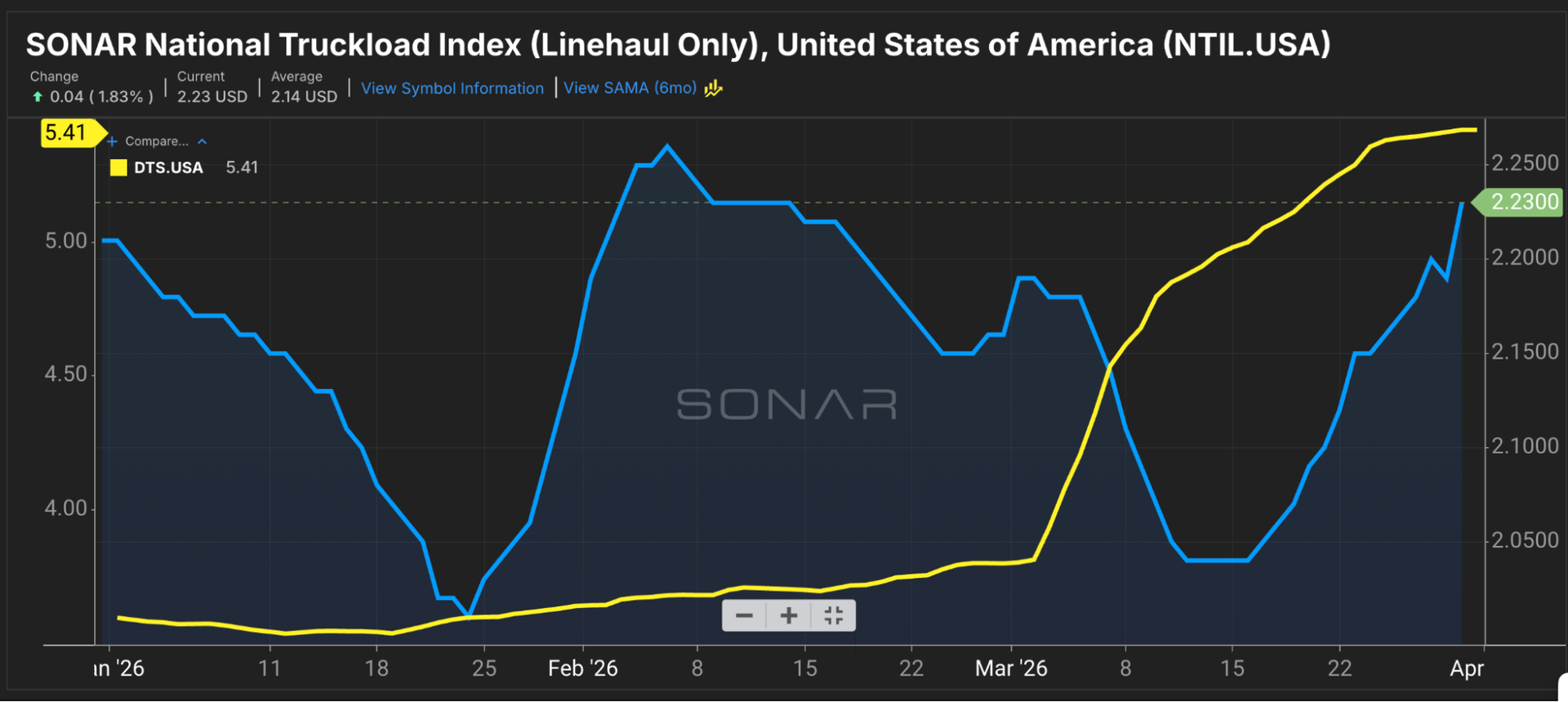
Summary: The last week of March saw a rebound in spot market linehaul rates, while diesel prices at the pump showed early signs of stabilization.
The SONAR National Truckload Index (Linehaul Only) rose 8 cents per mile week-over-week from $2.15 per mile on March 23 to $2.23 per mile. The NTIL is 7 cents per mile, or 3.2%, higher than $2.16 last month and 55 cents per mile, or 32.7%, higher than $1.68 per mile last year.
Fuel costs for the NTIL are based on the average retail price of diesel fuel and a fuel efficiency of 6.5 miles per gallon. The formula is NTID – (DTS.USA/6.5).
Diesel prices at the pump continued to rise but showed early signs of leveling off. The Diesel Truck Stop Actual Price Per Gallon (DTS) rose 13 cents per gallon from $5.28 to $5.41. The DTS is $1.62 per gallon, or 42%, higher than last month. Compared with last year, the DTS is $1.78 per gallon, or 49%, higher.
All-in dry van spot rates saw a much larger increase. The SONAR National Truckload Index 7-day average (NTI) rose 12 cents per mile from $2.94 to $3.06. The last time the NTI exceeded $3 per mile was April 2022.
Looking ahead, spot market rates are expected to face continued upward pressure. Capacity destruction in the trucking market, paired with higher fuel costs, remains a headwind—especially for smaller fleets and owner-operators. Larger fleets, more insulated through contracted freight or loads with fuel surcharges, are in a stronger position.
With greater pricing power in this environment, carriers are expected to keep pushing for higher rates.
|
|
|
The Routing Guide: Links from around the web
|
|
|
FWTV EVENT | APRIL 23, 2026
|
|
|
CLEVELAND, OH | MAY 20, 2026
|
|
|
FWTV EVENT | JUNE 17, 2026
|
|
|
Like the content? Subscribe to the Newsletter!
|
|
|
Loaded and Rolling Podcast links:
|
|
|
Download the FreightWaves App
|
|
|
|