|
View this email in your browser

THE DAILY
Thursday, March 12, 2026
The five minutes that makes you the most informed person in freight today
|
|
Newsletter Brought to You By — Descartes
 |
The #1 freight visibility platform, Descartes MacroPoint delivers real-time tracking via ELD, mobile app, and agentic AI — meet the future of intelligent visibility. Learn More
|
|
|
The Daily
6th Circuit rules NLRB overstepped authority with Cemex organizing standard
The federal appellate check that freight employers have been waiting for has arrived, but only in four states.
A divided 6th Circuit Court of Appeals ruled last week that the National Labor Relations Board overstepped its authority when it created the Cemex standard in 2023, a framework that let the NLRB issue bargaining orders without a successful union election. The decision has direct implications for Teamsters organizing strategy across the trucking and logistics sector, where the union has relied increasingly on authorization card submissions to claim organizing victories, not traditional secret ballot elections.
The original Cemex ruling, named for a case involving truck drivers at a cement producer, let the NLRB bypass the election process entirely when it found employer unfair labor practices. Under that standard, if a union had authorization cards and the employer committed violations, the board could order the company to bargain even without an election win. That was a significant shift from the prior Gissel standard, which imposed tighter conditions for imposing bargaining orders absent a valid election result. The 6th Circuit’s core legal finding: the NLRB created Cemex through adjudication rather than formal rulemaking with public notice and comment. That procedural shortcut, the court said, crossed the boundaries of adjudicatory authority.
The case arose from the Teamsters’ organizing drive at Brown Forman’s Woodford Reserve distillery in Kentucky. The company’s pre-election promises, which included pay increases and policy changes timed to the vote, constituted unfair labor practices, the court agreed. But it held the NLRB couldn’t use that finding to skip the election requirement. The union lost the vote, then filed an unfair labor practices action. The NLRB used Cemex to order recognition and bargaining anyway. The 6th Circuit reversed that.
The ruling’s geographic reach is real but limited. The 6th Circuit covers Kentucky, Tennessee, Ohio and Michigan; certainly a meaningful freight corridor, but not a national prohibition. Multiple circuits are still litigating Cemex, and the law firm Benesch noted the standard "is still being litigated in multiple circuits, and likely will be targeted by the current NLRB," meaning the governing standard could shift further. Review of Teamsters press releases shows most recent organizing wins appear to be based on authorization card submissions without a formal NLRB election record. If Cemex is dismantled nationally, that approach becomes harder to execute.
So What? Carriers and logistics companies in Kentucky, Tennessee, Ohio and Michigan with active or threatened organizing campaigns just gained meaningful legal ground. Within those four states, the NLRB can no longer automatically issue bargaining orders when it finds unfair labor practices during an organizing drive — an election is now required. That is not an invitation to commit unfair labor practices; the court confirmed Brown Forman still violated the law. But the automatic bargaining order remedy, the one Teamsters had been using to sidestep election losses, is now off the table in those states. Employers should be reviewing their organizing-response protocols with labor counsel regardless of geography, because the fight in other circuits is far from settled.
Read the full story →
|
 |
|
|
Top Stories
Maersk CEO says 10 ships are stranded in Persian Gulf as Hormuz closure holds
The world’s second-largest container carrier has 10 ships that cannot exit the Persian Gulf, Maersk CEO Vincent Clerc said in interviews with CNN and the Wall Street Journal this week. Iran’s closure of the Strait of Hormuz has left those vessels, at least one of which is under contract to the U.S. Military Sealift Command, anchored offshore and away from ports still under attack. Even if a ceasefire materialized today, Clerc said Maersk would need one to two weeks before normal operations could resume. Bunkering terminals across Asia and the Middle East risk running dry as fuel supply chains fracture, and Clerc said those added costs will pass to customers. Shipping executives gathered at an industry conference in Connecticut separately reported that the Hormuz closure has now idled 10,000 merchant crew members and hundreds of vessels, with most airlines suspended from the region offering no exit route for stranded mariners.
So What? The U.S. Navy has denied escort requests, telling carriers the Strait remains too dangerous for transit. Without naval protection, the reopening timeline is entirely dependent on Iran. Anyone with freight moving in or out of Gulf states should be treating this as a multi-week disruption at minimum, and cost exposure from emergency surcharges and fuel price swings is growing by the day.
Read the full story →
Supply chain job cuts top 3,900 as EV, auto and logistics companies file WARN notices
Nearly 4,000 workers across warehouses, factories and rail terminals have received or are facing layoff notices, according to WARN filings and company announcements compiled by FreightWaves. The cuts span at least a dozen companies across eight states: California, Georgia, Tennessee, Texas, Ohio, South Carolina, Pennsylvania and Alabama. The single largest event: SK Battery America cut 958 workers, about 37% of its workforce, at its EV battery plant in Commerce, Georgia, citing shifting demand as automakers reassess EV production plans. Bankrupt auto parts maker First Brands Group added 905 more cuts across Texas and Tennessee plants in its Chapter 11 restructuring. Intermodal operator Parsec LLC is closing three rail cargo handling facilities after losing key customer contracts, including a Columbus, Ohio, terminal that eliminates 115 jobs by May 1.
So What? The WARN filing pattern tells a story about where the freight recovery isn’t reaching. EV battery manufacturing is cooling as automakers revise production plans. Intermodal is losing contracts. 3PL facilities are shedding client-driven headcount. These are structural recalibrations across multiple sectors simultaneously — not a single cyclical blip.
Read the full story →
UPS CFO details premium services pivot as Amazon volumes draw down by mid-year
UPS is executing what CFO Brian Dykes called "not a shrink-the-company strategy — it’s a growth strategy," as the carrier sheds 50% of its Amazon delivery volume and $5 billion in revenue by the end of the second quarter. Speaking at the Raymond James Industrials Conference, Dykes was direct: "Less e-commerce, more small-and-medium business, more B2B, more healthcare." The company is cutting 30,000 jobs this year, closing 24 parcel sort centers and offering $150,000 voluntary buyouts to unionized delivery drivers. Analysts are marking the execution as disciplined. Fourth-quarter results beat earnings consensus by 8%, and ShipMatrix measured UPS holiday peak on-time delivery at 97.2%, highest in the industry. Q1 domestic margin is projected in the 4%-5% range, reflecting the transition costs, with improvement expected through the second half as efficiency gains compound.
So What? For shippers relying on UPS for low-cost residential e-commerce delivery, the repricing signal is clear. Volume that doesn’t generate premium economics is being removed from the network. Parcel rate negotiations in 2026 will reflect that calculus — expect continued pressure on shippers in the residential last-mile segment to either accept higher rates or find alternatives.
Read the full story →
Sponsored By Werner

How Moving Mission-Critical Tech Requires a Different Approach to Freight Logistics
When a single trailer carries tens of millions in AI infrastructure and semiconductor assets, the standard freight playbook doesn’t hold. Werner SVP Jaime Jones explains what "claim-free velocity," digital twin visibility and engineered capacity mean in practice — and why leading tech shippers are paying a premium to work with carriers who guarantee the condition of cargo on arrival, not just its location.
Read the full story → |
Identity fraud patterns from commercial freight are appearing in military PCS logistics
A $3.5 million Department of Justice settlement involving a transportation company that impersonated military personnel to manipulate customer satisfaction surveys signals a new risk vector inside the Defense Personal Property Program. The company spoofed phone numbers and used disguised voices to inflate performance scores and secure additional permanent change of station (PCS) shipments. Phil Brink, who has spent 12 years in military household goods logistics, details how commercial freight fraud patterns including identity manipulation, credential misuse, and unauthorized insertion into workflows are surfacing in a system that depends on knowing exactly who is handling freight at every step. The concern isn’t widespread fraud yet. The conditions for it are building, particularly heading into peak PCS season beginning in mid-May.
So What? TWIC card expansion for drivers handling military household goods is one concrete near-term recommendation to close verification gaps. Transportation service providers bidding on DPS work should audit identity verification protocols before peak season starts. The DoJ settlement shows the government is watching, and consequences extend beyond losing a single contract.
Read the full story →
Sponsored By PCS
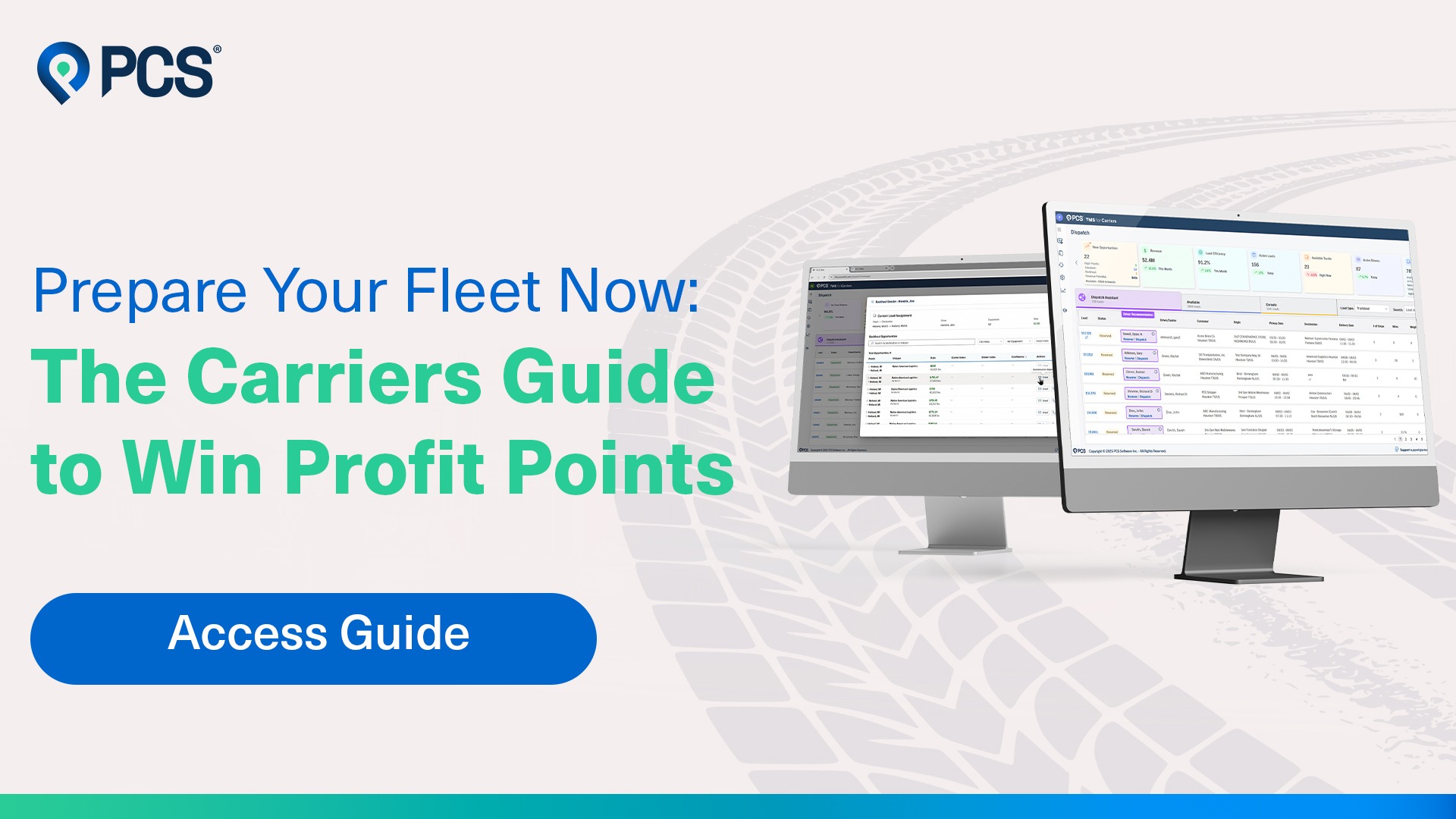
Strategy Guide for Mid-Market Carriers: How Winning Carriers Are Preparing for 2026
Freight conditions may level out in 2026, but profitability will separate fast. Rising costs, tighter labor and increasing compliance demands mean mid-market fleets can’t rely on market recovery to protect margin. PCS Software’s free strategic planning guide shows how disciplined operators are tightening cost control, building data-driven decision systems and choosing technology with clear ROI before the market forces their hand.
Download the guide → |
|
|
|
Sponsored Insight
|
Presented by Descartes

Vesta Freight Drives 18x Shipment Growth with Descartes TM Solutions
A unified transportation platform helped Vesta Freight streamline operations, strengthen its carrier network and drive 18x growth in shipment volume. When the technology infrastructure is right, scale compounds. Read the case study to see how Vesta got there.
Read the case study → |
|
 |
|
|
From the Research Desk
|
In partnership with Trimble
2026 Outlook: Spot Market Strategies for Shippers, Carriers, and Brokers
The spot market is no longer a last resort; it’s a deliberate planning tool. FreightWaves and Trimble surveyed shippers, carriers and brokers on how spot strategy is evolving in 2026. Given where rejection rates are trending, any procurement team still pricing off 2024 contract benchmarks needs this data before the next negotiation.
Download the full report → |
|
In partnership with Avalara
Supply Chain Strategies for an Uncertain Trade Environment
Tariffs, geopolitical shifts and regulatory whiplash are rewriting the rules faster than most supply chain teams can update their models. FreightWaves and Avalara examine how leading operators are building adaptive strategies that can absorb the next disruption before it arrives.
Download the full report → |
|
In partnership with Descartes
2026 TMS Buyer’s Guide
Selecting the wrong TMS is one of the most expensive operational mistakes a mid-market shipper or 3PL can make. This guide cuts through vendor noise with practical guidance on timing, capabilities, AI integration and evaluation criteria for platforms built to scale.
Download the buyer’s guide → |
|
Courtesy of S&P Global Market Intelligence
The Age of Agility: Seeking Advantage Amid Uncertainty
S&P Global identifies three themes driving strategic recalibration in 2026: adapting to trade realities, managing shaky economic foundations and navigating shifting geopolitical power dynamics. Their Age of Agility report maps where risks convert to opportunities for logistics and supply chain operators operating in a world where disruption is permanent.
Download the report → |
|
|
Upcoming Event
FreightWaves 3PL Summit
March 18, 2026 | FWTV Online Event
Join FreightWaves for the 3PL Summit: Partners through the Freight Cycle — a premier online event built for third-party logistics providers, freight brokers and industry intermediaries navigating the shifting dynamics of the freight market. Get the intelligence you need to protect your margins and position for the back half of 2026.
Register Here → |
|
|
|
What We’re Watching
▸ Whether other circuits follow the 6th Circuit on Cemex. The ruling is binding in Kentucky, Tennessee, Ohio and Michigan — but the Teamsters operate nationally and Cemex is still being litigated elsewhere. Watch for appellate decisions in circuits that cover major freight corridors. A circuit split makes this a likely Supreme Court candidate.
▸ Hormuz reopening signals and U.S. Navy posture. Maersk CEO Clerc says even a ceasefire gives carriers only 7-10 days before normal operations can restart. Watch for any diplomatic movement from Washington on naval escorts — carriers have been told the Strait is still too dangerous for transit, and that assessment hasn’t changed.
▸ UPS Q1 domestic margin versus guidance. Q1 guidance is 4%-5% — historically lean for a carrier positioning itself as the premium provider. Q1 results will show whether the Amazon draw-down costs are running ahead of the efficiency gains. If they are, back-half 2026 guidance comes down and the repricing pressure on shippers accelerates.
|
|
|
That’s your Daily for today. See you tomorrow.
Was this forwarded to you? Subscribe here | Have a tip? Just reply to this email.
FreightWaves 405 Cherry St., Chattanooga TN 37402
Unsubscribe | Forward to a Friend | FreightWaves.com
|
|