Dalilah’s Law that tightens CDL issuance gets House committee OK
|
|
|
|
|
NEWSLETTER BROUGHT TO YOU BY — PCS SOFTWARE
|
The market won’t fix your margin problem. PCS TMS with Cortex AI helps fleets eliminate manual drag, prioritize profitable freight, and move with precision. Learn More.
|
|
|
This week’s top stories in trucking
|
|
|
Cass Index Shows Truckload Rates Nearing Three-Year High
|
February’s Cass Freight Index reveals truckload linehaul rates hit their highest level since April 2023, climbing 2.2 percent year-over-year despite a 7.2 percent drop in multimodal shipments. This marks six consecutive months of rate increases — a supply-driven recovery fueled by capacity contraction rather than demand growth.
Tight spot capacity in early March stems from equipment constraints, weather disruptions, and driver shortages intensified by regulatory crackdowns on non-domiciled CDLs and ELD enforcement. Meanwhile, diesel prices surged 28 percent in two weeks, squeezing owner-operators who struggle to recoup costs in the spot market.
Carriers expect pronounced rate hikes in 2026, though sustaining increases amid fuel-driven inflation remains challenging.
|
|
|
House Committee Advances “Dalilah’s Law” to Tighten CDL Requirements
|
The House Transportation and Infrastructure Committee passed “Dalilah’s Law” 35-26 along party lines, advancing legislation that would mandate English proficiency for commercial drivers and crack down on fraudulent training schools.
Named after Dalilah Coleman, a girl injured in 2024 by a driver who was in the country illegally, the bill requires drivers to read highway signs, converse with law enforcement, and complete official reports in English. Noncompliant drivers face immediate out-of-service designation for one year.
The legislation also targets “CDL mills,” requiring the DOT to issue final self-certification rules within 18 months — building on FMCSA audits that already removed nearly 3,000 training providers.
|
|
|
Knight-Swift Divests FleetAero, Locks in Long-Term Efficiency Partnership
|
Knight-Swift Transportation has sold its FleetAero aerodynamic products business to Transtex in an asset purchase deal, pivoting from manufacturing to a strategic innovation partnership. The move comes as diesel prices have surged 28 percent — $1.05 per gallon — over the past two weeks amid U.S.-Israeli tensions, intensifying fleet demand for fuel-saving solutions.
Transtex, which already offers aerodynamic flaps, skirts and auxiliary power units, will leverage Knight-Swift’s operational scale to validate new technologies in real-world conditions.
“This partnership will drive measurable operational and environmental benefits,” said Dave Williams, Knight-Swift’s senior vice president of equipment and governmental relations.
|
|
|
Romanian Trucking Operator With $889,630 in Unpaid Fines, 10 Fatalities Found Dining at Mar-a-Lago With Secret Service Director
|
A FreightWaves investigation reveals Dragos Sprinceana — whose trucking empire accumulated 150 crashes, 10 fatalities, and $889,630 in unpaid federal fines — dined at Mar-a-Lago with Secret Service Director Sean Curran and then-DHS Secretary Kristi Noem in November 2025. This occurred while two federal out-of-service orders remained active against his company.
The investigation documents Sprinceana’s political donations totaling $134,992 from 2020 to 2024, including $20,000 or more to now-national security adviser Mike Waltz, whom he met at Mar-a-Lago one week before inauguration. Despite GoldCoast’s canceled authority, trucks bearing its branding reportedly still operate under related entities with a 46.2 percent vehicle out-of-service rate.
|
|
|
J.B. Hunt Sees Fuel Spikes Failing to Spark Intermodal Shift
|
Despite fuel prices surging 30 percent since the Iran conflict began, shippers aren’t rushing to rail. Darren Field, J.B. Hunt’s intermodal president, told attendees at the J.P. Morgan Industrials Conference that customers view current volatility as temporary — not structural.
Intermodal is 22.8 percent cheaper than truckload, well above the typical 10 percent to 15 percent spread, yet lean inventories and just-in-time strategies leave supply chains vulnerable. Field warned that low stock levels mean even modest demand spikes could create gaps.
Capacity pressures loom larger: J.B. Hunt estimates 5 percent to 12 percent of CDL holders may exit the industry over four years starting April 2025 due to English-language requirements and regulatory crackdowns.
|
|
|
IN PARTNERSHIP WITH PCS SOFTWARE
|
Freight conditions may level out in 2026, but profitability will separate fast. This free strategic planning guide shows how operators are tightening costs, using data to guide decisions, and choosing technology with clear ROI.
|
|
|
SONAR spotlight: Diesel prices surge to over $5 per gallon
|
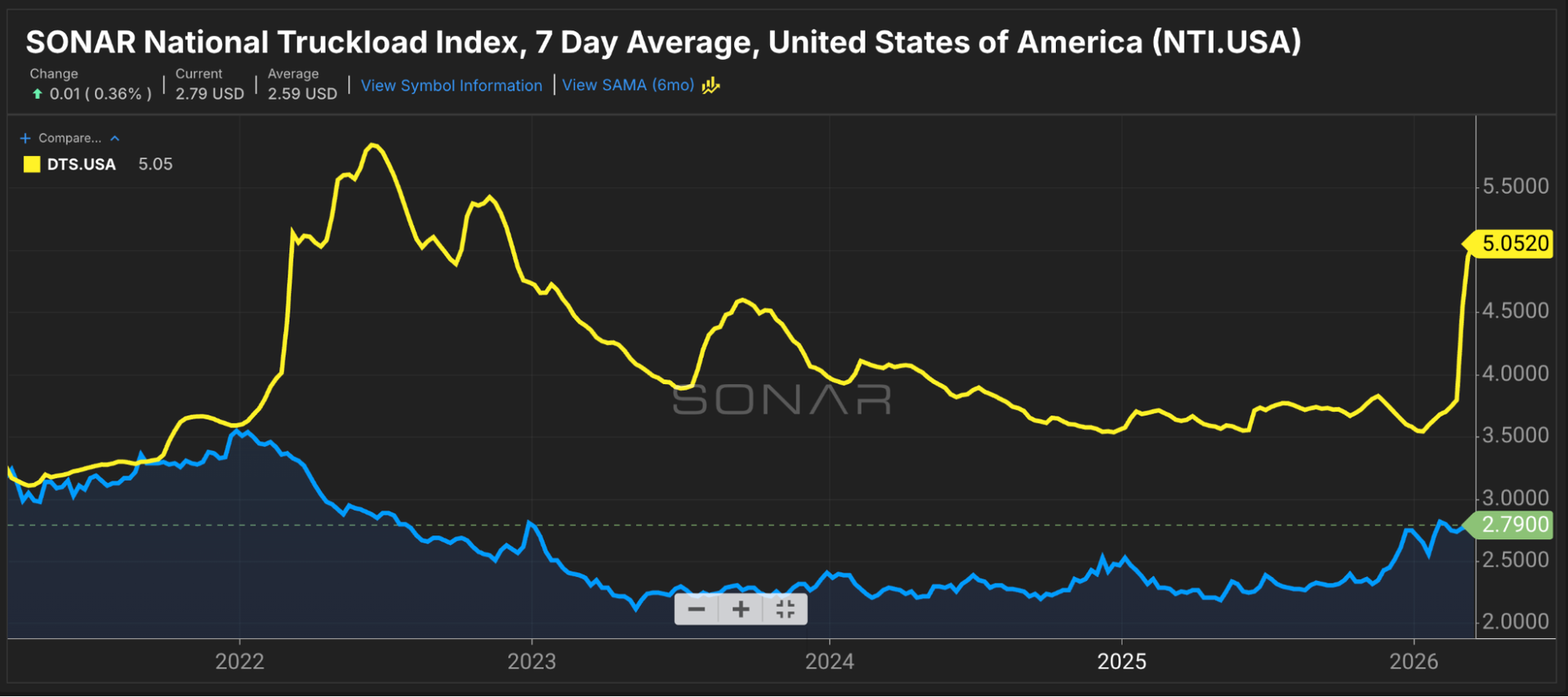
Summary: The Iran conflict continues to roil energy markets. Diesel prices paid at the pump nationwide have surged above $5 per gallon to $5.052. This is the first time since late 2022 that prices have been this high. Fuel surcharges are also expected to rise.
The Department of Energy on Monday published its latest fuel data, showing a 21.2-cent-per-gallon weekly increase. The national average is now $5.071 per gallon, its highest since 2022 during the early months of the Russia-Ukraine war.
In the two weeks since the Iran conflict started, diesel prices have risen $1.17 per gallon. For a 300-gallon diesel tank, that equates to roughly $351 in additional fuel costs per tank. If this trend continues, that’s more than $18,000 per year in lost net income for these cash-strapped carriers.
Dry van spot rates responded by showing slight gains — a worrying sign for smaller carriers and owner-operators more exposed to the higher fuel prices. The National Truckload Index (NTI) rose 3 cents per mile from $2.76 on March 9 to $2.79. These are all-in rates, meaning carriers so far have not been able to pass through these higher fuel costs unless they have a dedicated fuel surcharge.
Fuel surcharges are typically reserved for contracted freight, accessible only to the largest fleets or freight brokers.
This is a development worth watching. If prices stay higher for longer, the odds of more carrier exits increase. At the same time, with spring approaching, we may see less trucking capacity relative to an increase in demand, causing further market volatility.
|
|
|
The Routing Guide: Links from around the web
|
|
|
FWTV EVENT | MAY 13, 2026
|
|
|
CLEVELAND, OH | MAY 20, 2026
|
|
|
FWTV EVENT | JUNE 17, 2026
|
|
|
Like the content? Subscribe to the Newsletter!
|
|
|
Loaded and Rolling Podcast links:
|
|
|
Download the FreightWaves App
|
|
|
|