
| The Daily // Thu 09.17.26 | View in browser → |
.png)
The Daily
 |
NEWSLETTER BROUGHT TO YOU BY — QUANTIX
One call covers dry bulk, liquid bulk, packaging, warehousing and managed transportation. Quantix removes the obstacles between your material and your customer. One partner, nationwide. Learn more.
|
|
Announcement
|

Analysts call trucking market “fragile” as tender rejections swing
|
>17%
STRI’s June peak
|
<14%
STRI level after the recent pullback
|
+75bps
STRI’s jump in a single week
|
The trucking market looks calm on the surface. Freight analysts say that’s exactly the problem.
At the SONAR/Cass Shippers Forum in New York on Sept. 15, FreightWaves’ Zach Strickland and Craig Fuller told shippers gathered at JFK that recent stability in tender rejections is masking real fragility underneath. The SONAR Tender Rejection Index climbed above 17% in June, dropped below 14% in the weeks since, then jumped roughly 75 basis points in a single week — a swing Strickland said undercuts any read of a settled market.
Fuller cautioned against reading "fragile" as automatically bad. "I usually think bad" when he hears the word, he said, but the volatility traces to capacity tightness rather than a demand collapse — a different kind of fragility than the pandemic-era chaos shippers remember. Recent swings followed Roadcheck week, Memorial Day disruptions and the Supreme Court’s Montgomery v. Caribe Transport II ruling on broker liability, plus a shift of freight onto intermodal rail that has helped mute tender-volume growth.
If tender rejections can jump 75 basis points in a week even with demand below pandemic-surge levels, shippers locking in Q4 contracts should build in room for capacity shocks — this market doesn’t need a demand spike to tighten fast, just one more disruption on top of already-thin capacity.
Savannah port moves 1 million TEUs to start fiscal year
The Port of Savannah moved 1.03 million TEUs combined in July and August to open its fiscal year, up 2.2% from a year earlier, even as August volume alone dipped just under 1% to 529,523 TEUs. Loaded exports rose 4.2% to 117,242 TEUs and loaded imports climbed 1.5% to 265,859 TEUs. CEO Griff Lynch attributed the August softness to external weather, including Asian typhoons and low Panama Canal water levels tied to El Niño, saying "the customer demand is present for Savannah." Garden City Terminal cut dual-move truck turn times to 43 minutes, 6.5 minutes faster than the six-month average, while the Appalachian Regional Port posted 10% August growth and is up 25% over the fiscal year’s first two months.
Savannah’s operational gains, especially faster truck turns and inland rail growth at Appalachian Regional Port, show a port absorbing external shocks better than its raw TEU numbers suggest — drayage providers routing through Savannah should watch whether that efficiency holds once Panama Canal levels and Asian typhoon season normalize and volume accelerates.

Container shipping fuel prices stay elevated as supply fears ease
Marine fuel prices remain sharply elevated even as the acute shortage from March and April has resolved. Singapore VLSFO, the benchmark grade, has more than doubled this year, from $433.50 a ton on Jan. 1 to $878.50 a ton by Sept. 11, and current prices sit roughly 60% above pre-conflict levels. Regional prices vary widely: Fujairah, UAE, is quoting around $1,005 a ton and marine gasoil near $1,448 a ton, while Rotterdam sits at $731 and Houston at $804. Bunkering activity at Fujairah has recovered to about 40% of pre-conflict levels, with 10 to 15 vessels a day now routing through the Omani corridor as an alternative to Strait of Hormuz disruptions. The St. Louis Fed estimated the early-2026 fuel shock pushed China-U.S. West Coast container costs up from $155 to $269 on newer vessels and from $360 to $626 on older ones.
Carriers are still passing these costs through via bunker adjustment factors and emergency surcharges, so importers and exporters on trans-Pacific and Asia-Europe lanes should expect landed-cost volatility to persist even though the fuel shortage that started the spike has resolved.
Mexico arrests alleged cartel logistics operator tied to Seattle-Tacoma drug ring
Mexican authorities arrested Ángel Guerrero Carrillo, known as "El Canguro," in Zapopan, Jalisco, on Sept. 16 in a joint U.S.-Mexico intelligence operation, alleging he coordinated transportation and distribution of fentanyl and synthetic drugs into Seattle and Tacoma for a Beltrán Leyva Organization faction led by Fausto Isidro Meza Flores, known as "Chapo Isidro." Agents seized a firearm, ammunition, methamphetamine, 15 fentanyl pills, cash and a phone. Federal records tie the Meza Flores organization to Washington state drug distribution back to at least 2010, with 2017 court findings and 2023-2025 Treasury sanctions documenting continued cocaine, methamphetamine and fentanyl flows into the state. Mexico’s Security Cabinet said the arrest helps "weaken the logistical capacity of criminal organizations."
The arrest targets a logistics coordinator, not just a trafficker, underscoring how closely cartel supply chains mirror legitimate freight networks — carriers and warehouses in the Pacific Northwest should expect continued law enforcement attention to cross-border transportation links feeding synthetic-drug distribution.
Driver shortage pushes private fleets toward data-driven safety programs
With qualified drivers hard to replace and crash litigation costs climbing, private fleets are shifting from firing underperforming drivers to developing them, using data instead of gut instinct. At Dot Foods, which runs nearly 2,200 trucks, senior director of safety Tim Eckhardt said the company now scores drivers on a scale of 0 to 100 and puts anyone above 70 on a professional development plan; only about 30 Dot drivers were above that threshold heading into a recent industry conference. Quarterly safety bonuses now run close to 10% of driver income, the company keeps roughly 12 drivers per over-the-road trainer, and training runs four to 12 weeks depending on experience. "When your first conversation with that driver is discipline, normally that relationship doesn’t recover," Eckhardt said, adding the goal is technology-driven intervention, not just repeated coaching. Dot also tightened manager-to-driver ratios to 70-80 from 150 and uses camera and telematics data to catch risky behavior before it causes a crash.
A driver market too tight to simply replace problem performers is pushing fleets toward the same data-driven retention playbook carriers use for recruiting — expect more private fleets to follow Dot’s lead on scoring and development plans as litigation costs make one preventable crash more expensive than the technology to stop it.

Brought to you by Samsara — built with operators, for operators. Blind spots cause some of fleets’ costliest, most complex collisions. Learn how AI-powered 360-degree visibility helps you spot risks in real time and protect drivers, pedestrians and cyclists.

| Time | Guest | Topic |
|---|---|---|
| 12pm | Kyle Peacock | Principal, Peacock Tariff Consulting |
| 12:30pm | Mark McEntire | CEO, Emerge |

White Paper: Q3 2026 Carrier Rate Report
FreightWaves’ Carrier Rate Report — sponsored by Trimble — provides a review of the previous quarter and a forecast for the coming months.
Is Your Tech Stack Built for Growth? How Strategic LSPs Use AI to Win
Join Blue Yonder live on Sept. 22 for a look at how strategic logistics service providers are using AI to build tech stacks that scale with growth instead of limiting it.

One Network for Every Form of Chemical Freight
One partner for dry bulk, liquid bulk and warehousing.

What It Takes to Win in the Next Era of Drayage
Demand volatility, terminal congestion and driver shortages are squeezing drayage margins. FreightWaves and CargoWise Landside surveyed operators on where automation and digital investment are actually paying off.
High-Stakes Freight Brokerage: Risk and Accountability
Shippers moving high-value freight say lower-cost brokerage is starting to carry higher risk. FreightWaves and Werner surveyed where compliance gaps and carrier performance issues are driving accountability higher.
How Tariffs Raised the Execution Standard, Not Just Costs
New research from Infios shows 2025’s tariff overhaul turned transport mode, tariff exposure and trade-route selection into managed variables rather than fixed costs shippers can set and forget.
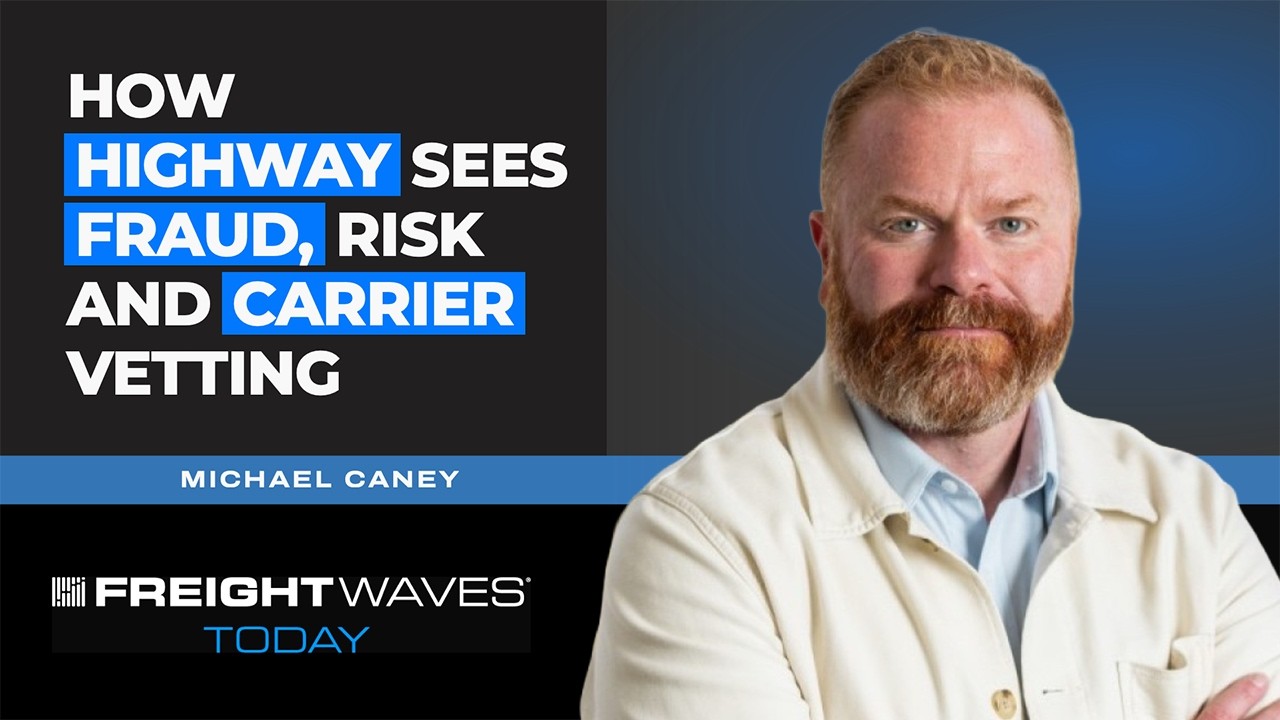 ▶ ▶ |
How Highway Sees Fraud, Risk and Carrier VettingWatch the full breakdown on FreightWaves TV. |
 ▶ ▶ |
Rail Freight Trends: The Risks Hiding in Plain SightWatch the full breakdown on FreightWaves TV. |
 ▶ ▶ |
Trucking Market: Volumes UP, Diesel Soaring: Is Peak Here?Watch the full breakdown on FreightWaves TV. |
|
▸
|
Whether the STRI’s next move confirms fragility or stabilityStrickland and Fuller flagged a 75-basis-point jump in tender rejections as evidence the market isn’t settled. Watch whether the index keeps climbing off its sub-14% low or snaps back toward June’s peak above 17%. |
|
▸
|
Whether Panama Canal and Asia weather keep denting Savannah volumeCEO Griff Lynch says demand is there despite the drag from El Niño-driven canal levels and Asian typhoons. Watch whether September volumes bounce back once those weather patterns clear. |
|
▸
|
Whether bunker prices keep sliding as the Omani corridor scales upFujairah bunkering has recovered to about 40% of pre-conflict levels. Watch whether more vessels shift to the Omani corridor and pull marine fuel prices down from their current 60%-above-pre-conflict levels. |
