
| The Daily // Fri 10.02.26 | View in browser → |
.png)
The Daily
 |
NEWSLETTER BROUGHT TO YOU BY — AURORA
More Miles. More Revenue. Our self-driving Class-8 trucks haul freight on public roads today with no one behind the wheel. Learn more.
|
|
ANNOUNCEMENTS
|

Daimler Truck maps what it takes to scale electric trucks
Daimler Truck used an industry gathering to lay out exactly what it will take to get battery-electric trucks from a niche product to a mainstream one, and the math is daunting, according to Thomas Wasson’s reporting. Mercedes-Benz Trucks holds 38% of Europe’s CO2-free medium- and heavy-duty truck market through the first half of 2026, and its eActros 600 has logged more than 160 million kilometers since late 2024. "Today, there are over 60 electric or zero-emission trucks available in the market, and over 25 different zero-emission bus models from us and from our competitors," CEO Karin Rådström said. "So our industry has clearly delivered."
The infrastructure hasn’t kept pace. Europe has fewer than 2,000 public truck charge points today, most of them standard CCS rather than the megawatt chargers heavy trucks need, versus an estimated 35,000 megawatt chargers required by 2030. Hydrogen fares worse: roughly 187 stations exist now, most delivering pressure too low for trucks, against a need for 1,000 truck-ready stations within four years. Stefan Hohm, chief development officer at German logistics provider Dachser, put the scale problem in blunt terms: "We are proud to have more than 200 battery-electric trucks on the road, but the truth is we run more than 15,000. So this is only a beginning." He added that mismatched depot and public charging tariffs "sometimes really messes up the business case if you have to pay more than double when you are charging publicly."
The EU wants 35% of new trucks running on batteries or hydrogen by 2030, and a 10-point shortfall would wipe out Mercedes-Benz Trucks’ annual global profitability under CO2-penalty rules. The trucks exist. The chargers, hydrogen stations and consistent carbon-toll rules across Europe don’t, and that gap, not vehicle technology, is now the limiting factor on how fast electrification actually scales.
R&R Family of Cos. CEO Rich Francis files for Chapter 11 bankruptcy
Richard "Rich" Francis, CEO of the collapsed R&R Family of Cos., filed a personal Chapter 11 petition Sept. 22 in U.S. Bankruptcy Court for the Middle District of Florida, according to Noi Mahoney’s reporting. The filing is personal, not corporate, covering R&R Express, RFX and affiliated entities, and lists estimated assets and liabilities each between $10 million and $50 million spread across 1 to 49 creditors. Francis didn’t file the detailed schedules and financial-affairs statements required with the petition, and a judge has ordered them in by Oct. 6. Separately, Huntington National Bank alleges R&R Express Properties transferred Francis’ Marco Island, Florida, residence to him and his wife in December 2025 as the company’s finances deteriorated; that state court case is now on hold under the bankruptcy stay, with Huntington participating in the federal proceedings. An initial status conference is set for Oct. 21, and Francis must appear at a creditors’ meeting Oct. 27.
R&R’s collapse already cost carriers and vendors unpaid invoices when operations wound down in January; a personal bankruptcy from its CEO, on top of unresolved asset-transfer litigation, signals the fallout isn’t finished for creditors chasing what they’re owed.

FMCSA’s Elison: ‘weeks’ away from fixing Motus user experience
FMCSA Deputy Administrator Jesse Elison told an audience in Long Beach, California, that the agency is "hopefully" weeks away from fixing the user interface on Motus, the federal registration system that launched May 14 to what Elison himself called a rollout "bordering on disastrous," according to John Kingston’s reporting. "Those following weeks were really really tough, because what we had built wasn’t working," Elison said, adding that "behind the scenes, there’s a lot of attention to timelines and schedules" even though "it is not where it needs to be." FMCSA suspended enforcement of biennial registration updates on Sept. 10 while the agency works through the backlog. "We’re much better off today than we were yesterday," Elison said.
A federal official calling his own agency’s system rollout "bordering on disastrous" is a rare admission; carriers still navigating Motus should treat the enforcement suspension as breathing room, not confirmation the system is fixed.
Alaska Air eyes 50% share of intra-island Hawaii cargo market
Alaska Airlines is targeting $750 million in cargo revenue by 2030, up from $549 million in 2025 and $316 million through the first half of 2026, according to Eric Kulisch’s reporting. The carrier is leasing four additional Boeing 737-800 converted freighters, two of which will fly Hawaii interisland routes, where Alaska wants to grow its share from 6% to 50%, competing against Northern Air Cargo, Lynden Air Cargo, Southwest and Aloha Air Cargo. Systemwide, Alaska is targeting 50% cargo market share overall, up from 37% today, while expanding international service from five destinations to 15 by 2030, adding Paris and Athens in 2027. "Cargo allows us to fully monetize our assets across the network," said Ian Morgan, Alaska’s vice president of cargo. "By adding dedicated freighter service … we see a path towards 50% share."
Cargo is only 2.6% of Alaska’s revenue but carries margins twice the system average, so a 50% share target is a bet that dedicated freighters pay for themselves even on routes too thin to justify passenger widebodies alone.
Took a while to happen, but trucking jobs are now more than a year ago
Truck transportation employment hit 1,473,100 jobs in September, up 2,600 from August and 800 above a year earlier, the first positive year-over-year comparison since April 2023, according to John Kingston’s reporting. It’s the third straight month of job growth and the fourth gain in five months. Truckload driver jobs rose to 503,200, still below the year-ago mark of 503,900 and well off the 553,600 peak hit in August and October 2022, while LTL employment reached 248,900 in August, up 1,200 month over month. Average hourly earnings in truck transportation climbed to $32.67 in August. Michigan State supply chain professor Jason Miller said the data "points to existing establishments adding some capacity" and that "capacity is slowly recovering," pushing back on narratives that capacity is still exiting the market. Warehouse employment, by contrast, fell to 1,831,800, down 4,100 from August and more than 107,000 below its March 2022 peak; independent economist Aaron Terrazas called the third straight warehouse decline "a troubling signal at a time of year when the sector should be busy" building holiday inventories.
Trucking capacity turning a corner after three-plus years of decline is a genuine milestone, but a shrinking warehouse workforce heading into the holiday season is the kind of mismatch that shows up later as service problems, not capacity relief.

Brought to you by Samsara — built with operators, for operators. Blind spots cause some of fleets’ costliest, most complex collisions. Learn how AI-powered 360-degree visibility helps you spot risks in real time and protect drivers, pedestrians and cyclists.

| Time | Guest | Topic |
|---|---|---|
| 12pm | Aaron Graft | Founder, Vice Chairman and CEO, Triumph Financial |
| 12:30pm | Matt Anderson | Vice President, Specialty Products Business Unit, WiseTech |
The Monthly Rail Report: Fuel, Freight & Merger Watch
From merger activity to rising fuel costs, rail is navigating a changing freight market.

The Four Eras of Freight Audit & Pay
A hundred years of checking carrier math, 1900 to 2026 and on.

More Miles. More Revenue
Our self-driving Class-8 trucks haul freight on public roads today with no one behind the wheel.

What It Takes to Win in the Next Era of Drayage
Demand volatility, terminal congestion and driver shortages are squeezing drayage margins. FreightWaves and CargoWise Landside surveyed operators on where automation and digital investment are actually paying off.
High-Stakes Freight Brokerage: Risk and Accountability
Shippers moving high-value freight say lower-cost brokerage is starting to carry higher risk. FreightWaves and Werner surveyed where compliance gaps and carrier performance issues are driving accountability higher.
New Research: Tariffs Didn’t Raise Costs. They Raised the Execution Standard.
Infios research shows the 2025 tariff overhaul turned transport mode, tariff exposure and trade-route selection into variables shippers now have to manage actively, not fixed costs they can set and forget.
 ▶ ▶ |
Free Driver Rewards Program? Samsara Targets RetentionFreightWaves looks at how Samsara is using a driver rewards program to tackle retention. |
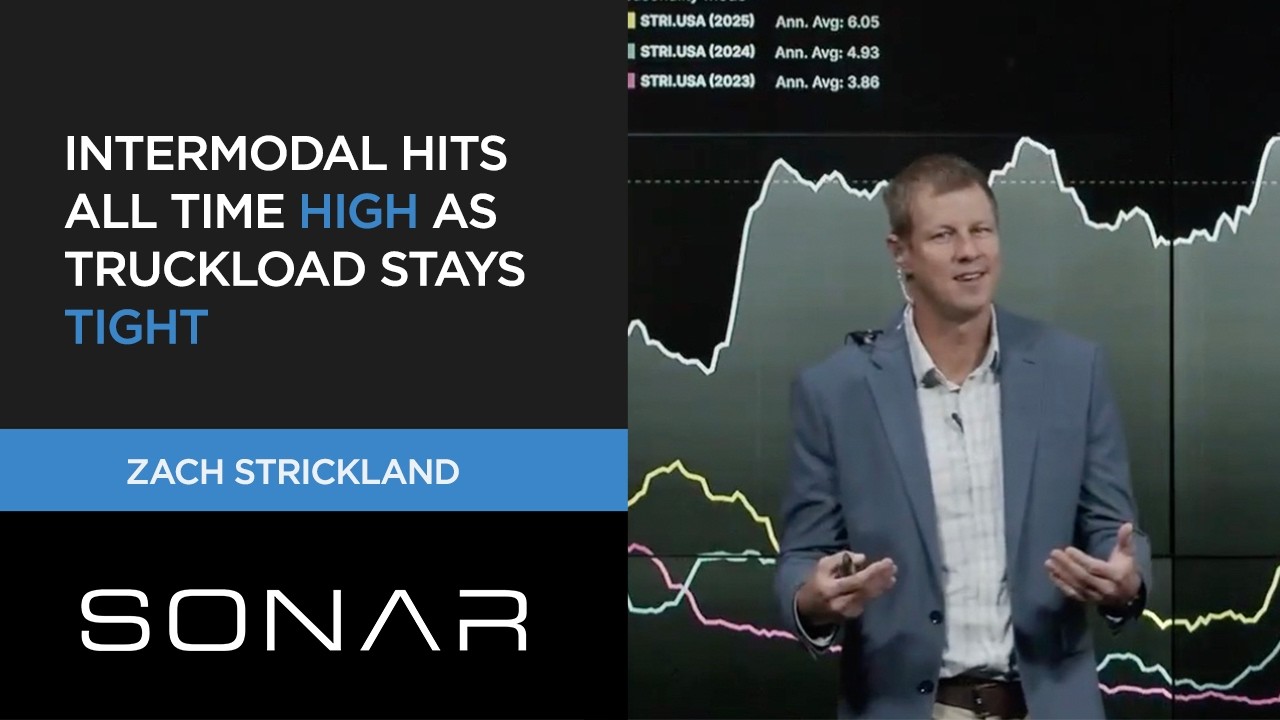 ▶ ▶ |
Intermodal Hits All-Time Highs as Truckload Stays TightFreightWaves looks at record intermodal volumes alongside continued tightness in truckload capacity. |
 ▶ ▶ |
IKEA Picks Kodiak for Driverless Freight RolloutFreightWaves covers IKEA’s selection of Kodiak to roll out autonomous freight operations. |

FreightWaves’ flagship event blends rapid-fire tech demos and world-class speakers with the most legendary networking in logistics. Join 1,000+ freight and logistics experts, industry leaders, entrepreneurs and innovators for a definitive look at the year ahead. Come for the insights, stay for the celebration and leave with the connections that will define your 2027.
|
▸
|
Whether Europe’s charging and hydrogen buildout keeps pace with EV truck mandatesThe EU wants 35% of new trucks running on batteries or hydrogen by 2030, but fewer than 2,000 public truck chargers exist today against a need for 35,000. Watch whether infrastructure spending accelerates or the mandate slips. |
|
▸
|
Whether the Motus fixes actually land in the promised "weeks"FMCSA’s Jesse Elison called the rollout "bordering on disastrous" and says a fix is close. Watch whether the enforcement suspension lifts on schedule once the interface is patched. |
|
▸
|
Whether warehouse job losses start weighing on holiday-season serviceTrucking employment just turned positive year-over-year for the first time since 2023, but warehouse jobs fell a third straight month. Watch whether that gap shows up as fulfillment slowdowns heading into peak. |
