
| The Daily // Thu 10.15.26 | View in browser → |
.png)
The Daily
 |
NEWSLETTER BROUGHT TO YOU BY — AURORA
More Miles. More Revenue. Our self-driving Class-8 trucks haul freight on public roads today with no one behind the wheel. Learn more.
|
|
ANNOUNCEMENTS
|

LTL rates hit new high in Q3, moving higher in Q4
LTL rates finished the third quarter at a new high and are projected to climb further in the fourth, according to Todd Maiden’s reporting on the TD Cowen-AFS Freight Index. Rate per pound ended Q3 at 78.8% above the January 2018 baseline, 11.9 percentage points higher year over year and 1.1 points above Q2. The index expects Q4 to finish at 82.5% above the benchmark, 14.7 points higher than a year ago.
Diesel is the main driver, alongside carrier pricing power. Fuel surcharges were 79% higher year over year in September, as retail diesel rose 31% year over year in July, 46% in August and 68% in September. Large public carriers captured mid-single-digit contractual increases, and many are pulling forward general rate increases. Noncontractual increases, once annual, have moved to an 11-month cadence in recent years. Saia installed a 7.1% increase on July 6, 120 basis points higher than its 2025 increase and three months earlier.
Per-shipment figures were mixed. Q3 cost per shipment fell 2.8% from Q2 but rose 5.3% year over year, while weight per shipment fell 3.4% sequentially and 2.3% year over year. Truckload pricing is firming too: rate per mile was 19.7% above the January 2018 baseline in Q3, with the index projecting 23.4% in Q4, the highest since Q1 2022. The ISM Manufacturing PMI was 54.5 in September, with new orders at 55.3.
Cost per shipment is up 5.3% year over year while weight per shipment is down 2.3%, so the increase is coming from pricing, not heavier freight. Shippers heading into contract talks should expect carriers to point to the index’s Q4 projection. J.B. Hunt reports Q3 results Thursday after the market close.
Houthi attacks add new geopolitical risk to softening container rates
Repeated Houthi missile and drone strikes on Saudi airports and energy sites have escalated the Saudi-Houthi conflict, according to Stuart Chirls’ reporting. Strikes on Riyadh’s King Khalid International Airport killed at least 14 people and injured more than 300, and the airport is closed until at least Oct. 17. Houthi efforts since July to close the Bab el-Mandeb Strait to Saudi-linked traffic included vessel attacks into August, though no broad closure has been confirmed. Freightos said, "For container lines, the immediate effect is uncertainty rather than a confirmed capacity shock." Both major Asia-Europe trades were above $3,000 per FEU last week, about 70% above October 2025.
Carriers had gradually resumed Red Sea Asia-Europe routings since June, adding effective vessel supply, and renewed attacks could reverse that and support rates. Far East-U.S. West Coast spot fell 2% to $8,150 per FEU, possibly the start of a decline after Golden Week.

New chief for DP World Americas
DP World named Morten Johansen chief executive officer of its Americas region, covering North America, South America and the Caribbean, according to Stuart Chirls’ reporting. He announced the appointment in a LinkedIn post Oct. 13 and succeeds Brian Enright. Johansen has more than 25 years of experience in integrated port and logistics businesses and joined the Dubai-based company in 2011. He previously led DP World Dominicana and later served as chief operating officer of DP World Americas. Before DP World, he held senior roles at APM Terminals, Maersk and Sociedade Gestora de Terminais. He is a native of Denmark and is based in Charlotte, N.C.
In June, DP World entered exclusive negotiations with the Port of Corpus Christi to design, build and operate a container terminal that could handle about 1 million TEUs a year. No construction start date or definitive lease terms have been announced. The region also has a $760 million port and free-trade-zone development in the Dominican Republic.
Parcel shipping costs approach record high as extra charges stack up
Rate increases and extra fees carried into Q4, putting 2026 on track to be the most expensive year on record for parcel shipping, according to Eric Kulisch’s reporting on the TD Cowen-AFS Freight Index. The fuel surcharge climbed from 7.75% of the transportation rate in Q1 2021 to 30% in September 2026, and nearly three-quarters of the increase comes from carrier changes to surcharge tables, not pump prices. The Q4 ground parcel index is projected at a record 43.3% above the January 2018 baseline, up 5.8% year over year. Mingshu Bates, chief analytics officer and president of parcel at AFS Logistics, said the fuel surcharge "has become a revenue lever for carriers in addition to a pass-through mechanism."
Bates said, "Even if crude oil normalizes and fuel prices recede, the effective fuel surcharge will not show a material decrease." The express parcel index is estimated at 20.3% this quarter, up 13.8% year over year, a record for a fifth consecutive quarter.
English language rule’s comments bring criticism from Sikh organization
FMCSA’s proposed English language proficiency rule drew more than 2,200 comments, overwhelmingly supportive, according to John Kingston’s reporting. The proposal would place drivers out of service for noncompliance. The Sikh Coalition asked FMCSA to withdraw the rule, saying its analysis of 2021-2025 roadside inspections found 0.19% involved an inability to communicate in or understand English. The group said, "It is critical that FMCSA establish clear, objective standards for roadside inspectors." The American Trucking Associations backs the rule’s goals but said it "remains concerned that the current assessment process leaves room for subjective interpretation."
The Sikh Coalition agrees there is a safety need for drivers to understand a level of English but wants safeguards against discrimination. The ATA wants standardized testing during CDL issuance and renewal. OOIDA noted roadside violations fell from more than 100,000 in 2014 to 9,700 in 2024.
Alabama association chief Colson named new head of ATA
The American Trucking Associations named Mark Colson, president and CEO of the Alabama Trucking Association, as its next president and CEO, effective Dec. 1, according to John Kingston’s reporting. The appointment follows Chris Spear’s sudden departure in late August. Colson has led the Alabama group since 2019 and earlier worked for Alabama business organizations, including the Business Council of Alabama. He sits on ATA’s Strategic Priorities Committee and the Truck PAC Board of Directors, and on the Advisory Committee of the American Transportation Research Institute, ATA’s research arm. His peers at other state trucking associations elected him vice chairman of the Trucking Association Executives Council.
Colson will be the 10th president and CEO in ATA’s history, which dates to 1933. He takes over as the group weighs in on federal rulemakings such as FMCSA’s English proficiency proposal, where ATA has pushed for standardized testing during CDL issuance and renewal.

Brought to you by Samsara — built with operators, for operators. Blind spots cause some of fleets’ costliest, most complex collisions. Learn how AI-powered 360-degree visibility helps you spot risks in real time and protect drivers, pedestrians and cyclists.

| Time | Guest | Topic |
|---|---|---|
| 12pm | Brendan O’Driscoll | Vice President of Product Management at Samsara |
| 12:15pm | Andy Kuchar | President of Centerline Insurance Company |

White Paper: Q3 2026 Freight Brokerage Rate Report
FreightWaves’ Freight Brokerage Rate Report — sponsored by Triumph— provides a review of the previous quarter and a forecast for the coming months.

A Virtual Compliance Department for Every Fleet
Dotra Compliance is giving small and midsize carriers the kind of regulatory oversight that used to require a full-time safety department.

More Miles. More Revenue
Our self-driving Class-8 trucks haul freight on public roads today with no one behind the wheel.

What It Takes to Win in the Next Era of Drayage
Demand volatility, terminal congestion and driver shortages are squeezing drayage margins. FreightWaves and CargoWise Landside surveyed operators on where automation and digital investment are actually paying off.
High-Stakes Freight Brokerage: Risk and Accountability
Shippers moving high-value freight say lower-cost brokerage is starting to carry higher risk. FreightWaves and Werner surveyed where compliance gaps and carrier performance issues are driving accountability higher.
New Research: Tariffs Didn’t Raise Costs. They Raised the Execution Standard.
Infios research shows the 2025 tariff overhaul turned transport mode, tariff exposure and trade-route selection into variables shippers now have to manage actively, not fixed costs they can set and forget.
 ▶ ▶ |
Why October’s Tender Rejections Hit 14% UnexpectedlyFreightWaves’ Zach Strickland breaks down why October tender rejections hit 14%. |
 ▶ ▶ |
Intermodal: Freight’s MUST-HAVE in Volatile MarketsTodd Maiden looks at why intermodal conversion has become a necessity for shippers amid supply chain disruption and persistent fuel costs. |
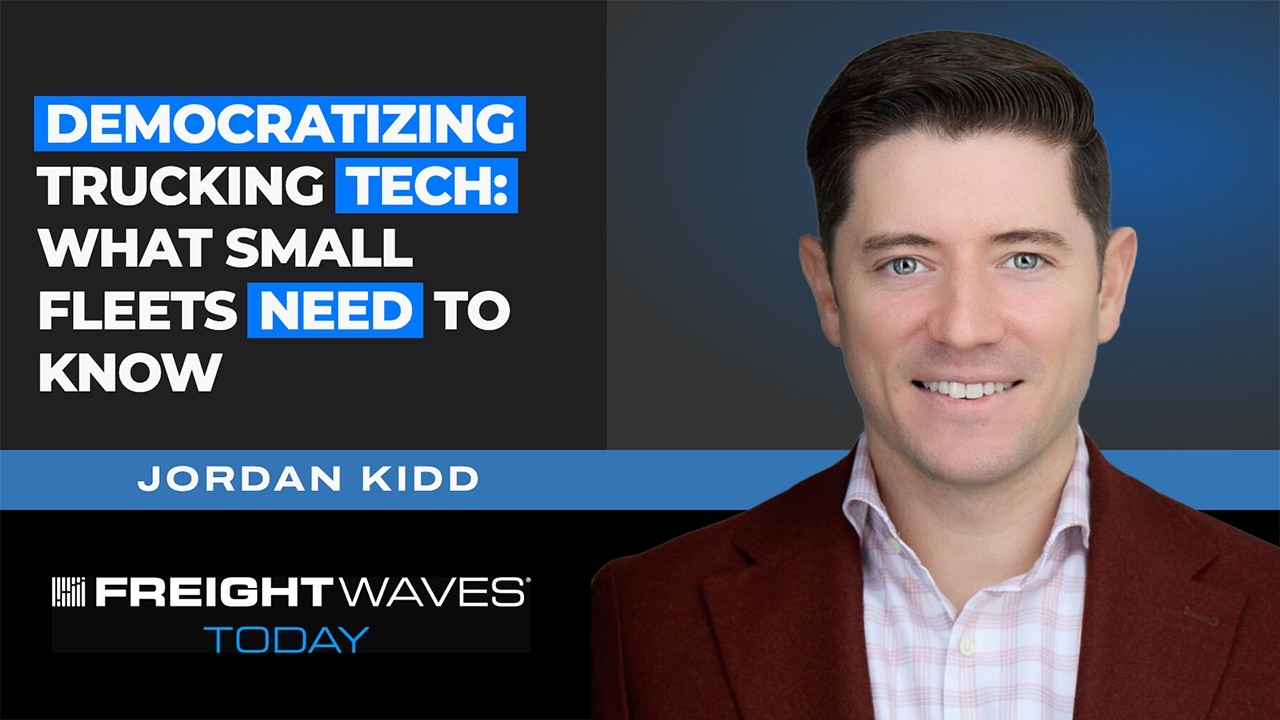 ▶ ▶ |
Democratizing Trucking Tech: What Small Fleets NEED to KnowJordan Kidd on democratizing trucking tech and what small fleets need to know. |

FreightWaves’ flagship event blends rapid-fire tech demos and world-class speakers with the most legendary networking in logistics. Join 1,000+ freight and logistics experts, industry leaders, entrepreneurs and innovators for a definitive look at the year ahead. Come for the insights, stay for the celebration and leave with the connections that will define your 2027.
|
▸
|
Whether J.B. Hunt’s results match the indexJ.B. Hunt reports Q3 results Thursday after the market close. Watch its pricing commentary against the index’s Q4 projections for LTL and truckload. |
|
▸
|
Whether Houthi strikes reach Red Sea shippingThe main upside risk to container rates is a sustained Houthi campaign against Saudi targets or renewed attacks on Red Sea vessels. Watch Far East-West Coast spot rates after Golden Week. |
|
▸
|
What FMCSA does with the English proficiency commentsMore than 2,200 comments are in. Watch whether the final rule adds the clear roadside criteria or standardized testing that the Sikh Coalition and ATA urged. |
