|
View this email in your browser

THE DAILY
Monday, May 11, 2026
The five minutes that makes you the most informed person in freight today
|
|
Newsletter Brought to You By — Amazon Supply Chain Services
|
|
The Daily
Project44 launches Autopilot, a no-code platform for deploying AI agents across logistics workflows
Project44 today launched Autopilot, a no-code platform that lets shippers, brokers and 3PLs stand up AI agents across their supply chain workflows without writing prompts, building integrations or hiring an engineering team to wire it up. CEO and founder Jett McCandless framed it as the future of supply chain software, and he is putting the company’s billion-dollar data graph behind the claim.
The product is built around a visual workflow canvas where agents react to real-time logistics signals, such as a late shipment, a missing PRO number, an ocean container dwelling too long at the port of discharge, and then act on them autonomously. Customers configure triggers, set conditional branching by carrier or lane, define escalation paths and pick post-agent actions like notifications, task creation or routing work back to a human. A draft-and-publish model lets teams iterate on live workflows without breaking production, and every agent action is logged and auditable through project44’s Movement Collaboration Center. The pre-built library covers roughly 40 workflows today, with two to three more shipping each week.
The numbers from 18 months of agent deployment across the project44 network are the part to read twice: a 4% reduction in freight spend, a 70% reduction in manual coordination, sourcing cycles up to 75% faster and as much as a 40% reduction in disruption-related costs. Early customer Eastman Chemical Co. credited the platform with letting its team expand into APAC and onboard less-technical carriers without adding operational complexity. "The right work reaches the right people without manual intervention," said Josh Moss, Eastman’s process lead for global supply chain.
McCandless described a signal-trigger-action framework: signal is the data graph project44 spent a decade building, now connecting 259,000 carriers across 186 countries and ingesting more than 700 million logistics events a day; trigger is the exception engine layered on top during the COVID era; action is Autopilot. "When we turn the lights on, what came back was chaos," he said. "People have been buying technology to help humans do jobs. Now we’re finally at the point where you can buy this technology and it will do the job." Project44 is also rejecting the "control tower" concept the rest of the category has chased for five years, positioning Autopilot instead as the action layer of an intelligent operating system. And the kicker: it is free today, with an implied outcome-based pricing model on the back end.
So What? If you run procurement, transportation or 3PL operations, the labor assumptions in your 2026 plan just got a benchmark you have to answer to. A no-code path to a 4% freight-spend cut and 70% less manual coordination, with zero seat fees today, is the pitch your incumbent visibility, TMS and procurement vendors now have to beat. Ask them for their agent roadmap and their production customer outcomes. If they cannot answer, you have your answer.
Read the full story →
|
 |
|
|
Top Stories
CVSA Roadcheck Week starts Tuesday with ELDs and cargo securement in focus
International Roadcheck, the Commercial Vehicle Safety Alliance’s 72-hour blitz inspection campaign, kicks off May 12 across North America. CVSA inspectors will run roughly 15 commercial vehicle and motorcoach inspections every minute over the window, with this year’s emphasis on electronic logging devices and cargo securement. Past Roadcheck weeks have ranged from a non-event in 2020 to 6-8% spikes in spot rates as drivers choose either to avoid hotspots or take the week off, temporarily pulling capacity. Larger fleets tend to keep running given their compliance investment; smaller operators are more likely to park.
So What? Brokers and shippers with covered loads moving Tuesday through Thursday should price in some Roadcheck premium and a higher rejection-rate risk on lanes that lean owner-operator. It is a modest input next to the broader market, but it can amplify an already volatile early-summer start.
Read the full story →
USPS narrows fiscal Q2 operating loss 24% to $642 million
The U.S. Postal Service cut its fiscal second-quarter operating loss to $642 million, a 24% improvement year over year, even with mail and parcel volumes softening. Total operating revenue rose 2.3% to $20.2 billion on price increases in parcel shipping, marketing mail and First-Class mail, and a $1.3 billion drop in workers’ compensation expense helped trim costs. Net loss, which includes mandated obligations outside management’s control, narrowed to $2 billion from $3.3 billion. Postmaster General David Steiner has still warned Congress that USPS could run out of cash by next spring, citing a 50% drop in mail volume over the digital era and policy mandates that continue to weigh on the books.
So What? For shippers and parcel carriers, the read is that USPS is buying itself time, not solving the underlying volume problem. Price hikes are the lever doing the heavy lifting. Expect another round of postage and parcel rate increases on the horizon if Congress does not move on structural reform.
Read the full story →

Oregon’s container port push lands more federal money, and it is not in Portland
The Oregon International Port of Coos Bay won an $11.25 million federal grant from the U.S. Maritime Administration’s Port Infrastructure Development Program to fund rail improvements on the North Spit, the latest installment in a multibillion-dollar effort to stand up the Pacific Coast Intermodal Port. The proposed ship-to-rail container terminal would create a new West Coast freight gateway with direct inland rail service, layered on top of $25 million in 2024 federal funding and a $100 million commitment from the state. Rep. Val Hoyle, who represents the district and sits on House Transportation and Infrastructure, says PCIP could ultimately support 8,000 supply chain jobs.
So What? West Coast capacity is becoming a portfolio question, not a Los Angeles versus Oakland question. If Coos Bay clears its remaining funding hurdles, ocean carriers and BCOs will have another inland-rail-connected option to relieve pressure on the San Pedro Bay complex.
Read the full story →
Eagle Pass summit underscores cross-border trucking’s nearshoring tailwind
The 6th annual Port of Eagle Pass Trade Summit drew more than 500 trade stakeholders to Texas to talk infrastructure, rail, customs and cross-border trucking, with a keynote from former Mexican President Vicente Fox. Eagle Pass ranked as the country’s 10th-largest border crossing by trade volume in March, handling $3.77 billion in goods. Panelists pointed to nearshoring as the dominant 2026 trend reshaping cross-border freight and called out the need for more transloading capacity, warehousing and heavy-lift infrastructure as oversized and industrial volumes climb. Cargo security and nighttime driving restrictions inside Mexico were flagged as continuing operational headaches for carriers.
So What? Eagle Pass is becoming an infrastructure planning problem as much as a trucking lane. Shippers reshoring or nearshoring production into Mexico should map carrier security posture and lane-level transit reliability now, before scaling volume into the corridor.
Read the full story →
|
|
|
Sponsored Insight
|
Presented by Amazon Supply Chain Services
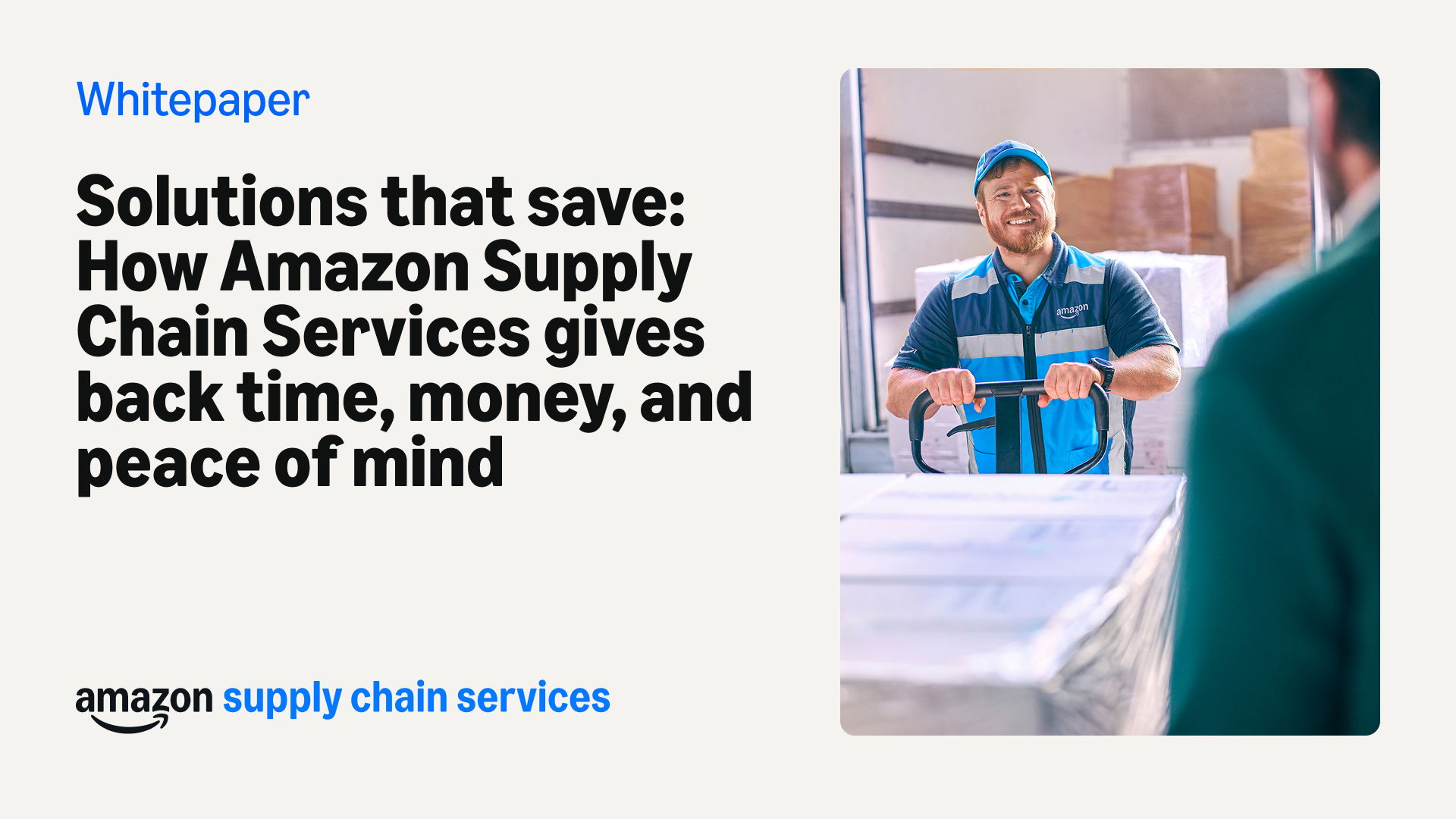
Solutions that save: How Amazon’s Supply Chain Services give back time, money, and peace of mind
Managing a supply chain shouldn’t mean choosing between cost, speed, and peace of mind — but for many businesses, it does. Amazon Supply Chain Services (ASCS) offers flexible, resilient logistics support that eliminates those tradeoffs, helping businesses of every size reduce complexity, cut costs, and reclaim time. With access to Amazon’s global infrastructure and no lock-in required, ASCS gives you the freedom to build the supply chain that works for your business.
Read more → |
|
 |
|
|
From the Research Desk
|
In partnership with Trimble
2026 Outlook: Spot Market Strategies for Shippers, Carriers, and Brokers
Trimble and FreightWaves surveyed shippers, carriers, brokers and 3PLs on how they use the spot market today and how they expect that approach to evolve in 2026. The report covers where organizations spend the most time managing spot freight, how resilience and scale shape sourcing decisions, and how technology and load boards are reshaping the contract-vs-spot balance.
Download the full report → |
|
In partnership with Avalara
Supply Chain Strategies for an Uncertain Trade Environment
Avalara and FreightWaves examine how supply chain teams are adjusting sourcing, classification and compliance workflows as tariffs, trade enforcement and cross-border rules keep shifting. The paper lays out the practical levers shippers can pull to keep costs and lead times under control without rebuilding the network from scratch.
Download the full report → |
|
Courtesy of Werner
Werner doubles down on Mexico with asset-based intermodal expansion
Werner is scaling its asset-based intermodal service into Mexico, with plans to double its 53-foot container fleet to roughly 800 by year-end and extend operations from Monterrey and Silao into Mexico City in the second half of 2026. The carrier is betting on record FDI, border congestion and mode-agnostic shipper demand to make owned cross-border capacity a structural advantage.
Read the full story → |
|
|
Upcoming Event
Freight Fraud Symposium
May 20, 2026 | Cleveland, OH
The industry’s leaders are converging at the Rock & Roll Hall of Fame for one reason: to build a bulletproof supply chain. Be part of this invaluable conversation, an intimate, high-stakes gathering designed to discuss the issues and tackle the escalating crisis head-on.
Register Here → |
|
|
|
What We’re Watching
▸ How fast project44’s Autopilot benchmarks pull other vendors into AI-agent positioning. A 4% freight-spend cut, 70% less manual coordination and sourcing cycles up to 75% faster — offered free today — now sit on every procurement team’s desk. Expect competing visibility, TMS and agentic AI startups to publish their own production metrics within weeks.
▸ Roadcheck Week rejection-rate moves. Tuesday through Thursday is the inspection window. Watch SONAR’s OTRI on owner-operator-heavy lanes for a midweek spike, and watch how quickly capacity normalizes Friday.
▸ Eagle Pass infrastructure announcements. The summit kicked off the conversation on transloading, warehousing and heavy-lift capacity. Expect operator and developer announcements over the next 60 days as nearshoring volumes keep pushing through the corridor.
|
|
|
That’s your Daily for today. See you tomorrow.
Was this forwarded to you? Subscribe here | Have a tip? Just reply to this email.
FreightWaves 405 Cherry St., Chattanooga TN 37402
Unsubscribe | Forward to a Friend | FreightWaves.com
|
|