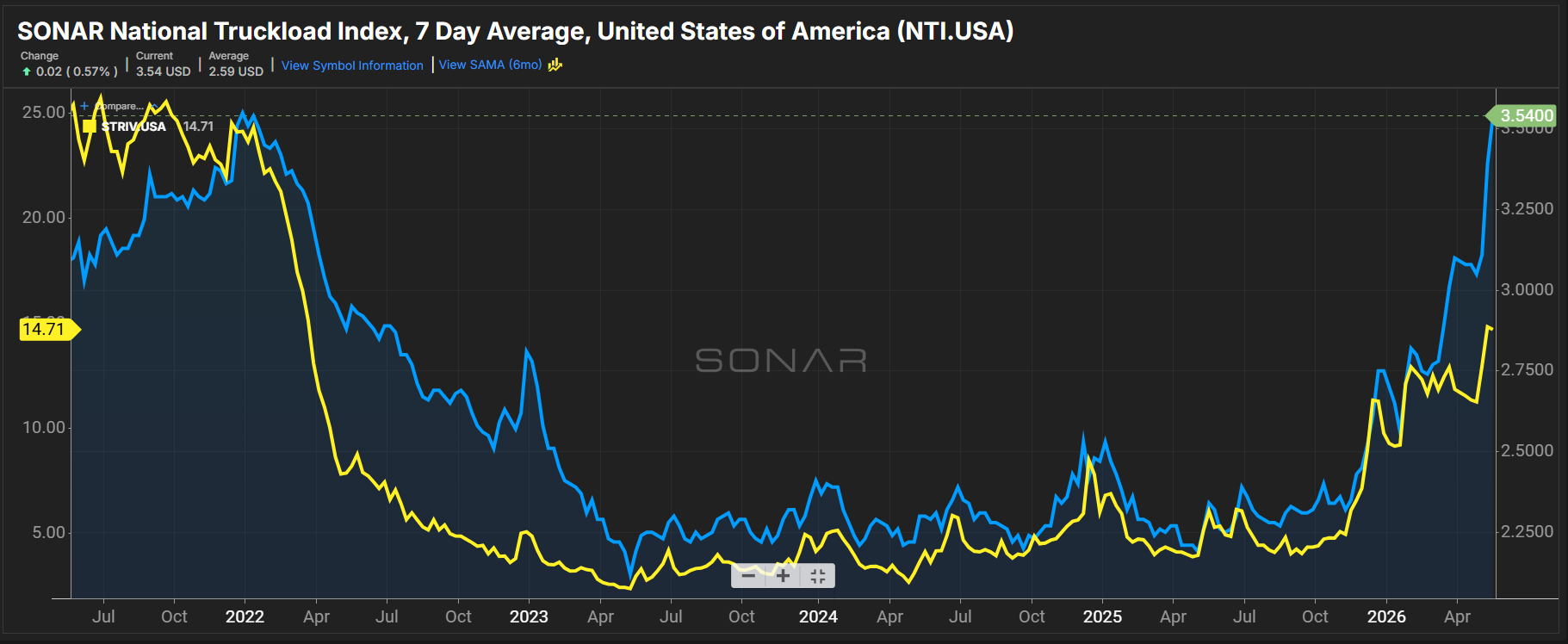
Summary: The week before Memorial Day saw dry van spot market rates and tender rejection rates reach new cycle highs. The holiday weekend historically sees an increase in both as trucking capacity leaves the market. Spot market rates increase while tender rejection rates rise due to decreases in larger fleets’ working tractor percentages until drivers return home.
The impact of the supply-side-driven upcycle continues. Spot market rates are at their highest levels observed in the SONAR dataset other than a brief period between late December 2021 and January 2022. Tender rejection rates are at their highest levels since Q1 2022.
In the past week, the SONAR National Truckload Index 7-Day Average (NTI) rose 27 cents per mile from $3.27 on May 14 to $3.54. The NTI is 80 cents per mile, or 29%, higher than $2.74 last month and $1.19 per mile, or 50.6%, higher than $2.35 last year.
In the contract market, dry van tender rejection rates rose as larger fleets reduced tender commitments due to declines in their fleet availability, expressed in working tractor percentages.
The SONAR Truckload Rejection Index Van (STRIV) rose a week earlier than the NTI, with the past week seeing a slight drop of 15 basis points from 14.86% to 14.71%. The real movement occurred in the comparisons with last month and last year. Compared with last month’s value of 11.31%, STRIV is 340 basis points higher. Compared with last year’s value of 5.98%, the increase is much more pronounced at 873 basis points.
A good rule of thumb for working tractor percentages: Fleets typically operate anywhere between 85% and 92%, meaning at any given time around 8% to 15% of their assets are either unseated or in shop status. When holidays happen, that number flips, with 80% to 90% of their fleet returning home and around 10% to 20% staying out. This effect is more pronounced during the Thanksgiving, Christmas and New Year’s holidays, but events like Memorial Day, the Fourth of July and Labor Day also show up in SONAR data via higher tender rejection and spot market rates.
Looking ahead, the next question for both rates remains whether there will be a new pricing floor or if rates will settle downward before rising again ahead of the Fourth of July holiday. Given that the current upcycle is capacity-driven, with higher barriers to entry and regulatory scrutiny, current consensus points to the former rather than the latter.