Border States Ramp Up Commercial Vehicle Enforcement
|
|
|
|
|
|
NEWSLETTER SPONSORED BY – TRUCKSTOP.COM
|
Whether you’re booking loads or hauling them, Truckstop gives you the tools, the rates, and the network to keep moving. Visit Truckstop.com.
|
|
|
|
This week’s top stories in trucking
|
|
|
|
Spot Rates Surge 31% as Freight Market Reprices From the Supply Side
|
Dry van spot rates hit $2.14 per mile in May, up 31% year-over-year, while contract rates climbed 9% to $2.18, per the latest U.S. Bank/DAT Freight Payment Index. The contract-to-spot spread narrowed from about 39 cents to just 11 cents, erasing the cushion shippers lean on to manage cost swings. Spot shipments fell to 1.11 million in May from 1.31 million in April, so costs are climbing even as volume shrinks. LTL held its ground: Old Dominion and XPO both posted yield gains despite fewer shipments per day.
|
|
|
|
Border States Ramp Up Commercial Vehicle Enforcement
|
Texas, Arizona and California agencies stepped up enforcement targeting unsafe trucks, unqualified drivers and hours-of-service violations. A North Texas sweep logged 132 stops, 109 equipment citations and 24 detentions for unlawful presence. Arizona troopers sidelined a Mesa driver lacking a CDL, medical certificate and USDOT number, with an inoperative trailer breakaway device. California Highway Patrol added inspections near El Centro after a rise in crashes and HOS violations, reminding drivers to keep accurate logbooks and skip driving fatigued.
|
|
|
|
How myMechanic is digitizing fleet roadside repairs
|
myMechanic launched Dealer-Connect, a digital dispatch layer that routes fleet road calls straight to tire dealers with no app, no login or call-center handoff. Founder Alex Bezzubets says digital dispatch shaves 15 to 25 minutes off breakdowns that otherwise take 4 to 4.5 hours, costing fleets $450 to $750 a day. The platform gives fleets one portal across dealer brands while giving dealers direct fleet access, live tracking and clean reporting, positioning itself as neutral infrastructure rather than another marketplace or dispatch competitor.
|
|
|
|
ISM Manufacturing Index Extends Growth Streak, Bodes Well for LTL
|
ISM’s Manufacturing PMI hit 53.3 in June, a sixth straight month of expansion, though below expectations. New orders held at 56, with four of six major industries reporting gains. Roughly two-thirds of LTL revenue ties to industrial output, and improving freight data from ArcBest, XPO, Old Dominion and Saia already reflect the tailwind. ArcBest pushed a 5.9% general rate increase six weeks early and raised its Q2 outlook. Tight supplier deliveries and lean customer inventories point to continued capacity pressure ahead.
|
|
|
|
Treasury Sanctions Target CJNG’s Cross-Border Fuel Smuggling Network
|
The Treasury Department sanctioned two Mexican nationals and nine companies accused of helping the Jalisco New Generation Cartel run a cross-border fuel-smuggling operation. Officials say huachicol — fuel theft and smuggling — has become the cartels’ top non-drug revenue source, costing Mexico roughly $9 billion in lost tax revenue in 2024. Investigators flagged more than 160 suspicious activity reports and $7 billion in suspect transactions, with cartel networks leaning on shell companies in trucking, logistics and finance to move fuel across the border.
|
|
|
|
SONAR spotlight: Spot rates party like it’s the Fourth of July
|
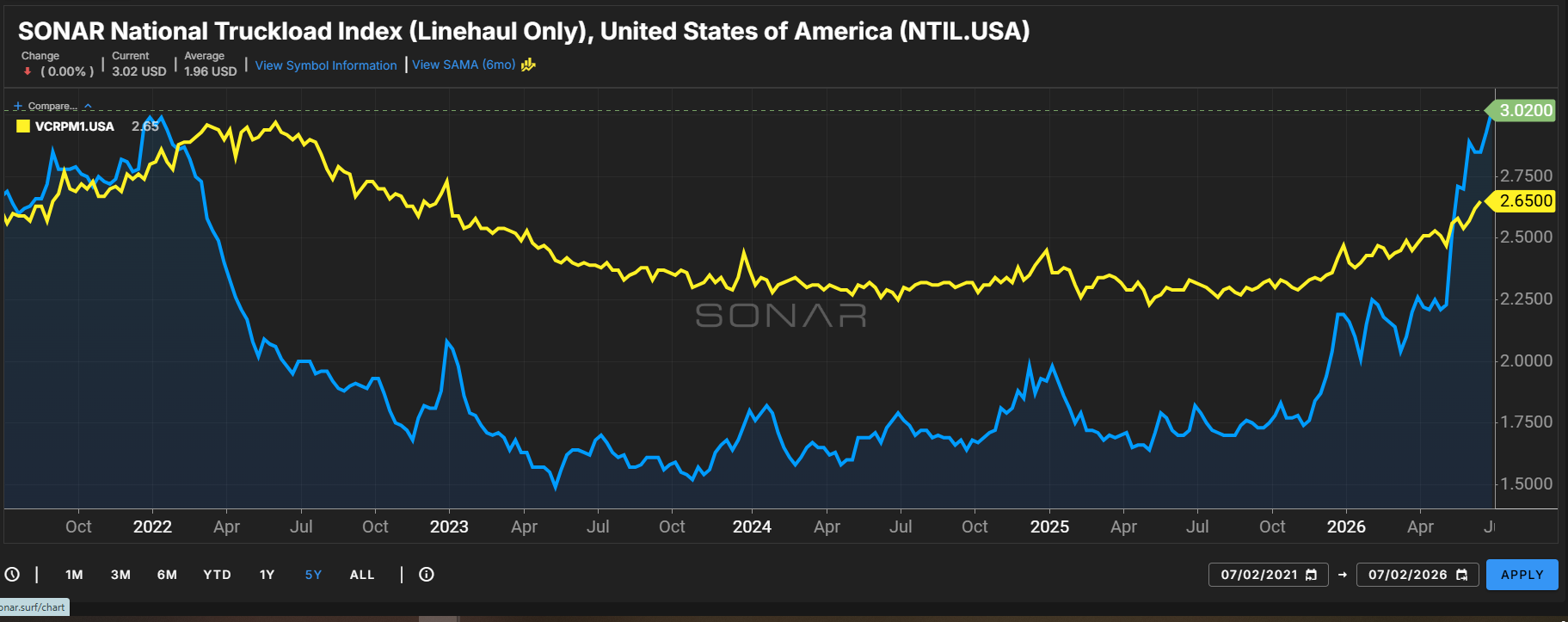
Summary: Two days before the Fourth of July weekend, spot market linehaul rates continue to outperform contract rates, breaking $3 per mile. The spread between contract and spot rates is one indicator that carriers continue to gain greater pricing power. As spot rates move higher, contract rates follow. The last time spot market linehaul rates reached this level was January 2022.
Diving into the data, the SONAR National Truckload Index (Linehaul Only), or NTIL, gained 11 cents per mile week-over-week, rising from $2.91 on June 24 to $3.02. The NTIL is 7.1% higher than $2.82 last month and 70% higher than $1.78 per mile last year.
To calculate the NTIL, fuel costs are based on the average retail price of diesel and assumed fuel efficiency of 6.5 miles per gallon. The formula is NTID – (DTS.USA / 6.5).
For contract rates, whose initial reported average base rate per mile (VCRPM1) lags 14 days, expect continued upward pressure as carriers reprice their networks through RFPs and mini-bids. Year-over-year comparisons are helpful to understand contract rates; the most recent reading was June 18. Compared with last June, contract rates are 14% higher.
Looking ahead, expect higher spot rates leading up to and through the Fourth of July weekend as trucking capacity exits the market. In the contract space, bid cycles are compressing. Before the current rate uptick, RFP cycles often spanned 12 to 18 months. Based on recent conversations with a large freight payment provider, that window has shrunk to three-month repricing cycles. In one case, a shipper repriced its network every 30 days.
This behavior is likely to continue as routing guide failures mount and previously agreed-upon rates and volumes become “paper rates” — an old Chicago trading term for contracts whose value is less than the paper they’re printed on. One reason is that carriers are seeking to recover years-long cost inflation that has eroded their margins. Another is stronger demand for drivers, which is raising the cost to attract and retain them. Recently announced driver pay increases by large truckload carriers support this view.
|
|
|
|
The Routing Guide: Links from around the web
|
|
|
|
THE OLD POST OFFICE, CHICAGO | JULY 15, 2026
|
|
|
|
FWTV EVENT | JULY 28, 2026
|
|
|
|
Like the content? Subscribe to the Newsletter!
|
|
|
Loaded and Rolling Podcast links:
|
|
|
Download the FreightWaves App
|
|
|
|
|