Daimler Truck Bets on Hydrogen Combustion With KEYOU Partnership
|
|
|
|
Kratos Takes Autonomous Platooning Cross-Country in NASCAR Logistics Run
|
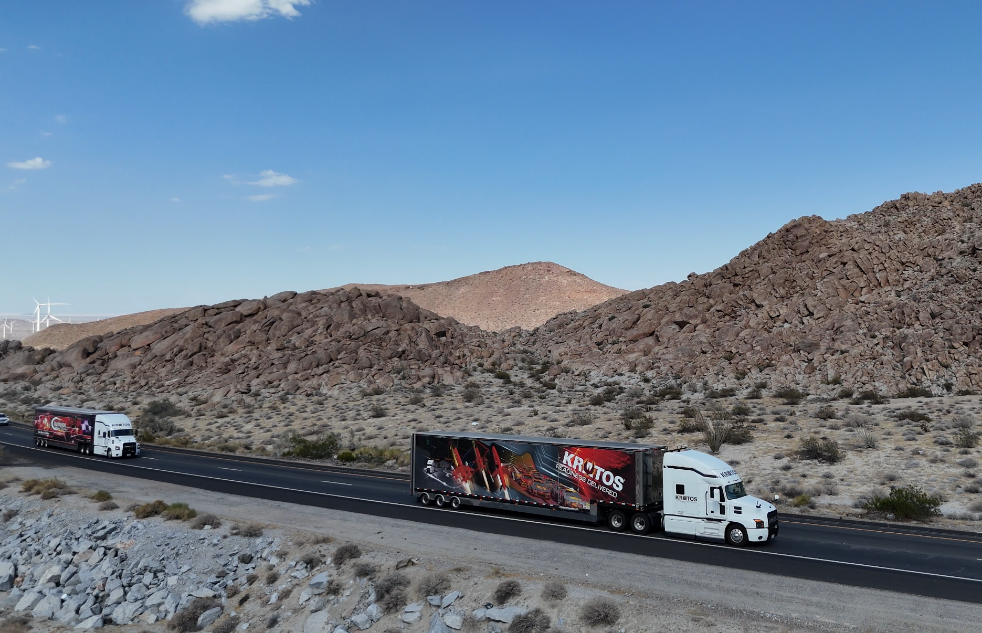
Defense-derived autonomy just completed its most demanding freight test yet. Kratos Defense & Security Solutions hauled race equipment from Charlotte, N.C., to Naval Base Coronado in California using an autonomous follower tractor-trailer, stretching its leader-follower platooning system into a multi-state, long-haul commercial logistics operation for the first time.
The June deployment, conducted with motorsports logistics provider Champion Tire & Wheel in support of the NASCAR Anduril 250, paired a human-driven lead truck with an autonomous follower supervised by an onboard safety rider. The system used synchronized steering, braking, and speed control across dynamic roadway and environmental conditions, combining GPS, onboard sensors, and advanced vehicle controls.
"Last year proved the concept. This year demonstrated scalable execution," said Maynard Factor, vice president of business development at Kratos. "Our autonomous follower tractor-trailer successfully completed a cross-country logistics haul, demonstrating how platooning technology can safely improve efficiency, expand freight capacity, and help address ongoing driver shortages."
Kratos (Nasdaq: KTOS) built the deployment on its 2025 auto-platooning demonstration at the Brickyard 400 in Indianapolis, a controlled-environment proof of concept now expanded into revenue-generating commercial logistics. By enabling one driver to oversee multiple vehicles, the company is pitching leader-follower platooning as a practical near-term answer to freight capacity constraints.
|
Daimler Truck Bets on Hydrogen Combustion With KEYOU Partnership
|
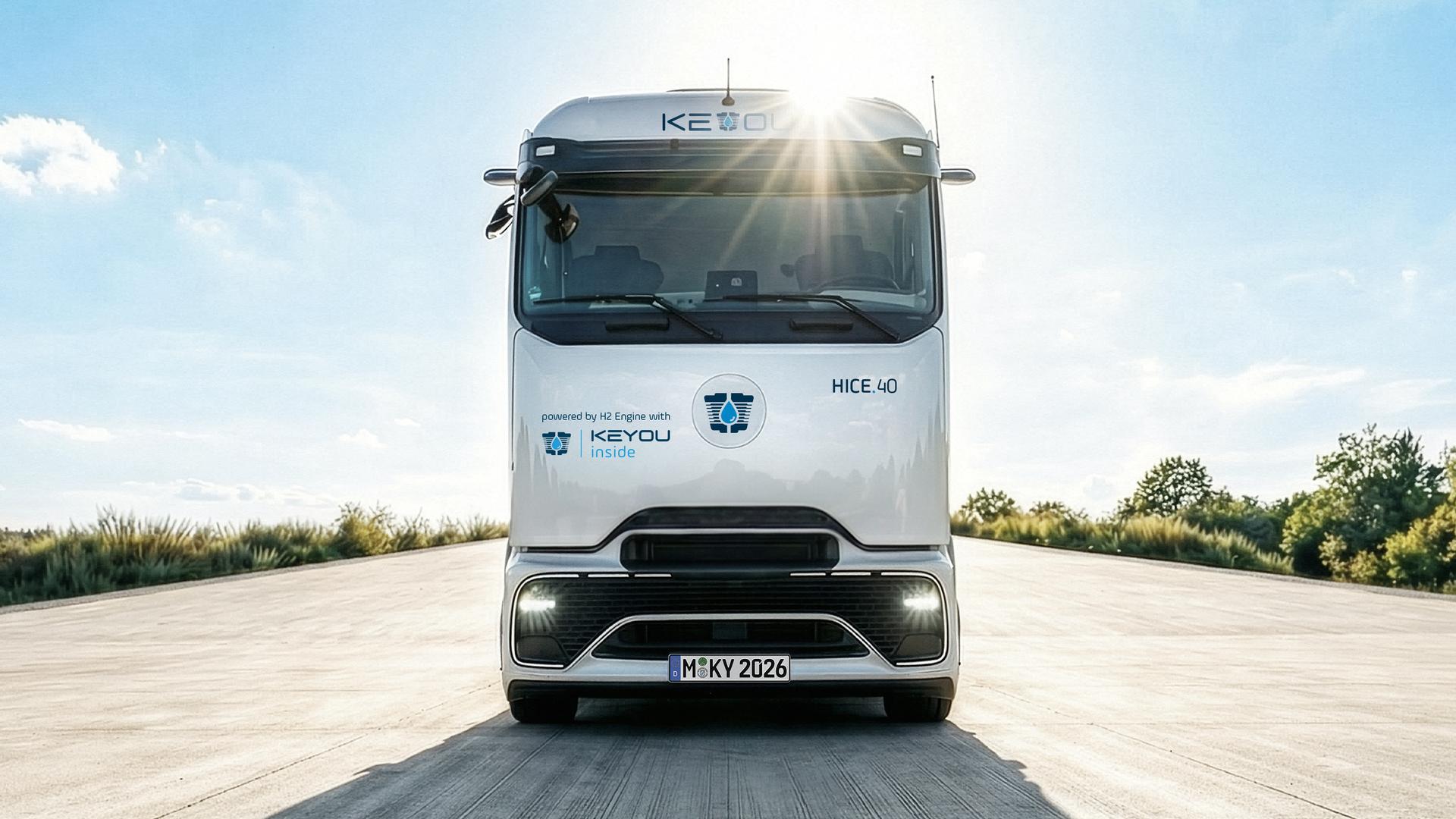
Battery-electric may not be the only path forward. Daimler Truck AG and Munich-based KEYOU GmbH signed an agreement June 22 to bring hydrogen internal combustion engines to market readiness, expanding Daimler Truck’s decarbonization strategy beyond batteries and fuel cells to include a third drivetrain option for road freight.
Under the deal, Daimler Truck plans to sell Mercedes-Benz Actros L 1848 tractor units and 12.8-liter engines, built in Mannheim, to KEYOU, which will convert them to run on hydrogen. External conversion partners will handle the technical adaptation. The resulting KEYOU HICE.40, designed for a 40-ton gross vehicle weight, is expected to deliver up to 650 kilometers of range on compressed hydrogen and up to 350 kW of power. Market launch is targeted for 2027.
"The road freight transport sector requires different drive solutions for different applications," said Andreas Gorbach, Daimler Truck board member responsible for truck technology. "By working with KEYOU, we are partnering with a specialized company to bring hydrogen combustion technology to market quickly and efficiently."
KEYOU chief executive Thomas Korn called the partnership "an important step" toward industrial application. "Together, we can significantly accelerate the development and scaling of hydrogen-based drive solutions in the commercial vehicle sector," he said.
Hydrogen internal combustion engines offer lower system complexity than fuel cells and can leverage existing engine architectures, a practical bridge for fleets not yet ready to go fully electric.
|
Mack’s OTR Order Book Is Full: Now Comes the Harder Part
|
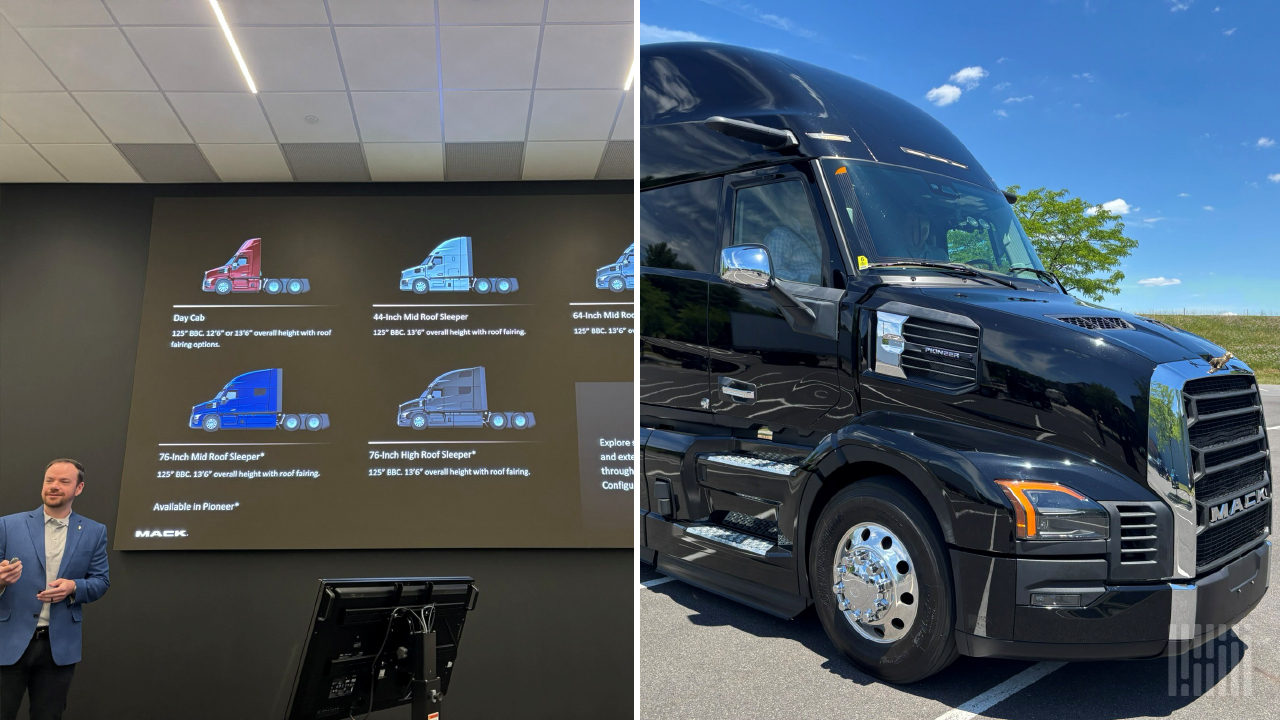
Fourteen months after returning to its Brooklyn roots to reveal the Pioneer, Mack Trucks gathered trucking journalists at its Allentown research center last week with a clear early signal: the order book for both the Pioneer and the Anthem is sold out through the end of 2026.
The product updates presented at the June session highlighted meaningful differentiation between the two trucks. The Pioneer now comes standard with a 76-inch sleeper, a battery-driven integrated parking cooler (Mack’s proprietary auxiliary power unit, installed at the factory) and a Bumper-to-Back-of-Cab measurement of 125.5 inches. The Anthem’s BBC was trimmed from 117 to 113.5 inches in its latest iteration, tightening its fit for urban and regional markets.
"We previously had just the Anthem that was really our do-it-all highway tractor," said Blake Routh, Mack Trucks senior highway product manager. "When we launched the Pioneer we really moved from one truck with just the Anthem to now two trucks with the Pioneer and the new Anthem."
Both trucks share identical powertrains. The Pioneer’s longer nose gives it a slight aerodynamic fuel efficiency edge. Routh cited comfort, safety, efficiency, and uptime as the four core selling points, with comfort leading the pitch.
David Galbraith, Mack vice president of global brand and marketing, put the growth strategy plainly: "We get people to put their butts in the seats, and once they realize they like it, they sell it themselves. The trucks are amazing. It’s just a matter of proving the value."
|
|
|
|
The National Highway Traffic Safety Administration proposed removing the manual brake pedal requirement for fully autonomous vehicles, a rule change that would clear a key regulatory hurdle for companies like Tesla and Zoox. Braking performance standards remain in place. The public has 30 days to comment before the DOT acts. (Reuters)
Mobileye plans to launch a U.S. robotaxi service in 2027 with an initial fleet of 100 autonomous vehicles in an unnamed city. The Intel subsidiary said it expects to scale to roughly 17,000 robotaxis over the following five years, using its Moovit app for consumer-facing bookings. (Tech Crunch)
Einride (Nasdaq: ENRD) appointed R. Lynn Atchison, a veteran financial executive with CFO roles at HomeAway, Spredfast, and Hoover’s, to its board of directors following the company’s recent Nasdaq listing. Atchison, who currently serves on the boards of Bumble and Q2 Holdings, brings IPO, M&A, and governance experience. (Einride)
Class8, which pulls real-time axle-weight data from Daimler, Volvo and Mack trucks built since 2019, says the technology can detect cargo theft without ELD integration. CEO Chris Atkinson calls ECU data tamper-proof and sees axle-weight monitoring as a simpler, less invasive alternative to current carrier vetting systems. (Overdrive)
Orange EV delivered its 2,000th electric terminal truck to Coke Canada Bottling, expanding across facilities in British Columbia and Quebec. The company’s fleet has now logged more than 33 million miles across more than 370 fleets in 41 U.S. states, four Canadian provinces, and the Caribbean. (Orange EV)
|
As always, thanks for watching and reading.
Thomas Wasson
twasson@firecrown.com
|
|
|
|
|