Welcome to this week’s Supply Chain Radar, where the Strait of Hormuz has a "cover charge," warehouses are growing wheels, and the freight market is catching a fever. 🌊🎟️🚛
The throughline? The era of "cheap and easy" is officially in the rearview. Whether it’s Iran institutionalizing maritime tolls or trucking rates hitting a three-year high, the cost of moving goods is being repriced in real-time. If you aren’t building flexibility into your fixed costs and your routes, you aren’t just behind—you’re paying the premium.
👉 Scroll on for the "Hormuz Toll," the rise of trailer-tenants, and why your freight budget just caught a 2026 heatwave.
The $2 Million "Cover Charge" at the Strait 🌊🎟️
Iran just turned one of the world’s most vital chokepoints into a high-stakes VIP club. Tehran has named six "friends" (China, Russia, India, Pakistan, Iraq, and Bangladesh) who get the green light to pass through the Strait of Hormuz. Everyone else? You’re either blocked as an "enemy" or looking at a proposed US$2 million "transit fee" per vessel. With Brent crude already dancing above $104, this isn’t just a regional spat—it’s a global tax on energy and a masterclass in using geography as a geopolitical lever.
Warehouses on Wheels: The Ultimate "Pressure Relief Valve" 🚛🏠
Why sign a five-year warehouse lease when you can just rent a few dozen trailers? As tariffs and nearshoring scramble inventory levels, companies are ditching fixed brick-and-mortar costs for mobile storage. Industry leader Warehouse on Wheels is seeing a surge in demand, offering "warehouse space" at roughly $6.64/sq. ft.—nearly half the cost of traditional leases. From Midwest auto plants to Mexican nearshoring hubs, the trailer is no longer just for transport; it’s a flexible, forklift-rated overflow valve.
Buckle up—the "Great Freight Recession" is officially over, and the hangover is going to be expensive. National dry van spot rates have rocketed to $2.89 per mile, a 20% year-over-year jump. Between a surge in industrial demand, produce season, and a "West Coast Awakening" as containers flood in post-Chinese New Year, carriers finally have the steering wheel. With tender rejections in the Midwest hitting 18%, shippers who waited to lock in contract rates are now staring down a very expensive spot market.
Forget glossy forecasts; the "Containers Don’t Lie" (CDL) Maritime Symposium is the industry’s ultimate reality check. Curated by trade expert Lori Ann LaRocco, this June 2026 D.C. gathering operates under Chatham House Rules, allowing titans to bypass PR spin for the "ground truth."
This isn’t a room built for scale. It’s built for signal. CDL is curated for private, high-quality discussions where access matters and every conversation carries weight. You’re not networking across the floor; you’re exchanging strategy with decision-makers from Target, National Tree Company, and IKEA.
The dialogue extends deeper. Leaders from the Port of Virginia, Akin, NYSHEX, IMC Logistics, and the Gemini Shipping Association will be there to compare notes on what’s actually moving.
In 2026, the box is the only honest broker. While sentiment reports fluctuate, LaRocco’s data reveals the hard reality of geopolitical friction.
If You Sound Like Everyone Else… You’ve Already Lost 🎯📦
In a 2026 market flooded with “AI-powered insights” and “end-to-end visibility” claims, most supply chain tech companies don’t actually have a product problem—they have a positioning problem. When every deck looks the same, buyers don’t get excited; they get "vendor fatigue" and default to the safest, biggest incumbent (or worse, they do nothing).
That’s where Pesti comes in. They argue that in a saturated ecosystem, innovation alone isn’t your shield—differentiation is. Whether you’re a WMS, TMS, or a shiny new orchestration platform, your survival depends on moving past generic buzzwords and defining a narrative that proves why you are the only choice for a specific operational fire drill.
That’s the minimum jump in truckload spot rates compared to last year. When you combine this with fuel shocks from the Iran conflict and a crackdown on non-domiciled driver regulations, the "waterfall effect" is in full swing.
The pivot? Keep an eye on Intermodal Rail. As diesel prices climb to 2022 highs, the cost-per-mile math is starting to favor the tracks again. If you can handle the longer lead times, the rails might be your only escape from the $3.00/mile trucking reality.
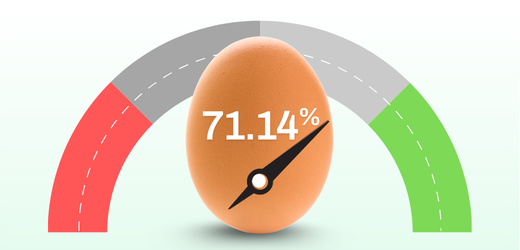
Here’s the scoop on the SCR Egg-O-Meter: It’s a brand-new rating tool that checks out what the media said about business and supply chain execs in the past 30 days and scores them based on the tonality of mentions from a natural language processing algorithm.
The “Egg-o-Meter” is like a quirky kitchen gadget for measuring how well a supply chain leader can cook up success. It cracks open key traits—like adaptability, collaboration, and innovation—and scrambles them into a perfect leadership recipe. The goal? To avoid being a hard-boiled traditionalist or a runny risk-taker. It’s all about being the ideal sunny-side-up mix to lead teams through the ever-changing heat of the supply chain kitchen! 🍳📦
Udit Madan, SVP Worldwide Operations at Amazon — 71.14% (Over-Easy)
Udit Madan is the man currently holding the keys to the world’s most complex logistics engine. With a score of 71.14%, Madan is landing in the "Over-Easy" category—solid, dependable, but feeling the heat of a rapidly shifting 2026 landscape.
Since taking the reins of global operations,Madan has been the chief architect of Amazon’s "regionalization" 2.0. By shortening the distance between the product and the prime member, he’s managed to slash delivery times while keeping a lid on the "bullwhip effect" that plagued the early 2020s. However, his score is being clipped by the macro-pressures we’re seeing elsewhere: rising diesel costs and the intensifying "labor vs. automation" debate in the fulfillment centers.
Madan’s leadership is currently defined by a "relentless refinement" strategy—using AI to predict local demand spikes before they happen, ensuring that when the freight market tightens (as we’ve seen this week), Amazon’s internal fleet is already positioned to absorb the shock.
Madan is proving that in 2026, the best supply chain isn’t the one with the most trucks, but the one with the best data. Shippers should watch his moves in "last-mile density" as a blueprint for surviving the current capacity crunch.
.png?width=1196&upscale=true&name=Header-Image-SCR%20(1).png)