|
View this email in your browser

THE DAILY
Wednesday, May 20, 2026
The five minutes that makes you the most informed person in freight today
|
|
Newsletter Brought to You By — Amazon Supply Chain Services
|
|
The Daily
Supreme Court ends federal preemption shield for freight brokers
Spot rates hit $3.55 a mile Tuesday, within 13 cents of the all-time record. That is the short story. The long story, the one that reshapes trucking for years, landed May 14, when the Supreme Court ruled 9-0 in Montgomery v. Caribe Transport II, LLC.
Justice Amy Coney Barrett wrote the opinion. The ruling eliminates the Federal Aviation Administration Authorization Act preemption defense that brokers have used for decades to get negligence lawsuits thrown out before discovery. The case: Shawn Montgomery lost part of his leg in a 2017 Illinois crash when a Caribe Transport truck rear-ended his stopped vehicle. C.H. Robinson brokered the load. Caribe carried a conditional safety rating. Barrett ruled that requiring a broker to exercise reasonable care in selecting carriers directly concerns motor vehicle safety — which the statute explicitly preserves from preemption. That shield is gone.
The capacity math is stark. FMCSA has flagged roughly 300,000 trucks with conditional safety ratings — carriers with documented deficiencies like those in Montgomery. Brokers who tender to a conditional-rated carrier now face exactly that fact pattern in court. If those 300,000 trucks lose freight access at scale, meaningful capacity exits. The problem extends further: approximately 1.2 million additional trucks carry no FMCSA safety rating at all. "Unrated" does not mean safe. It means no federal auditor has walked through the door. Brokers who need a defensible record in court are likely to stop tendering to unrated carriers as well.
"Rates are definitely going up, the question is how much," Craig Fuller wrote Tuesday. With spot already at $3.55, Memorial Day seasonality pushing capacity tighter through the weekend, and now a structural reduction in available trucks looming, the math points one direction. Fuller’s analysis: $4 spot rates are "written in the stars," and $5 per mile "is on the horizon." Remove 1.5 million trucks from broker networks — or even materially constrain their access — and there is no relief valve. This is how supercycles start.
Justice Kavanaugh’s concurrence offered the industry some guardrails, stressing that brokers acting reasonably and selecting reputable carriers "should be able to successfully defend against state tort suits." Trade groups seized on that language. It does not change the operational calculus. No broker wants to be the test case for what "reasonable" means in a given state court, and the cheapest path to defensibility is to stop tendering to carriers without clean safety records altogether.
So What? Carriers with clean safety ratings are entering the strongest market of their careers, especially if demand holds while capacity exits with no reset valve. Shippers who contracted in Q4 2025 are going to reprice in Q4 2026 at significantly higher rates. Brokers: build your written carrier onboarding SOPs before the first post-Montgomery lawsuit reaches discovery. In court, an undocumented process and a nonexistent one look identical to a jury.
Read the full story →
|
|
|
Top Stories
3PL insurance premiums face 3x to 5x increases after Supreme Court ruling
The first financial estimates from the post-Montgomery world are already circulating. TD Cowen’s Jason Seidl ran a phone roundtable with industry opinion leaders on the insurance picture; the conclusions were sweeping. The gap between what asset-based carriers and brokers pay in commercial auto premiums — carriers currently spend roughly 10x more than 3PLs — "should narrow significantly over the coming years," the report said. Early estimates from market sources run from 3x premium increases (per one attorney specializing in logistics who has heard from large brokerage clients in renewal discussions) to 5x (the figure TIA President Chris Burroughs said is prevalent in industry conversations). TD Cowen also said that 6-7% of trucking capacity, comprising mostly of conditional-rated carriers, may exit broker platforms as companies distance themselves from potential liability.
So What? Brokerage insurance has historically run 1-3% of revenue. At 3x to 5x those levels, the cost structure at most brokerages breaks. TD Cowen put the floor plainly: premium increases will "restrict brokers’ ability to gain share on price and likely raise the floor on trucking rates." If your brokerage is coming up for renewal in the next 90 days, expect the underwriter to ask for time.
Read the full story →
|
 |
STG Logistics gets court approval to exit Chapter 11, wiping out over 90% of debt
A federal bankruptcy court in New Jersey approved STG Logistics’ reorganization plan Monday, clearing the intermodal marketing company to emerge from Chapter 11 in the coming weeks. The plan reduces STG’s funded debt by more than $1 billion, which is over 90% of its total debt load, and delivers the remaining $25 million of $150 million in committed fresh capital. Affiliates of Fortress, Fidelity and Invesco led the restructuring and now hold a majority stake. The deal also resolves litigation from minority lenders who alleged their interests were compromised in a 2024 forbearance arrangement with lead lenders.
So What? STG operates roughly 100 CFS and transloading facilities, 15,000 53-foot containers and 3,000 owner-operator tractors coast to coast and into Mexico. A deleveraged STG with fresh institutional capital re-enters the market as a credible competitor in port-to-door intermodal. Watch how the company deploys that capital as the freight cycle strengthens.
Read the full story →
Einride deploys Level 4 autonomous electric trucks in Ohio in DriveOhio partnership
Autonomous trucking is expanding beyond the Sun Belt. Einride and EASE Logistics announced the deployment of SAE Level 4 cabless autonomous electric trucks between EASE warehouses in Marysville, Ohio — part of the Ohio Department of Transportation’s Truck Automation Corridor Project with DriveOhio and Indiana DOT. Two of Einride’s cabless trucks will operate on both private property and local public roads starting this summer. The deployment marks EASE’s third autonomous trucking project alongside DriveOhio, making the Columbus-based company one of the few logistics providers actively testing multiple autonomous freight platforms in live operations.
So What? Autonomous freight is pushing into Midwest manufacturing country. Data from live operations between EASE warehouses will produce the operational evidence — on safety, efficiency and workflow impact — that carriers and shippers need before committing capital to autonomous platforms.
Read the full story →
Sponsored By Infios
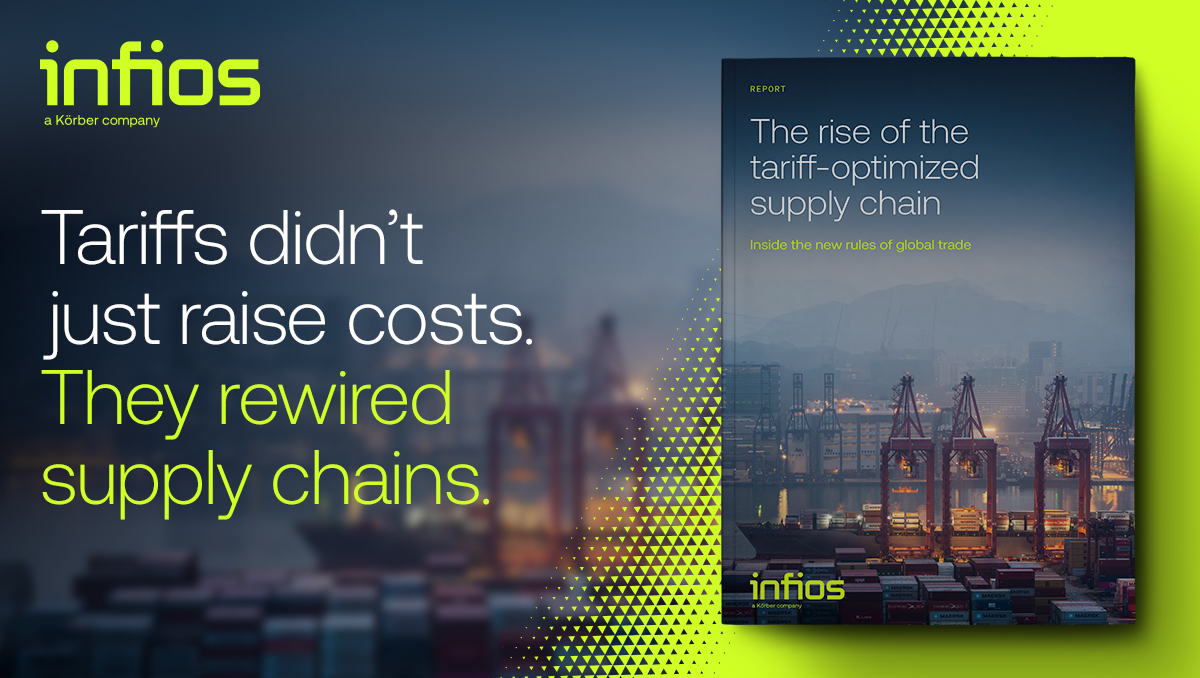
New Research: Tariffs Didn’t Raise Costs. They Raised the Execution Standard.
The 2025 tariff environment restructured U.S. trade overnight. Three patterns define the companies that adapted: transport mode became a tariff decision, tariff exposure shifted from a fixed cost to a managed variable, and trade routes became an early-warning system. The full Infios report covers the mechanics behind each pattern and the capability framework companies are building to compete in a tariff-volatile trade environment.
Download the report → |

Post-Montgomery, broker carrier vetting must shift from safety ratings to risk profiles
Expert witness and freight risk advisor Rob Carpenter argues the industry is asking the wrong question after Montgomery. Safety, compliance and risk are not synonyms. Roughly 92% of carriers are unrated, meaning FMCSA has never audited them, not that they passed. An empty file is not a clean bill of health. A real 360-degree risk profile extends past FMCSA data to financial health, corporate structure, federal litigation history and insurance policy language and limits. The most important shift: build a documented, repeatable carrier vetting SOP, because in discovery an undocumented process and a nonexistent one are indistinguishable.
So What? The post-Montgomery standard is not a safety rating. It is a documented vetting process that would survive cross-examination. Brokers and shippers who have not built one need to act now, before the next crash puts them in discovery.
Read the full story →
Sponsored By PCS
Busy But Not Profitable? A Fleet Owner’s Guide to Margin-First Operations
Operating costs hit $2.26 per mile in 2024 — the highest non-fuel cost ever recorded — and rates have not kept pace. This guide from PCS breaks down exactly where margin slips for mid-market fleets and what top performers are doing differently. Inside: why utilization is a motion metric, not a profitability metric, and the 30-day margin review every fleet leader should run today.
Download the guide → |
Announcing the FreightWaves Leadership Institute
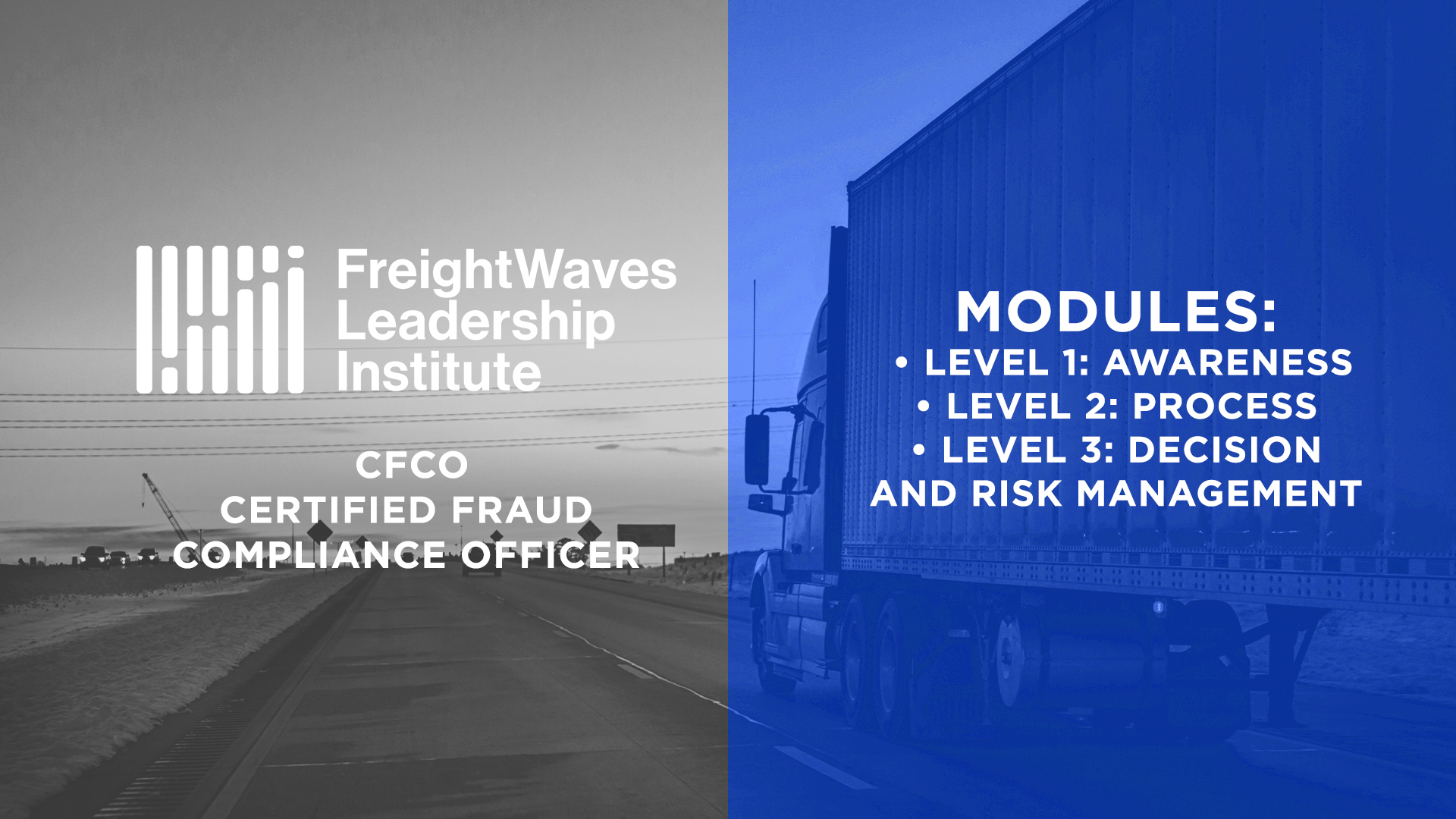 |
FreightWaves Leadership Institute
With freight fraud surging and new federal legislation targeting double brokering, the CFCO (Certified Fraud Compliance Officer) certification gives your team a structured framework to verify carriers and stop fraud before a load moves.
Get certified → |
|
|
|
Sponsored Insight
|
Presented by Amazon Supply Chain Services

Solutions That Save: How Amazon’s Supply Chain Services Give Back Time, Money, and Peace of Mind
Managing a supply chain shouldn’t mean choosing between cost, speed and peace of mind — but for many businesses, it does. Amazon Supply Chain Services offers flexible, resilient logistics support that eliminates those tradeoffs, helping businesses of every size reduce complexity, cut costs and reclaim time. With access to Amazon’s global infrastructure and no lock-in required, ASCS gives you the freedom to build the supply chain that works for your business.
Read more → |
|
 |
|
|
From the Research Desk
|
In Partnership with Trimble
2026 Outlook: Spot Market Strategies for Shippers, Carriers, and Brokers
FreightWaves and Trimble surveyed shippers, carriers and brokers on how they are approaching spot freight in 2026 — and the results show an industry treating spot as a deliberate strategic tool, not a fallback. With rejection rates climbing and capacity tightening post-Montgomery, procurement teams still benchmarking off 2024 contract rates need a new model. This report has it.
Download the full report → |
|
In Partnership with Avalara
Supply Chain Strategies for an Uncertain Trade Environment
FreightWaves and Avalara surveyed supply chain professionals navigating tariff volatility, geopolitical tension and shifting regulatory frameworks. The white paper covers how industry leaders are building adaptive sourcing and compliance strategies to protect margins as trade rules continue to change. If your compliance architecture is still built for the pre-2025 trade environment, this is required reading.
Download the full report → |
|
Courtesy of Amazon Supply Chain Services
Solutions That Save: How Amazon’s Supply Chain Services Give Back Time, Money, and Peace of Mind
Amazon Supply Chain Services offers end-to-end logistics support that removes the tradeoff between cost, speed and reliability. Access Amazon’s global infrastructure with no lock-in required.
Read more → |
|
Courtesy of Werner
Werner Doubles Down on Mexico With Asset-Based Intermodal Expansion
Werner is scaling an asset-based intermodal service into Mexico, deploying Werner-owned containers backed by 27 years of cross-border expertise. With nearshoring FDI setting records and border congestion intensifying, Werner’s Mexico intermodal expansion gives shippers a capacity solution built for what’s coming.
Read more → |
|
|
Upcoming Event
Freight Fraud Symposium
May 20, 2026 | Rock & Roll Hall of Fame • Cleveland, OH
The industry’s leaders are converging at the Rock & Roll Hall of Fame for one reason: to build a bulletproof supply chain. An intimate, high-stakes gathering designed to discuss the issues and tackle the escalating crisis of freight fraud head-on.
Register Now → |
|
|
|
What We’re Watching
▸ Whether broker insurance renewals trigger immediate capacity contraction. Brokers coming up for renewal in the next 60-90 days face premium shock. If underwriters pause or decline to write coverage while the post-Montgomery picture stabilizes, some broker operations could face disruption before year-end. Watch for announcements from major commercial auto carriers.
▸ Spot rate trajectory into the Memorial Day weekend. At $3.55 a mile, the all-time high of $3.68 is 13 cents away. Memorial Day historically pulls carriers off the road while shippers push volume early. Watch Friday’s rate data — an all-time record is within reach.
▸ Congressional and FMCSA response to the unrated carrier problem. The ruling exposed a critical gap in FMCSA’s data infrastructure: 1.2 million carriers with no audited safety status. Any federal guidance on what constitutes adequate broker due diligence after Montgomery becomes the new baseline standard for every operator in the country. Watch for Congressional hearings and agency guidance in the coming weeks.
|
|
|
That’s your Daily for today. See you tomorrow.
Was this forwarded to you? Subscribe here | Have a tip? Just reply to this email.
FreightWaves 405 Cherry St., Chattanooga TN 37402
Unsubscribe | Forward to a Friend | FreightWaves.com
|
|