|
View this email in your browser

THE DAILY
Wednesday, February 25, 2026
The five minutes that makes you the most informed person in freight today
|
|
Newsletter Brought to You by — J. J. Keller
 |
As a leader in safety and compliance for the transportation industry, J. J. Keller protects people and the businesses they run®. Learn More.
|
|
|
|
The Daily
RXO calls it the biggest structural change to truckload since deregulation. Spot rates just crossed contract for the first time in three years.
January and February are the slowest months on the freight calendar. Tender rejections are running at their highest since the post-COVID unwind. That’s not a seasonal pattern; it’s a signal.
RXO’s Q1 2026 state of freight report frames what’s happening as a supply-side structural shift, not just a seasonal bounce. Spot rates crossed above contract rates last month for the first time since 2022 — a crossing that typically signals a sustained tightening, not a blip. RXO CEO Drew Wilkerson calls it "one of the largest structural changes to truckload supply since deregulation." The driver isn’t a demand surge. It’s regulatory pressure on carrier supply: English-language proficiency requirements, new non-domiciled CDL restrictions, enforcement actions against ELD providers, forced driver school closures. Capacity that’s exiting this way doesn’t return when the cycle improves.
"In the past two years, the market would see brief spikes but quickly return to normal levels," said Corey Klujsza, RXO’s VP of pricing and procurement. "This time, rates have stayed elevated well beyond the busy holiday period." That distinction matters. Seasonal softening followed by springtime demand surges in produce, building materials, and beverage is the old pattern. But the way truckload spot rates have been holding above seasonal norms in January and February is something different.
The underlying supply data supports the concern. On a net basis, more than 19,000 carrier authorities have been revoked over two years, against roughly 100,000 new entrants between 2020 and 2022. Class 8 truck orders remain below replacement levels. Private fleets that insourced freight during the pandemic are pulling back as ownership costs rise. RXO’s outlook suggests this cycle resembles 2014 rather than the post-pandemic boom — sustained, but not extreme. “If the regulatory changes hold and enforcement continues, we believe a significant amount of truckload capacity will permanently exit the market,” Wilkerson said.
So What? For shippers still pricing off 2024 benchmarks, the math has already changed. The capacity RXO describes isn’t coming back when conditions improve — it’s structurally exiting. Carriers who survived three years on the thinnest margins are now positioned to recoup. If you’re not actively renegotiating contract rates for Q2 and Q3, you’re reacting, not planning. The spot-contract inversion is the clearest possible signal that the window is closing.
Read the full story →
|
|
|
Top Stories
A nearly 20-year-old Florida carrier with 57 drivers files for Chapter 11
Standard Freight Logistics, an over-the-road carrier founded in 2007 and based in St. Augustine, Fla., filed for Chapter 11 bankruptcy protection in the Middle District of Florida. The company operates 49 power units with 57 drivers, hauling general freight, household goods, and fresh produce. Court records list estimated assets between $100,000 and $500,000 against liabilities of $500,000 to $1 million. FMCSA data shows a vehicle out-of-service rate of 57.7% over the past 24 months — well above the national average. The company says it intends to maintain its active motor carrier status while restructuring.
So What? A 57.7% vehicle out-of-service rate is a compliance warning that was visible in FMCSA data well before this filing. Small carrier bankruptcies have been a steady undercurrent throughout this cycle, and they aren’t stopping as rates improve — carriers that couldn’t cover costs or fix compliance gaps at the bottom are running out of road. Shippers and brokers should be running FMCSA safety screens on small carriers regularly, not just at onboarding.
Read the full story →
A top-20 freight broker is now booking driverless trucks between Houston and Dallas
Bot Auto and Ryan Transportation — ranked 19th on the 2025 Transport Topics Top 100 Freight Brokerage list — announced a commercial partnership to run fully autonomous, humanless loads on an overnight lane connecting Houston to the southern Dallas-Fort Worth metro. Driverless operations are expected to begin this spring on the roughly 200-mile corridor, which has historically been difficult to staff with human drivers due to tight overnight delivery windows. Bot Auto completed the first fully humanless hub-to-hub run in Houston last year; this announcement moves the company from milestone demonstration to brokerage-integrated commercial capacity.
So What? This isn’t a test run or a press release stunt. It’s a brokered commercial lane, booked through a top-20 freight intermediary, running without a human in the cab. When a broker of Ryan’s scale starts routing freight through driverless trucks as a real capacity option, the technology has crossed from pilot to product. The spring launch timeline will set the benchmark for how autonomous freight integrates into the broader brokerage market.
Read the full story →
BMO’s Q1 numbers are the first sign in years that trucking credit may be turning
Bank of Montreal’s first-quarter earnings, covering the period through Jan. 31, showed meaningful improvement in trucking credit metrics. Provisions fell to $39 million from $57 million the prior quarter. Net writeoffs dropped to $24 million from $43 million. Loan formations came in at $65 million, down sharply from $131 million in Q4 2025. The overall book continues to shrink: net loans and acceptances now stand at $12.34 billion, compared to $15.6 billion in Q4 2023. BMO’s transportation segment, whose client base is overwhelmingly trucking companies, has been one of the most closely watched credit barometers in the freight industry throughout the downturn.
So What? When provisions and writeoffs both fall in the same quarter, it’s a forward-looking signal. BMO’s transportation data isn’t saying the market has healed — it’s saying the bleeding is slowing. For carriers still in restructuring mode, this is a signal that lenders may be moving from damage control to cautious re-engagement. The potential sale of BMO’s transportation unit adds another variable: a new owner could tighten or loosen credit standards, changing the access picture for small and mid-size fleets.
Read the full story →
Sponsored by PCS
White Paper: Why Some Mid-Market Fleets Will Win in 2026 — and Others Won’t
Three years of margin pressure forced mid-market fleets to make hard calls on equipment, staffing, and technology. The carriers that made the right bets — on compliance tools, driver retention, and operational efficiency — are now positioned to capture margin as capacity tightens. PCS breaks down the strategic differences separating the fleets built for 2026 from the ones still fighting the last cycle.
Download the white paper → |
The trucking insurance market looks diverse. Behind the subsidiary names, it’s four or five balance sheets.
Part 7 of FreightWaves’ ongoing insurance investigation, reported by Rob Carpenter, finds that the apparent diversity of the trucking insurance market is largely illusory. The 50 largest insurers by carrier count cover 55.2% of U.S. trucking carriers — and many share parent companies. Markel’s State National subsidiary, the largest pure-play fronting carrier in the U.S., operates six licensed insurance companies that can write competing programs in the same state while consolidating all exposure to the same balance sheet. The top 10 insurers for new authority placements account for more than 50% of all new carriers entering the market. This concentration sits against a litigation backdrop where the average nuclear verdict in a trucking crash case now exceeds $20 million.
So What? The apparent competition in trucking insurance is partially a mirage. A market shock — a verdict cluster, a reinsurance withdrawal, a major carrier failure — that hits one parent company ripples across multiple "competing" subsidiaries at once. Shippers and brokers who believe they’re spreading risk across different insurance carriers may not be as insulated as the certificate of insurance suggests. Part 7 of a series worth reading start to finish.
Read the full story →
|
|
|
From the Research Desk
|
In Partnership with Trimble
2026 Outlook: Spot Market Strategies for Shippers, Carriers, and Brokers
Tender rejections near 14%, spot rates up 23% year over year, and a capacity picture tightening structurally rather than seasonally. Trimble’s 2026 outlook report breaks down the lane-level dynamics and procurement strategies freight professionals need heading into a tightening market.
Download the full report → |
|
Courtesy of Descartes
2026 TMS Buyers Guide
The technology stack you built for a soft market doesn’t necessarily scale in a tightening one. Descartes’ 2026 TMS Buyers Guide covers what freight professionals should be evaluating now — from rate management to carrier integration — as market conditions shift.
Download the full guide → |
|
|
|
Sponsored by Taylor & Martin
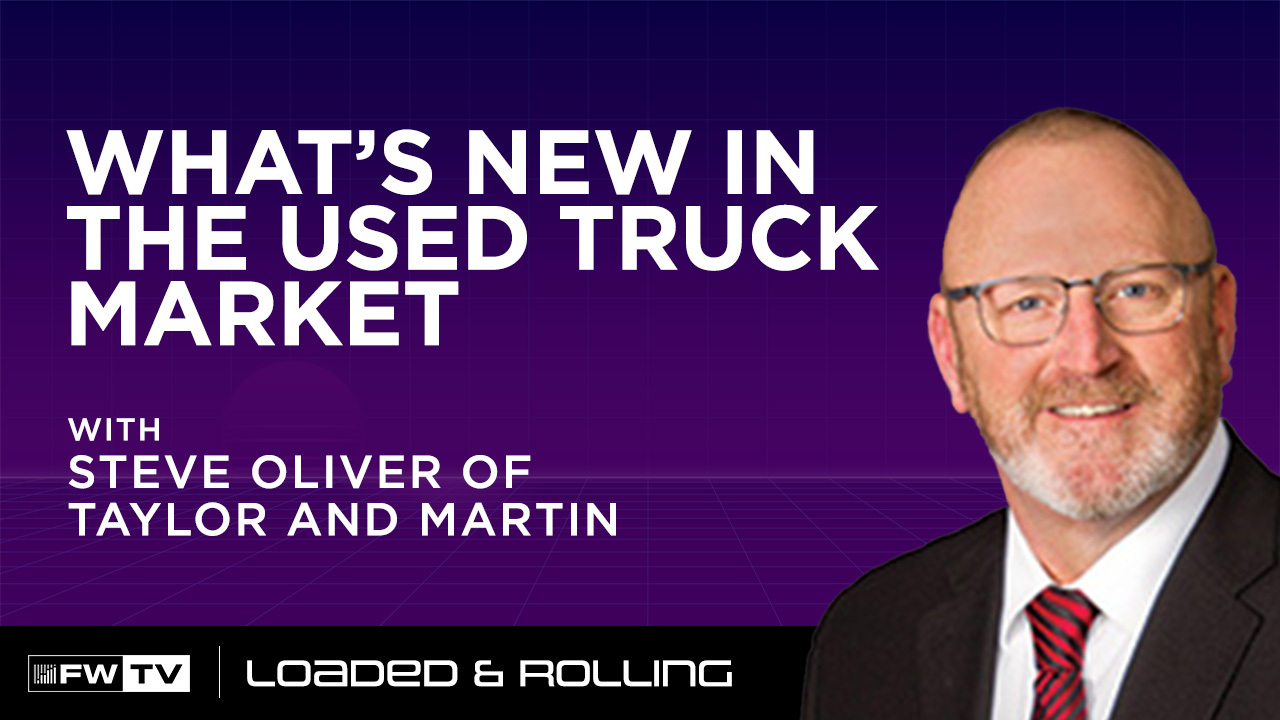
The Used Truck Market Is Turning — Here’s What the Auction Data Is Saying
Steve Oliver, VP of sales and marketing at Taylor & Martin Auctioneers, sat down with Loaded and Rolling host Thomas Wasson to break down what the company is seeing on the auction floor. Taylor & Martin is midway through the dispersal of more than 4,000 tractors and trailers from 10 Roads Express — and the patterns in that inventory reveal where used truck values and availability are headed as the market turns.
Read the full story → |
|
|
|
Upcoming Event
FreightWaves Roadshow
March 3, 2026 | Charlotte, NC
From AI integration to fraud prevention and a full array of pressing industry topics, you’ll gain the exclusive intelligence needed to protect your margins and scale in 2026.
Register Here → |
|
|
|
Around the Freight Web
Cartel violence disrupts western Mexico freight corridors — A military raid targeting CJNG leader Nemesio "El Mencho" Oseguera Cervantes triggered road blockades, vehicle fires, and port disruptions across Jalisco, Colima, Guanajuato, Veracruz, and Tamaulipas. Manzanillo port operations and the Guadalajara airport were both affected. Shippers with cross-border flows through western Mexico should expect delays until the situation stabilizes.
FedEx "highly confident" its grounded MD-11 fleet returns to service — FedEx said it is highly confident the grounded MD-11 cargo aircraft will return to service, though the company offered no specific timeline. The wide-body trijet remains a core piece of FedEx’s long-haul international air cargo network; any extended grounding carries real capacity implications for trans-Pacific and trans-Atlantic freight.
ATSG exits the A321 cargo conversion joint venture — Air cargo lessor ATSG has pulled out of 321 Precision Conversions, the joint venture converting Airbus A321 passenger aircraft to main-deck cargo configurations. The exit adds uncertainty to a narrowbody freighter conversion pipeline that had been building toward commercial deployments. No reason was given for the departure.
Werner CEO: TL carriers are "only in the early innings" of regulatory capacity constraint — Derek Leathers, chairman and CEO of Werner Enterprises, told Citi’s Global Industrial Tech and Mobility Conference the industry is well short of peak tightening. He estimates 250,000 to 400,000 drivers could be forced out of the market by regulatory changes — drawn from a pool of roughly 1 million active over-the-road drivers. "We are only in the early innings of some of this regulatory constraint on capacity," Leathers said.
|
|
|
What We’re Watching
▸ The Q2 contract renegotiation cycle. RXO’s data shows spot has crossed contract for the first time since 2022. That inversion typically forces a contract repricing conversation within one to two quarters. Watch how quickly shippers move to lock new rates — and whether carriers hold the line or accept early renewals at modest increases to secure volume.
▸ Bot Auto’s first live commercial driverless load. The Ryan Transportation partnership targets spring 2026. When it launches, the question shifts from capability to scalability: can a brokered driverless lane run without intervention at commercial frequency? The first 30 days of real operations will tell more than three years of test runs.
▸ The legal status of non-domiciled CDL restrictions. The supply-side structural change RXO is pricing in depends on enforcement holding. Several of the capacity-constraining rules are being challenged in federal court. If legal challenges delay implementation, the "higher for longer" thesis compresses. Watch the federal docket — the outcome shapes the entire rate cycle narrative for 2026.
|
|
|
That’s your Daily for today. See you tomorrow.
Was this forwarded to you? Subscribe here | Have a tip? Just reply to this email.
FreightWaves 405 Cherry St., Chattanooga TN 37402
Unsubscribe | Forward to a Friend | FreightWaves.com
|
|