Teradar emerges with $150M backing to replace radar and LiDAR in autonomous vehicles
|
|
|
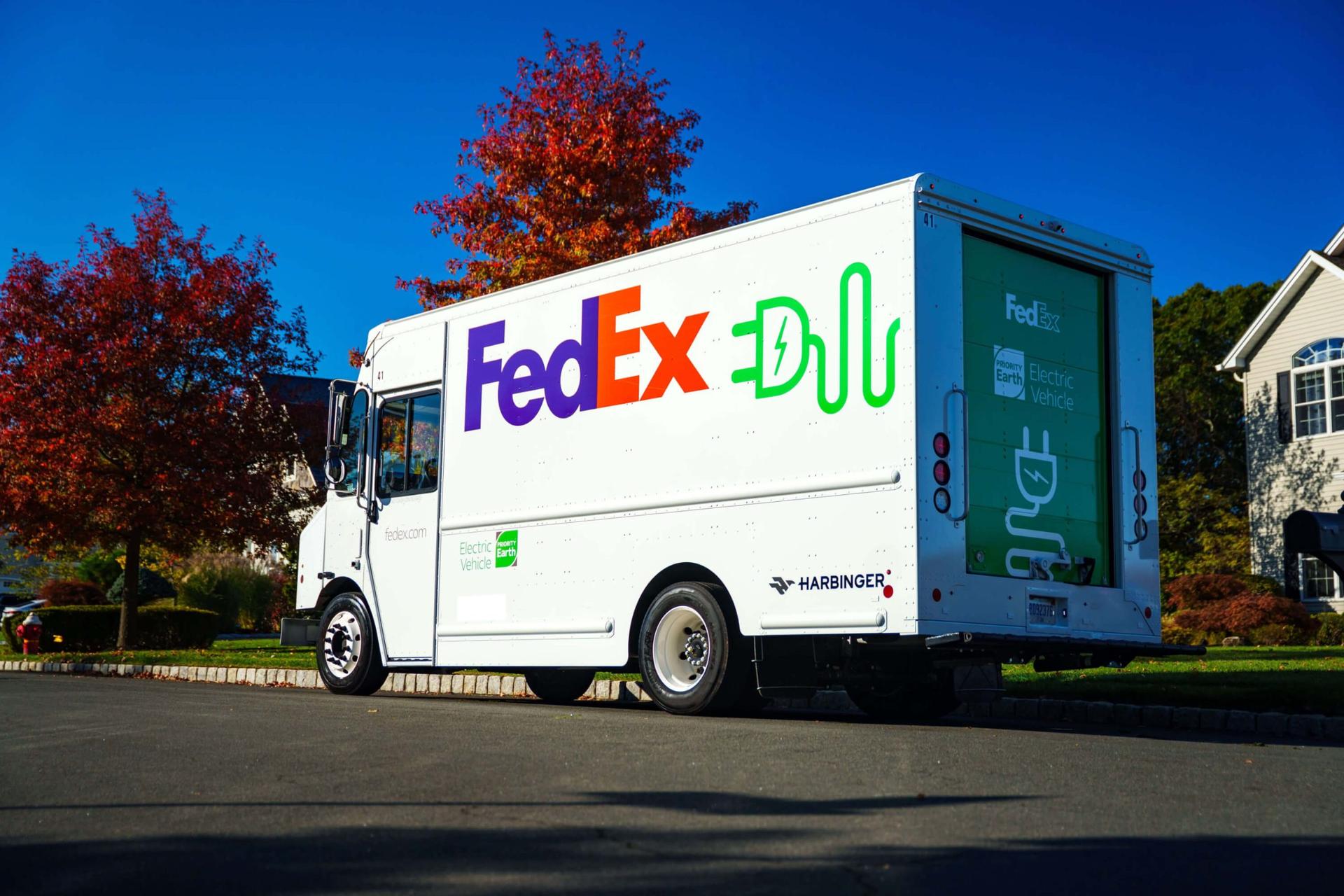
Harbinger lands $160M Series C, inks initial FedEx deal for 53 electric trucks
|
Medium-duty EV truck and hybrid vehicle maker Harbinger recently announced it has raised a $160 million Series C funding round. With this Series C, Harbinger has raised $358 million to date. In addition to the investment, FedEx placed an initial order for 53 Harbinger EVs.
By the end of the calendar year, Harbinger expects to deliver the chassis, which will be ready for upfit. The vehicles will be a mix of Class 5 and Class 6 models. These trucks are larger-capacity pickup and delivery vehicles, part of a larger network transformation effort by FedEx.
Harbinger notes its proprietary electric platform features acquisition costs competitive with traditional combustion engines. It offers modular battery configurations ranging from 140 to over 200 miles, and driver-centric design improvements. The vehicles include advanced safety features uncommon in medium-duty trucks, such as backup cameras with dynamic trajectory and acoustic vehicle alerting systems.
“Any vehicle that holds up to our rigorous on-road testing and offers state-of-the-art safety features with lower total cost of ownership is win-win for drivers and for our business,” said Paul Melander, senior vice president of safety and transportation, FedEx, in the release. “As we work toward a goal to electrify the entire FedEx pickup and delivery fleet by 2040, this trifecta of performance, price, and operational resilience is what we need to be able to continue to scale,” added Melander.
Read the full article here.
|
Teradar emerges with $150M backing to replace radar and LiDAR in autonomous vehicles
|
Boston-based Teradar recently emerged from stealth mode, introducing the world’s first commercial terahertz vision sensor. The company secured $150 million in Series B funding led by VXI Capital with participation from IBEX Investors, Capricorn Investment Group, The Engine Ventures and Lockheed Martin Ventures to develop technology that delivers 20 times the resolution of current automotive radar.
Teradar was founded five years ago with the goal of creating an entirely new sensor category. “The entire premise from day one was, ‘How do you create a completely new category of sensor that isn’t trapped by the fundamental trade-offs of radar and LiDAR?’” said Matt Carey, CEO and co-founder of Teradar, during an interview with FreightWaves.
The innovation addresses fundamental limitations in current vehicle perception systems. “LiDAR is incredibly precise, but it’s expensive and it falls apart in bad weather—fog, rain, snow, sleet. Radar is cheap, sees far in any weather, but the resolution is terrible,” Carey added.
The terahertz band represents what the company calls the “Goldilocks frequency”—offering wavelengths long enough to penetrate adverse weather conditions like radar while short enough to provide extremely high angular resolution.
“We went to the very last unused practical band—the terahertz band—and turned it into a sensor,” Carey said. “Long enough wavelength to bend around raindrops and snowflakes like radar, short enough to give you insane angular resolution.”
Read the full article here.
|
The Impossible Gap: Autonomous trucks enable death-defying Red Bull stunt
|
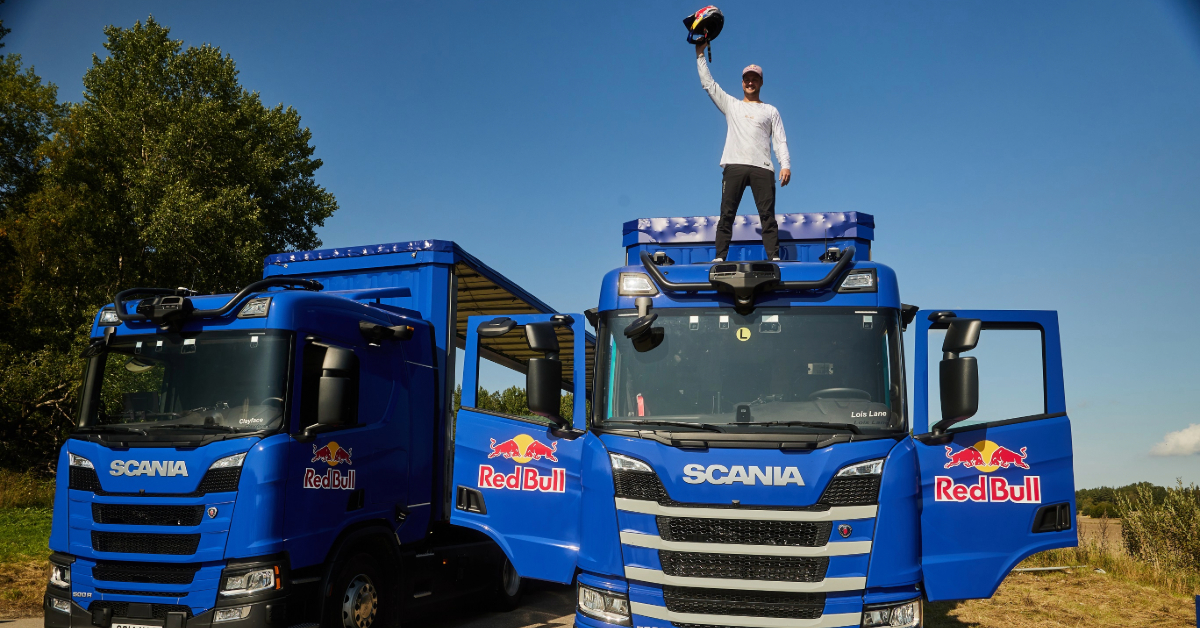
In the annals of human history, there have been many firsts: the moon landing, the circumnavigation of the globe and the invention of sliced bread. For trucking, aspirations have historically been less lofty — mostly getting cargo from point A to point B, or packing in more of it. That changed when Matt Jones, a Red Bull athlete and mountain bike star, became the first human to jump through two Scania autonomous trucks moving toward each other at full speed.
The challenge was of NASA-like proportions: Could two trucks moving in perfect synchronization create a window of less than one second for a professional biker traveling at approximately 40 mph to pass through both open trailers? The answer was yes — but only with two Scania autonomous trucks powered by Plus’ SuperDrive virtual driver system.
The legendary run took place on an airfield near Stockholm, Sweden, where Jones was towed to 65 km/h (40 mph) by a 600-plus-bhp Audi RS Q8. The trucks were each traveling at 11 meters per second, giving Jones less than one second to thread the needle.
“When I got halfway up the ramp and the trucks had initially passed each other, I felt huge adrenaline because I could see the target on the other side. I instantly went from feeling numb to being flooded with adrenaline — it was nothing like I’ve experienced before,” Jones said.
The entire feat lasted only 10 seconds — two seconds less than the Wright brothers’ first flight at Kitty Hawk, North Carolina. Making those 10 seconds of history required months of training and testing.
Read the full article here.
|
|
|
EV Realty has secured a direct minority investment from Outpost. The company also announced that it has acquired an industrial property in Stockton, Calif., ideally located for freight and logistics operations. The property is a four-acre truck parking and trailer storage yard.
The Environmental Protection Agency is sticking to its 2027 timeline for its heavy-duty NOx rule, which is set to take effect with 2027 model-year vehicles, but accordingującą to Commercial Carrier Journal, further changes are ahead. The American Trucking Associations and Owner-Operator Independent Drivers Association sent a letter to the EPA urging the agency to push implementation to 2031. Jason Cannon wrote, “EPA told CCJ on Monday the agency continues to reevaluate the rule and plans to propose a rule in the spring of 2026 that will take effect the following model year.”
The Associated Press reports that China’s heavy-duty trucks are rapidly shifting from diesel to electric, with potentially significant effects on global liquefied natural gas and diesel demand. Aniruddha Ghosal writes that in 2020 nearly all trucks were diesel-powered, but in the first half of 2025 battery-powered trucks accounted for 22% of new heavy-duty truck sales, up from 9.2% in the same period of 2024. Christopher Doleman, an analyst at the Institute for Energy Economics and Financial Analysis, said electric trucks now outsell LNG models in China, meaning the country’s demand for fossil fuels could fall sharply — and “in other countries, it might never take off.”
|
As always, thanks for watching and reading.
Thomas Wasson
twasson@firecrown.com
|
|
|
|