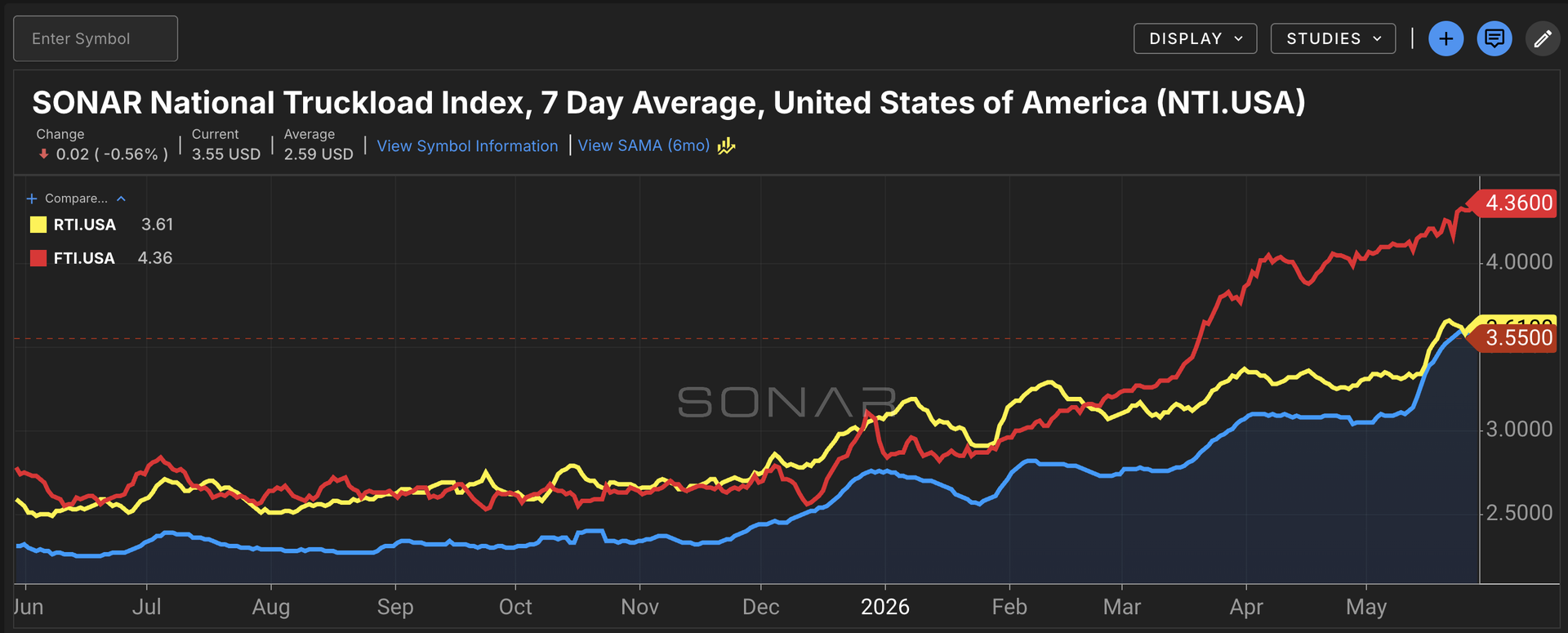
Summary: Spot truckload rates showed an unusual post-Memorial Day twist as dry van rates briefly eclipsed reefer rates before settling slightly lower. Flatbed rates continued climbing to new record highs in the SONAR dataset.
Dry van rates received a superseasonal boost leading up to Memorial Day, followed by a typical seasonal dip. The SONAR National Truckload Index’s seven-day average fell 1 cent per mile week over week to $3.54 from $3.55 on May 21. The index stood 50 cents per mile, or 16%, above the $3.05 level last month. Compared with last year, it was up $1.24 per mile, or 54%, from $2.31.
Reefer spot rates followed a similar Memorial Day pattern of a seasonal gain then slight loss. The SONAR Reefer Truckload Index fell 5 cents per mile week over week to $3.61 from $3.66. The index stood 31 cents per mile, or 9%, above the $3.30 level last month and $1.02 per mile, or 39%, above the $2.59 level last year.
The flatbed segment continued rising at a historic pace. The SONAR Flatbed Truckload Index rose 11 cents per mile week over week to $4.36 from $4.25. It stood 33 cents per mile, or 8%, above the $4.03 level last month. Year-over-year comparisons highlight the parabolic rise best: The index was up $1.58 per mile, or 57%, from $2.78 last year.
A relative shortage of trucking capacity compared with truckload demand remains the key driver. The produce season continues gaining momentum and is affecting dry van and reefer rates depending on the region. Shippers in states such as Florida, Texas and California should prepare for added capacity challenges.
Data center construction appears to be a primary driver for flatbed rates, with downstream effects that include power grid expansion by utilities. This is also increasing demand for the raw materials required to build them.
Looking ahead, seasonal rate declines have typically weighed on spot rates leading up to the Fourth of July holiday weekend. However, tender rejection rates remain elevated, suggesting tighter upstream capacity and more frequent routing guide failures. Sudden demand shocks from consumers or geopolitical events could add even greater volatility to an already turbulent market.